. 2018 Jun 6;16(22):4141-4150.
doi: 10.1039/c8ob00646f.

Probing the competition between duplex and G-quadruplex/i-motif structures using a conformation-sensitive fluorescent nucleoside probe

Affiliations

Probing the competition between duplex and G-quadruplex/i-motif structures using a conformation-sensitive fluorescent nucleoside probe

Pramod M Sabale et al. Org Biomol Chem. .

Abstract

Double-stranded segments of a genome that can potentially form G-quadruplex (GQ) and/or i-motif (iM) structures are considered to be important regulatory elements. Hence, the development of a common probe that can detect GQ and iM structures and also distinguish them from a duplex structure will be highly useful in understanding the propensity of such segments to adopt duplex or non-canonical four-stranded structures. Here, we describe the utility of a conformation-sensitive fluorescent nucleoside analog, which was originally developed as a GQ sensor, in detecting the iM structures of C-rich DNA oligonucleotides (ONs). The analog is based on a 5-(benzofuran-2-yl)uracil scaffold, which when incorporated into C-rich ONs (e.g., telomeric repeats) fluorescently distinguishes an iM from random coil and duplex structures. Steady-state and time-resolved fluorescence techniques enabled the determination of transition pH for the transformation of a random coil to an iM structure. Furthermore, a qualitative understanding on the relative population of duplex and GQ/iM forms under physiological conditions could be gained by correlating the fluorescence, CD and thermal melting data. Taken together, this sensor could provide a general platform to profile double-stranded promoter regions in terms of their ability to adopt four-stranded structures, and also could support approaches to discover functional GQ and iM binders.


Conflict of interest statement

Conflicts of interest

There are no conflicts to declare.

Figures

Fig. 1
Fig. 1
Schematic diagram showing the assay design to monitor the pH-induced transition from the random coil and duplex to iM structure by using a conformation-sensitive fluorescent nucleoside probe 1. The probe is placed in the loop region of C-rich DNA ONs. The iM structure of the C-rich H-Telo DNA ON repeat (PDB: 1EL2) is used as an example to illustrate the design (site of modification: second loop, T10 residue, cyan color). A random coil structure of C-rich H-Telo DNA ON shows high fluorescence compared to its perfect complementary duplex. Upon reducing the pH to ~5.0, the random coil folds into an iM structure and exhibits very low fluorescence. The duplex can dissociate and form iM and GQ structures depending on the conditions (e.g., acidic pH) and sequence.
Fig. 2
Fig. 2
Sequence of nucleoside analog 1-labeled C-rich DNA ONs 2 and 3, which fold into iM structures is shown. ONs 4 and 5 are the respective control unmodified C-rich sequences. Nucleoside analog 1-labeled H-Telo DNA ON 6, which folds into a G-quadruplex structure, is shown. G-rich ON 7 is complementary to C-rich ONs 2 and 4. G-rich H-Telo DNA ONs 6 and 8 are complementary to H-Telo C-rich ONs 3 and 5.
Fig. 3
Fig. 3
(A) Fluorescence spectra of 5-benzofuran-modified DNA ON 2 (1 μM) at different pH values. Samples were excited at 330 nm with excitation and emission slit widths of 3 nm and 4 nm, respectively. (B) tpH value was determined by fitting the curve obtained by plotting normalized fluorescence intensity at emission maximum (black) or lifetime (red) against pH. See Fig. S2† for individual curve fits.
Fig. 4
Fig. 4
(A) Fluorescence spectra of 5-benzofuran-modified H-Telo DNA ON 3 (1 μM) at different pH values. Samples were excited at 330 nm with excitation and emission slit widths of 3 nm and 4 nm, respectively. (B) tpH value was determined by fitting the curve obtained by plotting normalized fluorescence intensity at emission maximum (black) or lifetime (red) against pH. See Fig. S5† for individual curve fits.
Fig. 5
Fig. 5
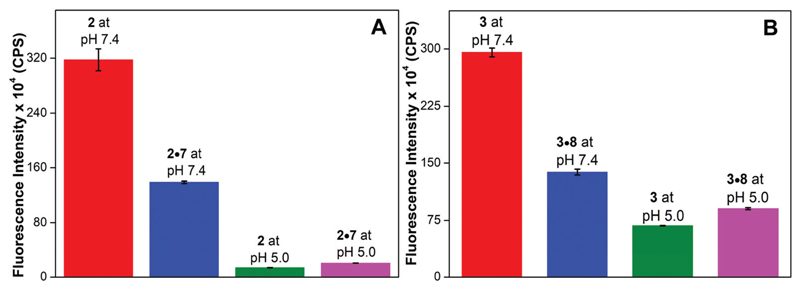
Bar diagram showing the fluorescence intensity (1 μM) at λem of benzofuran-modified C-rich DNA ON 2 and H-Telo DNA ON 3 and the corresponding hybrids at basic and acidic pH. Samples of single stranded ON and the corresponding hybrids were prepared by heating the ON or a 1 : 1 mixture of the respective ONs in buffers of different pH values at 90 °C for 3 min. The samples were cooled to RT slowly and incubated at RT for 1 h before analysis. All samples were excited at 330 nm. Excitation and emission slit widths were kept at 3 nm and 4 nm, respectively. See Fig. S7† for emission spectra. For λem see Table 1.
Fig. 6
Fig. 6
CD spectra (5 μM) of C-rich ON 2, complementary G-rich ON 7 and 1 : 1 solution of 2 and 7 at pH 7.4 and 5.0. ON 2 is a random coil (red) at pH 7.4 and iM (green) at pH 5.0. CD profile of ON 7 at both the pH values shows a similar pattern (orange and brown) resembling a parallel GQ structure. A solution of 2·7 at pH 7.4 displays a typical duplex CD profile (blue) along with a shoulder near 285 nm, potentially arising from alternative structures, namely iM/random coil and GQ forms. At acidic pH, a CD profile (magenta) mainly resembling a combination of the iM and GQ forms of 2 and 7, respectively, is seen.
Fig. 7
Fig. 7
CD spectra (5 μM) of H-Telo C-rich ON 3, complementary G-rich ON 8 and 1 : 1 solution of 3 and 8 at pH 7.4 and 5.0. ON 3 is a random coil (red) at pH 7.4 and iM (green) at pH 5.0. CD profile of ON 8 at both the pH values shows a similar pattern (orange and brown) resembling an antiparallel GQ structure., A solution of 3·8 at pH 7.4 displays a profile corresponding to the duplex structure (blue). However, at acidic pH a duplex CD profile along with a shoulder near 285 nm is observed (magenta), potentially arising from alternative structures, namely iM and GQ forms.
Fig. 8
Fig. 8
(A) Bar diagram showing the fluorescence intensity (1 μM) at λem of benzofuran-modified H-Telo G-rich DNA ON 6 and corresponding hybrid with complementary ON 5 at pH 7.4 and 5.0. Samples were excited at 330 nm, and excitation and emission slit widths were kept at 4 nm and 5 nm, respectively. (B) CD spectra (5 μM) of H-Telo G-rich ON 6, complementary C-rich ON 5 and 1 : 1 solution of 6 and 5 at pH 7.4 and 5.0. CD profile of ON 6 at both the pH values shows a similar pattern (red and green) resembling an antiparallel GQ structure. ON 5 is a random coil (orange) at pH 7.4 and iM (brown) at pH 5.0. A solution of 6·5 at pH 7.4 displays a profile corresponding to a duplex structure (blue). However, at acidic pH a duplex CD profile along with a shoulder near 285 nm is observed (magenta), potentially arising from alternative structures, namely iM and GQ forms.

References

    1. Brooks TA, Kendrick S, Hurley L. FEBS J. 2010;277:3459–3469. - PMC - PubMed
    1. Collie GW, Parkinson GN. Chem Soc Rev. 2011;40:5867–5892. - PubMed
    1. Yadav VK, Abraham JK, Mani P, Kulshrestha R, Chowdhury S. Nucleic Acids Res. 2008;36:D381–D385. - PMC - PubMed
    2. Sun D, Hurley LH. J Med Chem. 2009;52:2863–2874. - PMC - PubMed
    3. Balasubramanian S, Hurley LH, Neidle S. Nat Rev Drug Discovery. 2011;10:261–275. - PMC - PubMed
    1. Guéron M, Leroy J-L. Curr Opin Struct Biol. 2000;10:326–331. - PubMed
    2. Dzatko S, Krafcikova M, Hänsel-Hertsch R, Fessl T, Fiala R, Loja T, Krafcik D, Mergny J-L, Foldynova-Trantirkova S, Trantirek L. Angew Chem, Int Ed. 2018;57:2165–2169. - PMC - PubMed
    1. Xu Y, Suzuki Y, Ito K, Komiyama M. Proc Natl Acad Sci U S A. 2010;107:14579–14584. - PMC - PubMed
    2. Lam EYN, Beraldi D, Tannahill D, Balasubramanian S. Nat Commun. 2013;4:1796. - PMC - PubMed
    3. Henderson A, Wu Y, Huang YC, Chavez EA, Platt J, Johnson FB, Jr, Brosh RM, Sen D, Lansdrop PM. Nucleic Acids Res. 2014;42:860–869. - PMC - PubMed
    4. Laguerre A, Hukezalie K, Winckler P, Katranji F, Chanteloup G, Pirrotta M, Perrier-Cornet J-M, Wong JMY, Monchaud D. J Am Chem Soc. 2015;137:8521–8525. - PubMed
    5. Liu H-Y, Zhao Q, Zhang T-P, Wu Y, Xiong Y-X, Wang S-K, Ge Y-L, He J-H, Lv P, Ou T-M, Tan J-H, et al. Cell Chem Biol. 2016;23:1261–1270. - PubMed
    6. Bao H-L, Ishizuka T, Sakamoto T, Fujimoto K, Uechi T, Kenmochi N, Xu Y. Nucleic Acids Res. 2017;45:5501–5511. - PMC - PubMed

Publication types

LinkOut - more resources