


Changes in Psychiatric and Medical Conditions and Health Care Utilization Following a Diagnosis of Sexual Assault: A Retrospective Cohort Study
- PMID: 29781924
- PMCID: PMC6041188
- DOI: 10.1097/MLR.0000000000000930
Changes in Psychiatric and Medical Conditions and Health Care Utilization Following a Diagnosis of Sexual Assault: A Retrospective Cohort Study
Abstract
Introduction: Sexual assault (SA) is alarmingly common and is associated with higher prevalence of psychiatric and medical conditions. However, many prior studies are limited to cross-sectional designs. Health care systems with electronic health records provide unique longitudinal data to examine whether SA is associated with changes in health and health care utilization.
Methods: The sample included 1350 Kaiser Permanente Northern California adult female patients with a SA diagnosis from 2009 to 2015 and 4050 adult female patients without a SA diagnosis, matched on age, medical facility, and continuous enrollment during the study period. Using a retrospective cohort design, we tested whether a SA diagnosis was associated with 12-month changes in psychiatric and medical comorbidities and health care utilization using difference-in-difference models. Analyses were conducted in 2017.
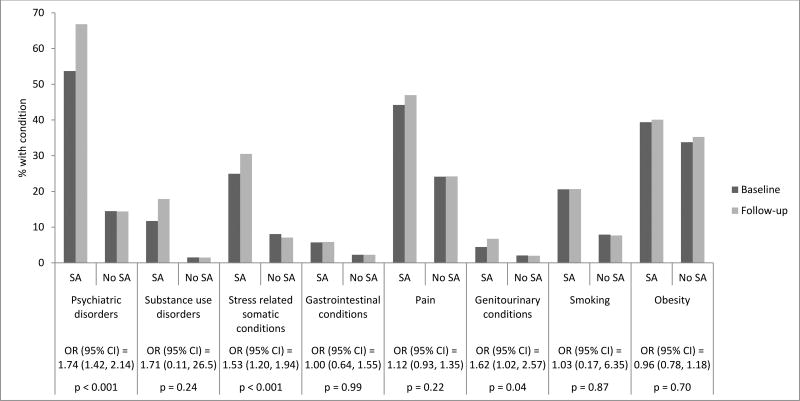
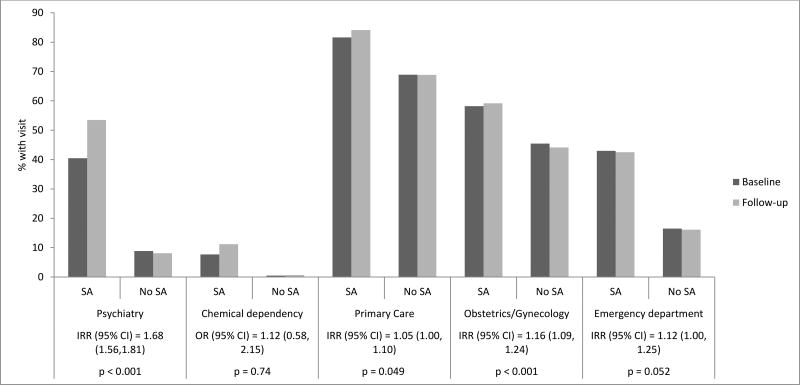
Results: Patients with a SA diagnosis had a higher prevalence of psychiatric and medical comorbidities and greater health care utilization than matched patients without SA in the 12 months before the SA diagnosis, and greater increases in the prevalence of psychiatric disorders and stress-related somatic conditions, and psychiatry and obstetrics/gynecology utilization (all P<0.001), 12 months after the SA diagnosis, relative to matched non-SA patients during this time.
Discussion: SA is associated with increases in psychiatric disorders and stress-related somatic conditions as well as increases in utilization of psychiatry and obstetrics/gynecology. Clinicians should be trained in how to inquire about, respond to, and refer women who have experienced SA.
Conflict of interest statement
All other authors declare no conflict of interest.
Figures
Comment in
-
Sexual Assault and Women's Health: Universal Screening or Universal Precautions?Med Care. 2018 Aug;56(8):645-648. doi: 10.1097/MLR.0000000000000948. Med Care. 2018. PMID: 29939914 No abstract available.
References
-
- Harrell MC, Castaneda LW, Adelson M, Gaillot S, Lynch C, Pomeroy A. A compendium of sexual assault research. Santa Monica, CA: RAND National Defense Research Institute; 2009.
-
- Black MC, Basile KC, Breiding MJ, Smith SG, Walters ML, Merrick MT. The National Intimate Partner and Sexual Violence Survey (NISVS): 2010 summary report. Atlanta, GA: National Center for Injury Prevention and Control, Centers for Disease Control and Prevention; 2011.
-
- National Sexual Violence Resource Center. Research brief. Sexual Violence and Health. 2012
-
- Black MC. Intimate partner violence and adverse health consequences. American Journal of Lifestyle Medicine. 2011;5(5):428–439.
Publication types
MeSH terms
Grants and funding
LinkOut - more resources
Full Text Sources
Other Literature Sources
Medical
