Obstetric outcomes after fresh versus frozen-thawed embryo transfers: A systematic review and meta-analysis
- PMID: 29782139
- PMCID: PMC6106638
- DOI: 10.5935/1518-0557.20180049
Obstetric outcomes after fresh versus frozen-thawed embryo transfers: A systematic review and meta-analysis
Abstract
Objective: To evaluate if there are differences in the risks of obstetric outcomes in IVF/ICSI singleton pregnancies when compared fresh to frozen-thawed embryo transfers (FET).
Methods: This was a systematic review and meta-analysis evaluating the obstetric outcomes in singleton pregnancies after FET and fresh embryo transfer. The outcomes included in this study were pregnancy-induced hypertension (PIH), pre-eclampsia, placenta previa, and placenta accreta.
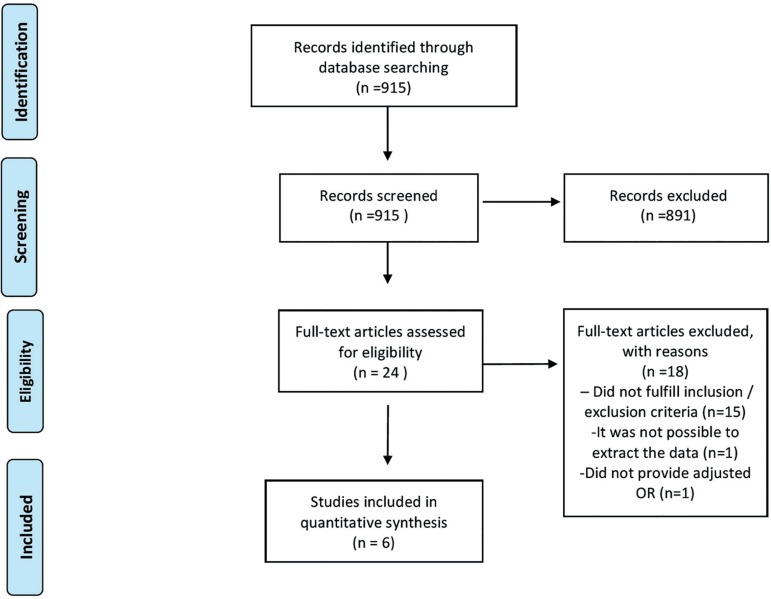
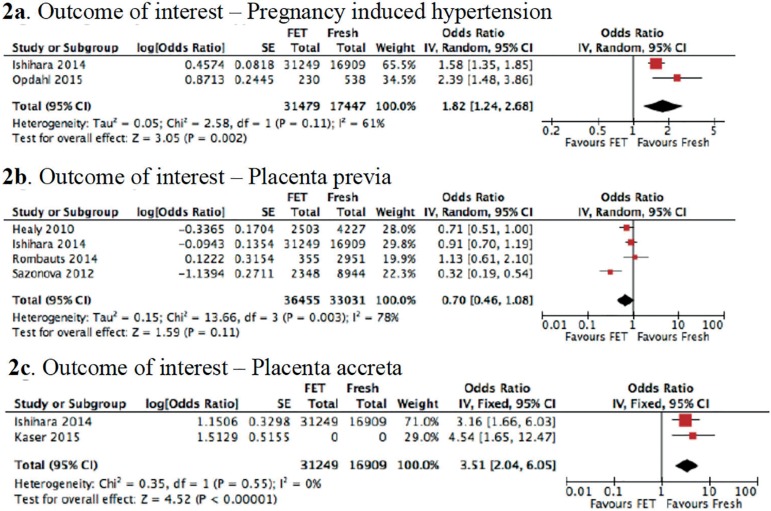
Results: The search yielded 654 papers, 6 of which met the inclusion criteria and reported on obstetric outcomes. When comparing pregnancies that arose from FET or fresh embryo transfer, there was an increase in the risk of obstetric complications in pregnancies resulting from FET when compared to those emerging from fresh embryo transfers in PIH (aOR 1.82; 95% CI 1.24-2.68), pre-eclampsia (aOR 1.32, 95% CI 1.07, 1.63), and placenta accreta (aOR 3.51, 95% CI 2.04-6.05). There were no significant differences in the risk between the FET and fresh embryo transfer groups when evaluating placenta previa (aOR 0.70; 95% CI 0.46-1.08).
Conclusion: The obstetric outcomes observed in pregnancies arising from ART may differ among fresh and FET cycles. Thus, when evaluating to perform a fresh embryo transfer or a freeze-all cycle, these differences found in obstetric outcomes between fresh and FET should be taken into account. The adverse obstetric outcomes after FET found in this study emphasize that the freeze-all policy should not be offered to all the patients, but should be offered to those with a clear indication of the benefit of this strategy.
Keywords: Obstetric outcome; fresh embryo transfer; frozen-thawed embryo transfer; placenta.
Figures
References
-
- Aytoz A, Van den Abbeel E, Bonduelle M, Camus M, Joris H, Van Steirteghem A, Devroey P. Obstetric outcome of pregnancies after the transfer of cryopreserved and fresh embryos obtained by conventional in-vitro fertilization and intracytoplasmic sperm injection. Hum Reprod. 1999;14:2619–2624. doi: 10.1093/humrep/14.10.2619. - DOI - PubMed
-
- Belva F, Henriet S, Van den Abbeel E, Camus M, Devroey P, Van der Elst J, Liebaers I, Haentjens P, Bonduelle M. Neonatal outcome of 937 children born after transfer of cryopreserved embryos obtaned by ICSI and IVF and comparison with outcome data of fresh ICSI and IVF cycles. Hum Reprod. 2008;23:2227–2238. doi: 10.1093/humrep/den254. - DOI - PubMed
-
- Chen ZJ, Shi Y, Sun Y, Zhang B, Liang X, Cao Y, Yang J, Liu J, Wei D, Weng N, Tian L, Hao C, Yang D, Zhou F, Shi J, Xu Y, Li J, Yan J, Qin Y, Zhao H, Zhang H, Legro RS. Fresh versus Frozen Embryos for Infertility in the Polycystic Ovary Syndrome. N Engl J Med. 2016;375:523–533. doi: 10.1056/NEJMoa1513873. - DOI - PubMed
Publication types
MeSH terms
LinkOut - more resources
Full Text Sources
Other Literature Sources
Miscellaneous