. 2018 Aug:94:143-151.
doi: 10.1016/j.psyneuen.2018.05.012. Epub 2018 May 21.

A peripheral immune response to remembering trauma contributes to the maintenance of fear memory in mice

Affiliations

A peripheral immune response to remembering trauma contributes to the maintenance of fear memory in mice

Matthew B Young et al. Psychoneuroendocrinology. 2018 Aug.

Abstract

Alterations in peripheral immune markers are observed in individuals with post-traumatic stress disorder (PTSD). PTSD is characterized in part by impaired extinction of fear memory for a traumatic experience. We hypothesized that fear memory extinction is regulated by immune signaling stimulated when fear memory is retrieved. The relationship between fear memory and the peripheral immune response was tested using auditory Pavlovian fear conditioning in mice. Memory for the association was quantified by the amount of conditioned freezing exhibited in response to the conditioned stimulus (CS), extinction and time-dependent changes in circulating inflammatory cytokines. Brief extinction training with 12 CS rapidly and acutely increased circulating levels of the cytokine interleukin-6 (IL-6), downstream IL-6 signaling, other IL-6 related pro-inflammatory cytokines. Transgenic manipulations or neutralizing antibodies that inhibit IL-6 activity did not affect conditioned freezing during the acquisition of fear conditioning or extinction but significantly reduced conditioned freezing 24 h after extinction training with 12 CS. Conversely, conditioned freezing after extinction training was unchanged by IL-6 inhibition when 40 CS were used during the extinction training session. In addition to effectively diminishing conditioned freezing, extinction training with 40 CS also diminished the subsequent IL-6 response to the CS. These data demonstrate that IL-6 released following fear memory retrieval contributes to the maintenance of that fear memory and that this effect is extinction dependent. These findings extend the current understanding for the role of the immune system in PTSD and suggest that IL-6 and other IL-6 related pro-inflammatory cytokines may contribute to the persistence of fear memory in PTSD where fear memory extinction is impaired.

Keywords: Extinction; Fear; Immune system; Inflammation; Interleukin-6; PTSD; Reconsolidation.


Conflict of interest statement

All other authors declare no conflicts of interest pertinent to this manuscript.

Figures
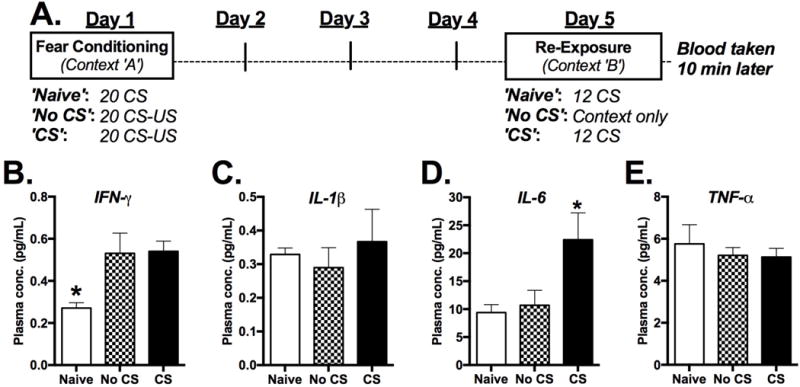
Figure 1
Figure 1
Rapid effect of fear memory retrieval on plasma cytokine levels. a Study design. b-e Plasma levels of IFN-γ, IL-1β IL-6 and TNF-α 10 minutes after mice were removed from the re-exposure apparatus. “Naïve” mice were not fear-conditioned, but were re-exposed to the CS. “No CS” mice were fear conditioned, but were not re-exposed to the CS while in Context B. “CS” mice were both fear conditioned and re-exposed to the CS. (n=7-8/group) *P<0.05.
Figure 2
Figure 2
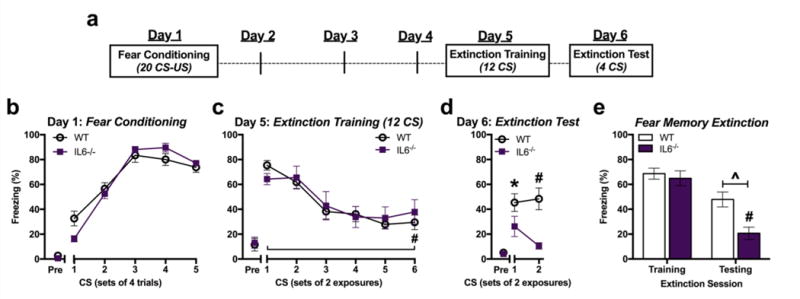
Genetic knockout of IL-6 selectively improves retention of fear memory extinction. a Study design. b Freezing during CS exposures terminating with a footshock during fear conditioning in wild-type (WT) and IL-6−/− mice. c Conditioned freezing in response to extinction training with 12 CS four days after conditioning. d Testing for retention of fear memory extinction with 4 CS one day after extinction training. e Total average conditioned freezing in response to four CS during extinction training (Day 5) and testing (Day 6). (n=8/group) *P<0.05, ^P<0.01, #P<0.001. “Pre” = 2-min period before CS presentations begin.
Figure 3
Figure 3
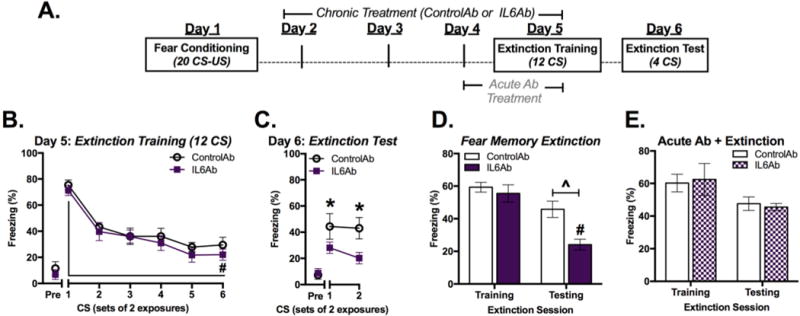
Pharmacological inhibition of IL-6 prior to extinction training improves retention of fear memory extinction. a Study design. b Conditioned freezing in response to 12 CS following four days of Ab treatment. c Testing for retention of fear memory extinction one day after extinction training. d Total average conditioned freezing in response to four CS during extinction training (Day 5) and testing (Day 6). e Total average conditioned freezing in response to four CS during extinction training and testing in mice treated with only two doses of ControlAb or IL6Ab prior to extinction training. (n=10/group) *P<0.05, ^P<0.01, #P<0.001.
Figure 4
Figure 4
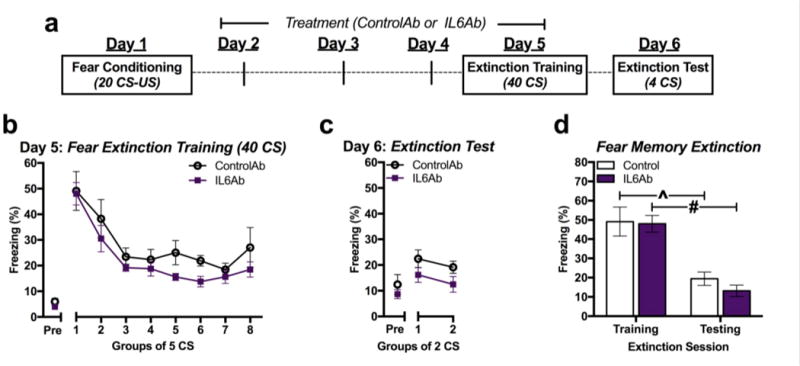
Extinction by prolonged training is unaffected by IL-6 inhibition. a Study design. b Conditioned freezing measured during extinction training with 40 CS in ControlAb- and IL6Ab-treated mice. (n=10-11/group). c Conditioned freezing measured during extinction testing with four CS. d Total average conditioned freezing in response to four CS during extinction training and testing. *P<0.05, ^P<0.01, #P<0.001.
Figure 5
Figure 5
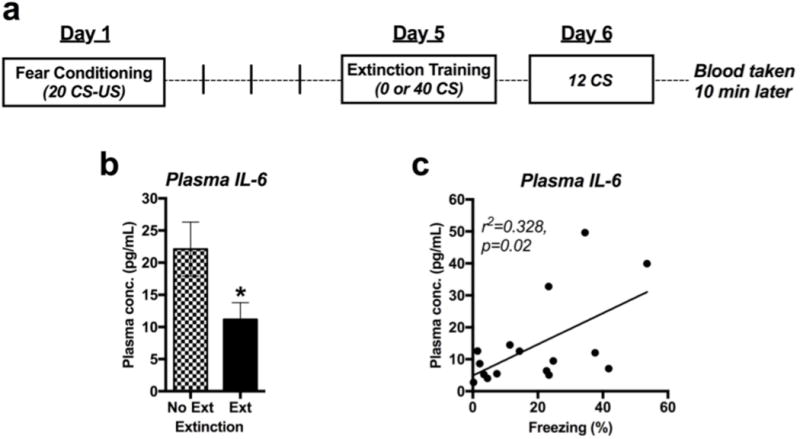
Prolonged extinction training has lasting effect on peripheral and central IL-6 signaling. a Study design. b Correlation between plasma levels of IL-6 after 12 CS re-exposures and total average freezing in response to those 12 CS (N=16). c Plasma IL-6 response to 12 CS in fear-conditioned mice exposed to either extinction training with 40 CS (Ext) or to 0 CS (No Ext) (n=8/group).
Figure 6
Figure 6
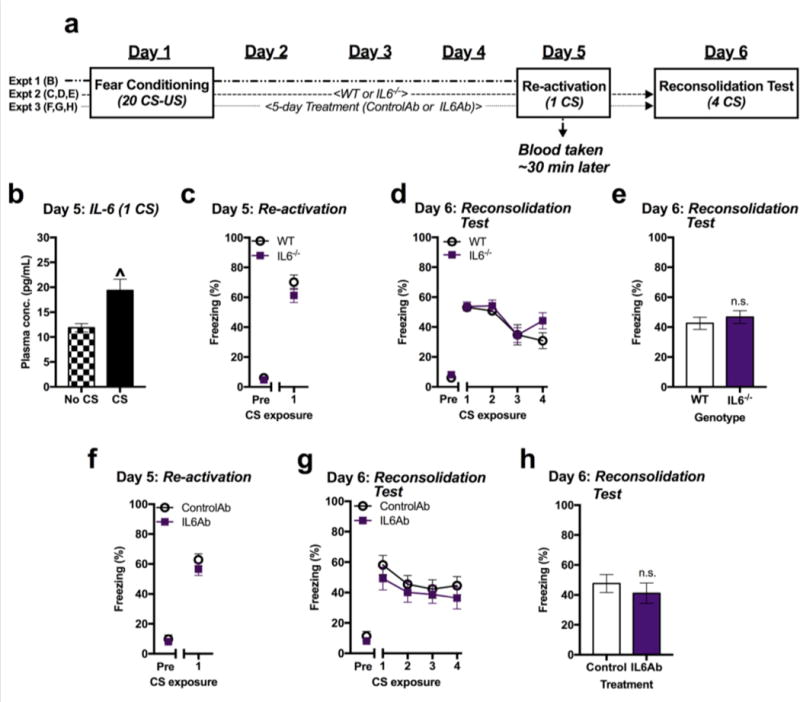
IL-6 is not required for the reconsolidation of fear memory. a Study design. b Plasma levels of IL-6 in fear-conditioned mice re-exposed to 0 (No CS) or 1 CS. c Conditioned freezing in response to 1 CS in WT and IL-6−/− mice. d Conditioned freezing of WT and IL-6−/− mice in response to each of 4 CS presented 24 hours after initial re-exposure. e Conditioned freezing averaged across 4 CS re-exposures during test. f Conditioned freezing in response to 1 CS re-exposure in ControlAb- and IL6Ab-treated mice. g Maintenance of fear memory in ControlAb-and IL6Ab-treated mice during each of 4 CS in a test of reconsolidation h and averaged across 4 CS. (n=8/group). ^P<0.01.

References

    1. Baker DG, Ekhator NN, Kasckow JW, Hill KK, Zoumakis E, Dashevsky BA, Chrousos GP, Geracioti TD. Plasma and cerebrospinal fluid interleukin-6 concentrations in posttraumatic stress disorder. Neuroimmunomodulation. 2001;9:209–217. - PubMed
    1. Bi Q, Shi L, Yang P, Wang J, Qin L. Minocycline attenuates interferon-α-induced impairments in rat fear extinction. Journal of Neuroinflammation. 2016;13:172. doi: 10.1186/s12974-016-0638-z. - DOI - PMC - PubMed
    1. Breen MS, Maihofer AX, Glatt SJ, Tylee DS, Chandler SD, Tsuang MT, Risbrough VB, Baker DG, O’Connor DT, Nievergelt CM, Woelk CH. Gene networks specific for innate immunity define post-traumatic stress disorder. Mol Psychiatry. 2015;20:1538–1545. doi: 10.1038/mp.2015.9. - DOI - PMC - PubMed
    1. Breznitz S, Ben-Zur H, Berzon Y, Weiss DW, Levitan G, Tarcic N, Lischinsky S, Greenberg A, Levi N, Zinder O. Experimental induction and termination of acute psychological stress in human volunteers: effects on immunological, neuroendocrine, cardiovascular, and psychological parameters. Brain Behavior and Immunity. 1998;12:34–52. doi: 10.1006/brbi.1997.0511. - DOI - PubMed
    1. Clark SM, Soroka JA, Song C, Li X, Tonelli LH. CD4(+) T cells confer anxiolytic and antidepressant-like effects, but enhance fear memory processes in Rag2(−/−) mice. Stress. 2016;19:303–311. doi: 10.1080/10253890.2016.1191466. - DOI - PMC - PubMed

Publication types