


Cobalamin and Folate Status among Breastfed Infants in Bhaktapur, Nepal
- PMID: 29783689
- PMCID: PMC5986518
- DOI: 10.3390/nu10050639
Cobalamin and Folate Status among Breastfed Infants in Bhaktapur, Nepal
Abstract
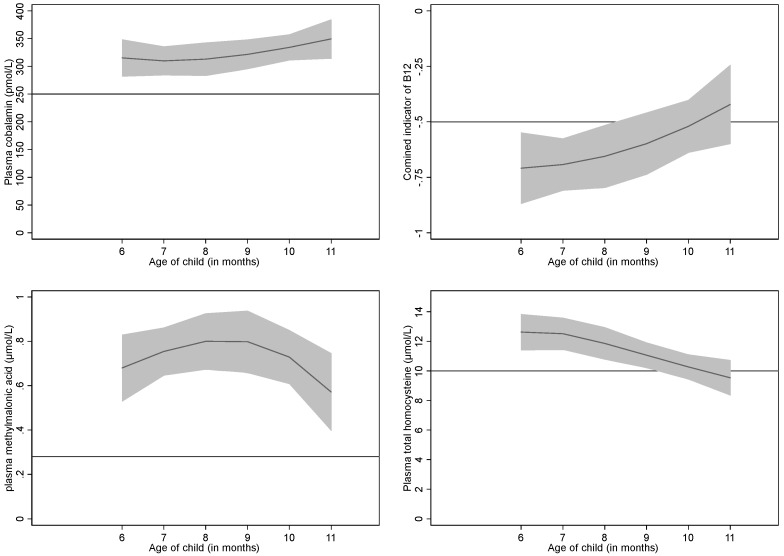
Cobalamin and folate are crucial micronutrients during infancy and they are required for growth and cognitive development. Due to the monotonous and predominantly vegetarian-based complementary feeding and poor maternal micronutrient status, infants from low- and middle-income countries are susceptible to cobalamin deficiency. However, data on plasma cobalamin and folate and the functional markers methylmalonic acid and total homocysteine from breastfed infants in Nepal are still needed. We collected plasma samples from 316 6⁻11-month-old breastfed infants with a length-for-age of less than minus one z-score and analyzed blood for plasma folate, cobalamin, methylmalonic acid and total homocysteine concentrations. Cobalamin deficiency (plasma cobalamin 10 µmol/L) and methylmalonic acid (>0.28 µmol/L) indicating functional cobalamin deficiency were found among 53% and 75% of the infants, respectively. Based on a combined indicator of cobalamin status, 58% were found to have low cobalamin status. However, folate deficiency (.
Keywords: cobalamin; combined B12; folate; homocysteine and Nepal; infants; methylmalonic acid.
Conflict of interest statement
The authors declared no conflict of interest.
Figures
References
Publication types
MeSH terms
Substances
LinkOut - more resources
Full Text Sources
Other Literature Sources
Medical
