


Erythrocyte microRNA sequencing reveals differential expression in relapsing-remitting multiple sclerosis
- PMID: 29783973
- PMCID: PMC5963124
- DOI: 10.1186/s12920-018-0365-7
Erythrocyte microRNA sequencing reveals differential expression in relapsing-remitting multiple sclerosis
Abstract
Background: There is a paucity of knowledge concerning erythrocytes in the aetiology of Multiple Sclerosis (MS) despite their potential to contribute to disease through impaired antioxidant capacity and altered haemorheological features. Several studies have identified an abundance of erythrocyte miRNAs and variable profiles associated with disease states, such as sickle cell disease and malaria. The aim of this study was to compare the erythrocyte miRNA profile of relapsing-remitting MS (RRMS) patients to healthy sex- and age-matched controls.
Methods: Erythrocytes were purified by density-gradient centrifugation and RNA was extracted. Following library preparation, samples were run on a HiSeq4000 Illumina instrument (paired-end 100 bp sequencing). Sequenced erythrocyte miRNA profiles (9 patients and 9 controls) were analysed by DESeq2. Differentially expressed miRNAs were validated by RT-qPCR using miR-152-3p as an endogenous control and replicated in a larger cohort (20 patients and 18 controls). After logarithmic transformation, differential expression was determined by two-tailed unpaired t-tests. Logistic regression analysis was carried out and receiver operating characteristic (ROC) curves were generated to determine biomarker potential.
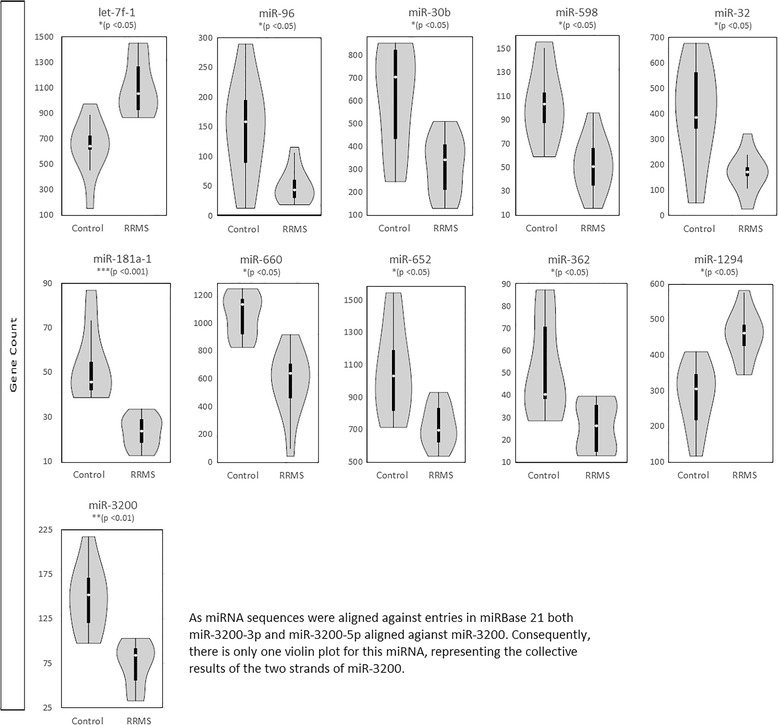
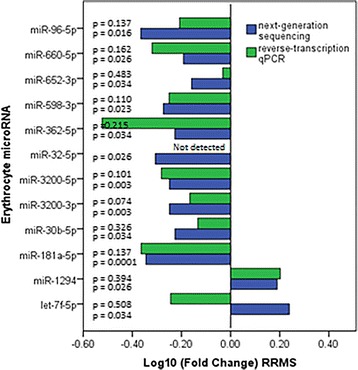
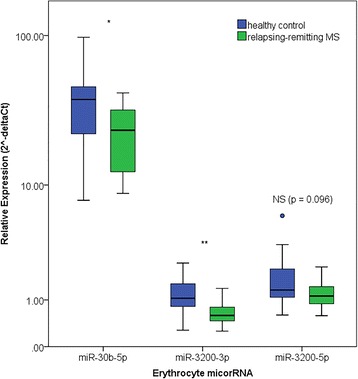
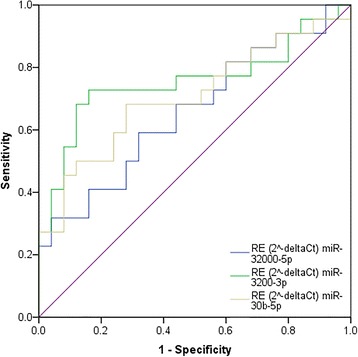
Results: A total of 236 erythrocyte miRNAs were identified. Of twelve differentially expressed miRNAs in RRMS two showed increased expression (adj. p < 0.05). Only modest fold-changes were evident across differentially expressed miRNAs. RT-qPCR confirmed differential expression of miR-30b-5p (0.61 fold, p < 0.05) and miR-3200-3p (0.36 fold, p < 0.01) in RRMS compared to healthy controls. Relative expression of miR-3200-5p (0.66 fold, NS p = 0.096) also approached significance. MiR-3200-5p was positively correlated with cognition measured by audio-recorded cognitive screen (r = 0.60; p < 0.01). MiR-3200-3p showed greatest biomarker potential as a single miRNA (accuracy = 75.5%, p < 0.01, sensitivity = 72.7%, specificity = 84.0%). Combining miR-3200-3p, miR-3200-5p, and miR-30b-5p into a composite biomarker increased accuracy to 83.0% (p < 0.05), sensitivity to 77.3%, and specificity to 88.0%.
Conclusions: This is the first study to report differences in erythrocyte miRNAs in RRMS. While the role of miRNAs in erythrocytes remains to be elucidated, differential expression of erythrocyte miRNAs may be exploited as biomarkers and their potential contribution to MS pathology and cognition should be further investigated.
Keywords: Erythrocytes; Next-generation sequencing; Relapsing-remitting multiple sclerosis; microRNA.
Conflict of interest statement
Ethics approval and consent to participate
Ethical approval was obtained from the Bond University Human Research Ethics Committee (RO-1382), the University of Newcastle Ethics Committee (H-505-0607), and the Hunter Area Research Ethics Committee (no. 05/04/13/3.09). All participants gave written informed consent prior to enrolment.
Competing interests
JLS’s institution receives non-directed funding, as well as honoraria for presentations and membership on advisory boards from Sanofi Aventis, Biogen Idec, Bayer Health Care, Merck Serono, Teva, Roche, and Novartis Australia.
Publisher’s Note
Springer Nature remains neutral with regard to jurisdictional claims in published maps and institutional affiliations.
Figures

References
-
- Marieb EN, Hoehn K. Human anatomy & physiology. Boston: Pearson; 2013.
Publication types
MeSH terms
Substances
Grants and funding
LinkOut - more resources
Full Text Sources
Other Literature Sources
Medical
Miscellaneous
