Review
. 2018 Jun 19;46(3):691-698.
doi: 10.1042/BST20170394. Epub 2018 May 21.

Harnessing post-translational modifications for next-generation HIV immunogens

Affiliations
Review

Harnessing post-translational modifications for next-generation HIV immunogens

Joel D Allen et al. Biochem Soc Trans. .

Abstract

The extensive post-translational modifications of the envelope spikes of the human immunodeficiency virus (HIV) present considerable challenges and opportunities for HIV vaccine design. These oligomeric glycoproteins typically have over 30 disulfide bonds and around a 100 N-linked glycosylation sites, and are functionally dependent on protease cleavage within the secretory system. The resulting mature structure adopts a compact fold with the vast majority of its surface obscured by a protective shield of glycans which can be targeted by broadly neutralizing antibodies (bnAbs). Despite the notorious heterogeneity of glycosylation, rare B-cell lineages can evolve to utilize and cope with viral glycan diversity, and these structures therefore present promising targets for vaccine design. The latest generation of recombinant envelope spike mimetics contains re-engineered post-translational modifications to present stable antigens to guide the development of bnAbs by vaccination.

Keywords: glycobiology; glycosylation; immunogen; vaccine; virus.


Figures

Figure 1
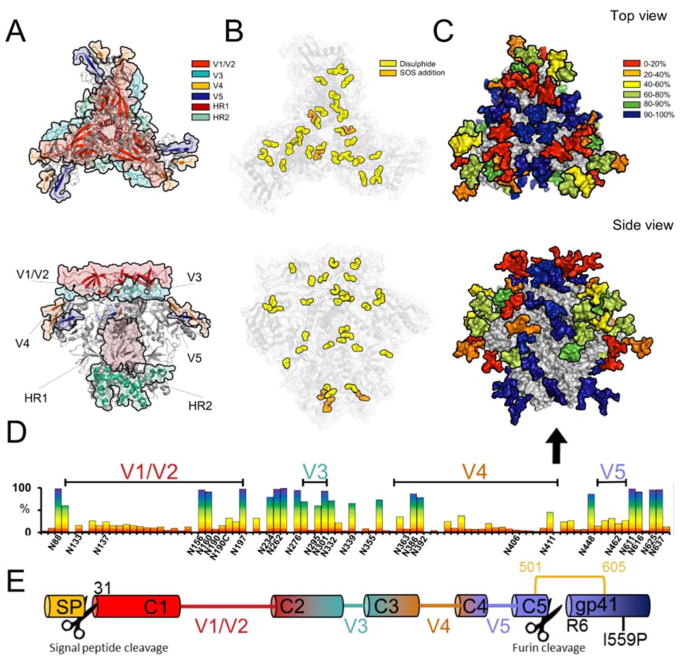
Figure 1. Representation of the post-translational modifications of BG505 clade A envelope glycoprotein
Models were generated using the cryo-EM structure of BG505 SOSIP.664 PDB ID:5ACO [12]. A) 3D representation of the variable loops on gp120 and the heptad repeats of gp41. B) Canonical disulphide bonds found in BG505[36] with the additional stabilizing disulphide bond found in BG505 SOSIP.664 shown in orange. C) Conservation map of the glycans of BG505 SOSIP.664. The glycans were coloured according to their conservation across 4000 Env strains Huang et al.[44]. BG505 crystal structure with N-linked glycans modelled by Behrens et al.[52] D) The frequency of potential N-linked glycan sites across the Env sequence with the PNGs found in BG505 SOSIP.664 labelled on the X axis. E) Schematic showing the locations of proteolytic cleavage for the signal peptide and the furin cleavage site.

References

    1. Barouch DH, Stephenson KE, Borducchi EN, Smith K, Stanley K, McNally AG, et al. Protective efficacy of a global HIV-1 mosaic vaccine against heterologous SHIV challenges in rhesus monkeys. Cell. 2013;155:531–539. - PMC - PubMed
    1. Chung AW, Kumar MP, Arnold KB, Yu WH, Schoen MK, Dunphy LJ, et al. Dissecting Polyclonal Vaccine-Induced Humoral Immunity against HIV Using Systems Serology. Cell. 2015;163:988–998. - PMC - PubMed
    1. Rerks-Ngarm S, Pitisuttithum P, Nitayaphan S, Kaewkungwal J, Chiu J, Paris R, et al. Vaccination with ALVAC and AIDSVAX to Prevent HIV-1 Infection in Thailand. N Engl J Med. 2009;361:2209–2220. - PubMed
    1. Chuang G-Y, Geng H, Pancera M, Xu K, Cheng C, Acharya P, et al. Structure-Based Design of a Soluble Prefusion-Closed HIV-1 Env Trimer with Reduced CD4 Affinity and Improved Immunogenicity. J Virol. 2017;91:e02268–16. - PMC - PubMed
    1. Sanders RW, Derking R, Cupo A, Julien J, Yasmeen A, De N, et al. A Next-Generation Cleaved, Soluble HIV-1 Env Trimer, BG505 SOSIP. 664 gp140, Expresses Multiple Epitopes for Broadly Neutralizing but Not Non-Neutralizing Antibodies. 2013;9 - PMC - PubMed

Publication types

LinkOut - more resources