


Latest developments in MUC1 immunotherapy
- PMID: 29784646
- PMCID: PMC6008591
- DOI: 10.1042/BST20170400
Latest developments in MUC1 immunotherapy
Abstract
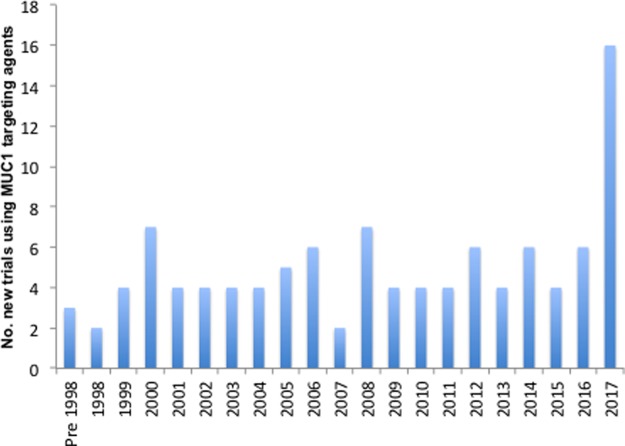
Currently, there is renewed interest in attempting to recruit the host immune system to eliminate cancers, and within this renewed activity, MUC1 continues to arouse interest. MUC1 has been considered a possible therapeutic target for the past 30 years as it is up-regulated, aberrantly glycosylated and its polarization is lost in many adenocarcinomas. Moreover, MUC1 is expressed by some haematopoietic cancers, including acute myeloid leukaemia and myeloma. Although multiple clinical trials have been initiated and immune responses have been documented, effective clinical benefit worthy of approval for general application has not as yet been achieved. However, this does not appear to have quelled the interest in MUC1 as a therapeutic target, as shown by the increase in the number of MUC1-based clinical trials initiated in 2017 ( Figure 1). As with all translational studies, incorporating new relevant research findings into therapeutic strategy is difficult. Decisions are made to commit to a specific strategy based on the information and data available when the trial is initiated. However, the time required for preclinical studies and early trials can render the founding concept not always appropriate for proceeding to a larger definitive trial. Here, we summarize the attempts made, to date, to bring MUC1 into the world of cancer immunotherapy and discuss how research findings regarding MUC1 structure and function together with expanded knowledge of its interactions with the tumour environment and immune effector cells could lead to improved therapeutic approaches. ppbiost;46/3/659/BST20170400CF1F1BST-2017-0400CF1Figure 1.Number of MUC1-targeted trials initiated each year.
Keywords: MUC1; cancer; immunotherapy.
© 2018 The Author(s).
Conflict of interest statement
J.B. is a consultant for Palleon Pharmaceuticals. All other authors declare no conflicts of interest.
Figures
References
-
- Lan M.S., Batra S.K., Qi W.N., Metzgar R.S. and Hollingsworth M.A. (1990) Cloning and sequencing of a human pancreatic tumor mucin cDNA. J. Biol. Chem. 265, 15294–15299 PMID: - PubMed
-
- Ligtenberg M.J., Vos H.L., Gennissen A.M. and Hilkens J. (1990) Episialin, a carcinoma-associated mucin, is generated by a polymorphic gene encoding splice variants with alternative amino termini. J. Biol. Chem. 265, 5573–5578 PMID: - PubMed
-
- Baruch A., Hartmann M., Yoeli M., Adereth Y., Greenstein S., Stadler Y. et al. (1999) The breast cancer-associated MUC1 gene generates both a receptor and its cognate binding protein. Cancer Res. 59, 1552–1561 PMID: - PubMed
Publication types
MeSH terms
Substances
Grants and funding
LinkOut - more resources
Full Text Sources
Other Literature Sources
Medical
Research Materials
Miscellaneous
