


Opportunistic pulse checks in primary care to improve recognition of atrial fibrillation: a retrospective analysis of electronic patient records
- PMID: 29784865
- PMCID: PMC6002015
- DOI: 10.3399/bjgp18X696605
Opportunistic pulse checks in primary care to improve recognition of atrial fibrillation: a retrospective analysis of electronic patient records
Abstract
Background: Atrial fibrillation (AF) is an important and modifiable risk factor for stroke. Earlier identification may reduce stroke-related morbidity and mortality. Trial evidence shows that opportunistic pulse regularity checks in individuals aged ≥65 years increases detection of AF. However, this is not currently recommended by the National Screening Programme or implemented by most clinical commissioning groups (CCGs).
Aim: To evaluate the impact of a systematic programme to promote pulse regularity checks, the programme's uptake in general practice, and the prevalence of AF.
Design and setting: Retrospective analysis of electronic primary care patient records in three east London CCGs (City and Hackney, Newham, and Tower Hamlets) over 10 years.
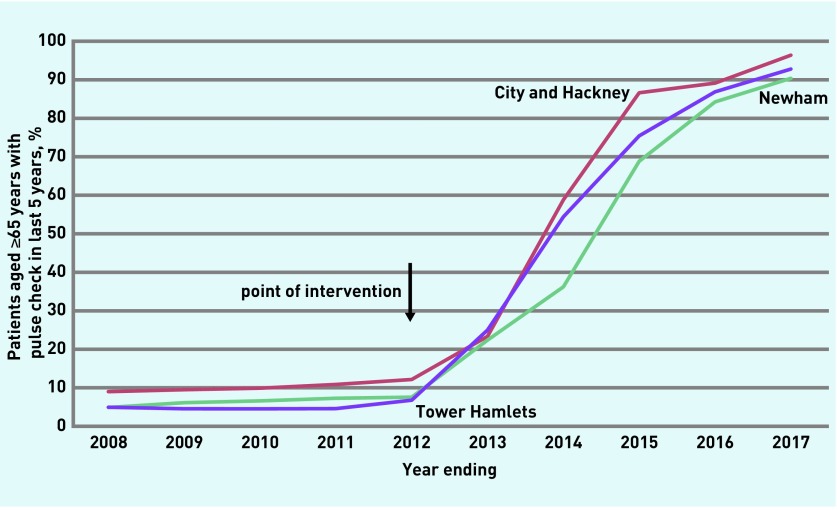
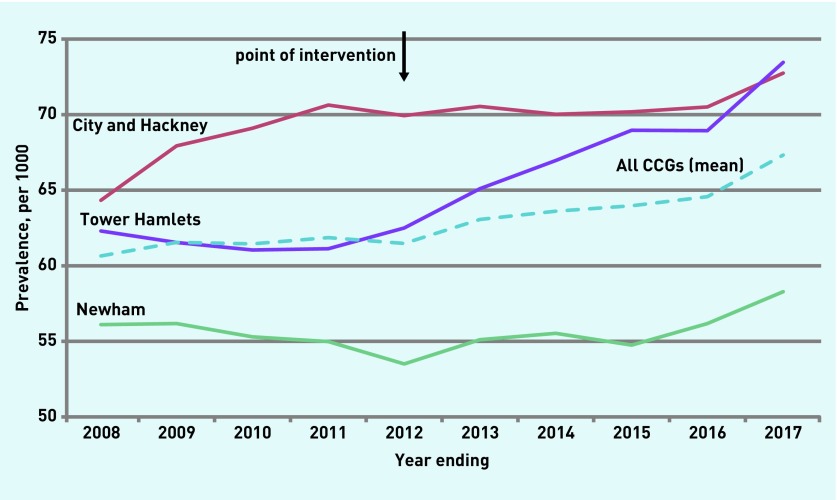
Method: Rates of pulse regularity checks and prevalence of AF in individuals aged ≥65 years were compared from the pre-intervention period, 2007-2011, to the post-intervention period, 2012-2017.
Results: Across the three CCGs, rates of pulse regularity checks increased from a mean of 7.3% pre-intervention to 66.4% post-intervention, achieving 93.1% (n = 58 722) in the final year. Age-standardised prevalence of AF in individuals aged ≥65 years increased significantly from a pre-intervention mean of 61.4/1000 to a post-intervention mean of 64.5/1000. There was a significant increase in a post-intervention trend to a final-year mean of 67.3/1000: an improvement of 9.6% (5.9/1000) with 790 additional new cases identified.
Conclusion: Organisational alignment, standardised data entry, peer-performance dashboards, and financial incentives rapidly and generally increased opportunistic screening with pulse regularity checks. This was associated with a significant increase in detection and prevalence of AF and is of public health importance.
Keywords: atrial fibrillation; pulse; screening.
© British Journal of General Practice 2018.
Figures
References
-
- Lin HJ, Wolf PA, Kelly-Hayes M, et al. Stroke severity in atrial fibrillation. The Framingham Study. Stroke. 1996;27(10):1760–1764. - PubMed
-
- Davis RC, Hobbs FD, Kenkre JE, et al. Prevalence of atrial fibrillation in the general population and in high-risk groups: the ECHOES study. Europace. 2012;14(11):1553–1559. - PubMed
-
- Sterne JA, Bodalia PN, Bryden PA, et al. Oral anticoagulants for primary prevention, treatment and secondary prevention of venous thromboembolic disease, and for prevention of stroke in atrial fibrillation: systematic review, network meta-analysis and cost-effectiveness analysis. Health Technol Assess. 2017;21(9):1–386. - PMC - PubMed
-
- Aronsson M, Svennberg E, Rosenqvist M, et al. Cost-effectiveness of mass screening for untreated atrial fibrillation using intermittent ECG recording. Europace. 2015;17(7):1023–1029. - PubMed
MeSH terms
LinkOut - more resources
Full Text Sources
Other Literature Sources
Medical
