


Orthopedic Injured versus Uninjured Comparison Groups for Neuroimaging Research in Mild Traumatic Brain Injury
- PMID: 29786476
- PMCID: PMC6338561
- DOI: 10.1089/neu.2017.5513
Orthopedic Injured versus Uninjured Comparison Groups for Neuroimaging Research in Mild Traumatic Brain Injury
Abstract
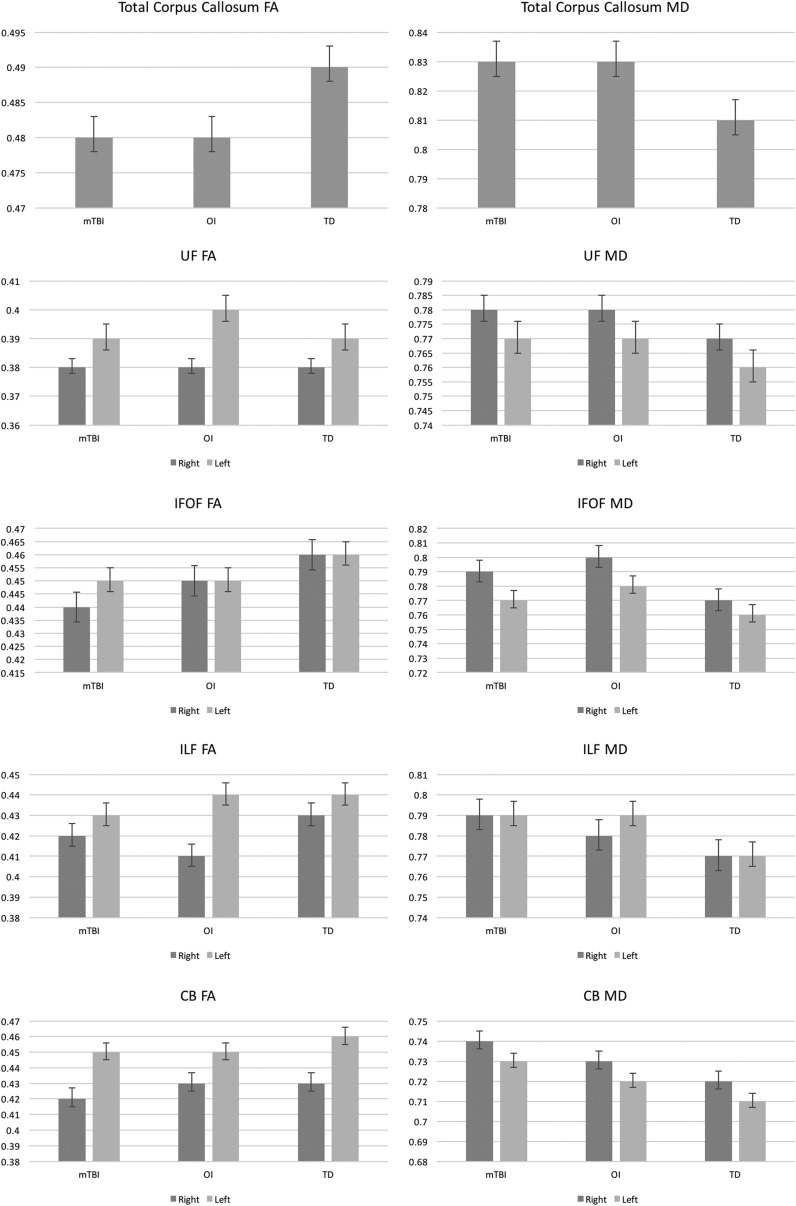
To address controversy surrounding the most appropriate comparison group for mild traumatic brain injury (mTBI) research, mTBI patients 12-30 years of age were compared with an extracranial orthopedic injury (OI) patient group and an uninjured, typically developing (TD) participant group with comparable demographic backgrounds. Injured participants underwent subacute (within 96 h) and late (3 months) diffusion tensor imaging (DTI); TD controls underwent DTI once. Group differences in fractional anisotropy (FA) and mean diffusivity (MD) of commonly studied white matter tracts were assessed. For FA, subacute group differences occurred in the bilateral inferior frontal occipital fasciculus (IFOF) and right inferior longitudinal fasciculus (ILF), and for MD, differences were found in the total corpus callosum, right uncinate fasciculus, IFOF, ILF, and bilateral cingulum bundle (CB). In these analyses, differences (lower FA and higher MD) were generally observed between the mTBI and TD groups but not between the mTBI and OI groups. After a 3 month interval, groups significantly differed in left IFOF FA and in right IFOF and CB MD; the TD group had significantly higher FA and lower MD than both injury groups, which did not differ. There was one exception to this pattern, in which the OI group demonstrated significantly lower FA in the left ILF than the TD group, although neither group differed from the mTBI group. The mTBI and OI groups had generally similar longitudinal results. Findings suggest that different conclusions about group-level DTI analyses could be drawn, depending on the selected comparison group, highlighting the need for additional research in this area. Where possible, mTBI studies may benefit from the inclusion of both OI and TD controls.
Keywords: DTI; MRI; OI; mTBI.
Conflict of interest statement
No competing financial interests exist.
Figures
References
-
- Whiteneck G.G., Gerhart K.A., and Cusick C.P. (2004). Identifying environmental factors that influence the outcomes of people with traumatic brain injury. J. Head Trauma Rehabil. 19, 191–204 - PubMed
-
- Boake C., McCauley S.R., Levin H.S., Pedroza C., Contant C.F., Song J.X., Brown S.A., Goodman H., Brundage S.I., and Diaz-Marchan P.J. (2005). Diagnostic criteria for postconcussional syndrome after mild to moderate traumatic brain injury. J. Neuropsychiatry Clin. Neurosci. 17, 350–356 - PubMed
-
- Ezaki Y., Tsutsumi K., Morikawa M., and Nagata I. (2006). Role of diffusion-weighted magnetic resonance imaging in diffuse axonal injury. Acta Radiol. 47, 733–740 - PubMed
-
- Bigler E.D. (2015). Neuropathology of mild traumatic brain injury: correlation to neurocognitive and neurobehavioral findings., in: Brain Neurotrauma: Molecular, Neuropsychological, and Rehabilitation Aspects. Kobeissy F.H. (ed.). CRC Press/Taylor & Francis: Boca Raton, FL - PubMed
-
- Shenton M.E., Hamoda H.M., Schneiderman J.S., Bouix S., Pasternak O., Rathi Y., Vu M.-A., Purohit M.P., Helmer K., Koerte I., Lin A.P., Westin C.-F., Kikinis R., Kubicki M., Stern R.A., and Zafonte R. (2012). A review of magnetic resonance imaging and diffusion tensor imaging findings in mild traumatic brain injury. Brain Imaging Behav. 6, 137–192 - PMC - PubMed
Publication types
MeSH terms
Grants and funding
LinkOut - more resources
Full Text Sources
Other Literature Sources
Medical
