


Temporally feathered intensity-modulated radiation therapy: A planning technique to reduce normal tissue toxicity
- PMID: 29786861
- PMCID: PMC6041138
- DOI: 10.1002/mp.12988
Temporally feathered intensity-modulated radiation therapy: A planning technique to reduce normal tissue toxicity
Abstract
Purpose: Intensity-modulated radiation therapy (IMRT) has allowed optimization of three-dimensional spatial radiation dose distributions permitting target coverage while reducing normal tissue toxicity. However, radiation-induced normal tissue toxicity is a major contributor to patients' quality of life and often a dose-limiting factor in the definitive treatment of cancer with radiation therapy. We propose the next logical step in the evolution of IMRT using canonical radiobiological principles, optimizing the temporal dimension through which radiation therapy is delivered to further reduce radiation-induced toxicity by increased time for normal tissue recovery. We term this novel treatment planning strategy "temporally feathered radiation therapy" (TFRT).
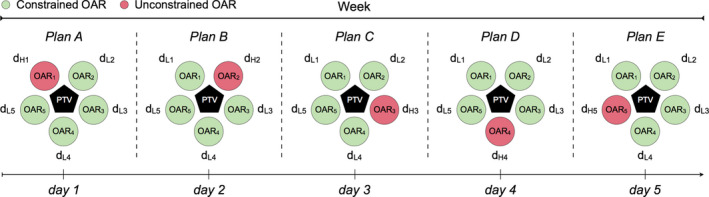
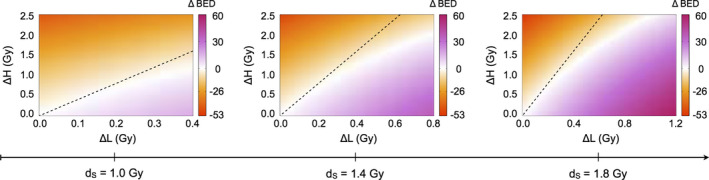
Methods: Temporally feathered radiotherapy plans were generated as a composite of five simulated treatment plans each with altered constraints on particular hypothetical organs at risk (OARs) to be delivered sequentially. For each of these TFRT plans, OARs chosen for feathering receive higher doses while the remaining OARs receive lower doses than the standard fractional dose delivered in a conventional fractionated IMRT plan. Each TFRT plan is delivered a specific weekday, which in effect leads to a higher dose once weekly followed by four lower fractional doses to each temporally feathered OAR. We compared normal tissue toxicity between TFRT and conventional fractionated IMRT plans by using a dynamical mathematical model to describe radiation-induced tissue damage and repair over time.
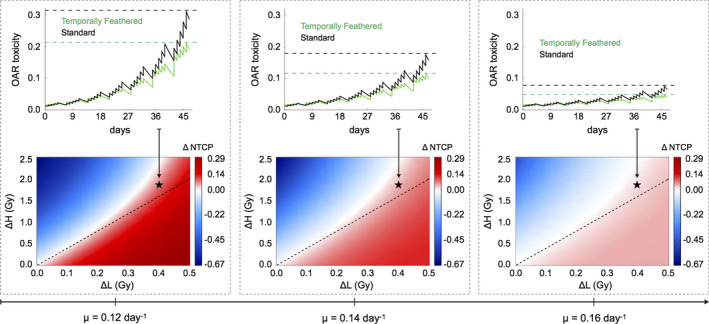
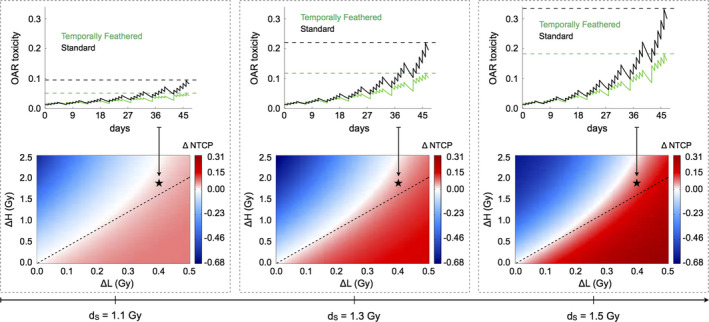
Results: Model-based simulations of TFRT demonstrated potential for reduced normal tissue toxicity compared to conventionally planned IMRT. The sequencing of high and low fractional doses delivered to OARs by TFRT plans suggested increased normal tissue recovery, and hence less overall radiation-induced toxicity, despite higher total doses delivered to OARs compared to conventional fractionated IMRT plans. The magnitude of toxicity reduction by TFRT planning was found to depend on the corresponding standard fractional dose of IMRT and organ-specific recovery rate of sublethal radiation-induced damage.
Conclusions: TFRT is a novel technique for treatment planning and optimization of therapeutic radiotherapy that considers the nonlinear aspects of normal tissue repair to optimize toxicity profiles. Model-based simulations of TFRT to carefully conceptualized clinical cases have demonstrated potential for radiation-induced toxicity reduction in a previously described dynamical model of normal tissue complication probability (NTCP).
Keywords: dosimetry planning; normal tissue complication probability; normal tissue toxicity reduction; temporally feathered radiation therapy; therapeutic ratio.
© 2018 American Association of Physicists in Medicine.
Conflict of interest statement
The authors have no conflicts to disclose.
Figures

References
-
- Atun R, Jaffray DA, Barton MB, et al. Expanding global access to radiotherapy. Lancet Oncol. 2015;16:1153–1186. - PubMed
-
- Emami B, Lyman J, Brown A, et al. Tolerance of normal tissue to therapeutic irradiation. Int J Radiat Oncol Biol Phys. 1991;21:109–122. - PubMed
-
- Bortfeld T, Bürkelbach J, Boesecke R, Schlegel W. Methods of image reconstruction from projections applied to conformation radiotherapy. Phys Med Biol. 1990;35:1423–1434. - PubMed
-
- Brahme A. Optimization of stationary and moving beam radiation therapy techniques. Radiother Oncol. 1988;12:129–140. - PubMed
-
- Bortfeld TR, Kahler DL, Waldron TJ, Boyer AL. X‐ray field compensation with multileaf collimators. Int J Radiat Oncol Biol Phys. 1994;28:723–730. - PubMed
MeSH terms
Grants and funding
LinkOut - more resources
Full Text Sources
Other Literature Sources
