


Effectiveness of a Blended Physical Therapist Intervention in People With Hip Osteoarthritis, Knee Osteoarthritis, or Both: A Cluster-Randomized Controlled Trial
- PMID: 29788253
- PMCID: PMC6016690
- DOI: 10.1093/ptj/pzy045
Effectiveness of a Blended Physical Therapist Intervention in People With Hip Osteoarthritis, Knee Osteoarthritis, or Both: A Cluster-Randomized Controlled Trial
Abstract
Background: Integrating physical therapy sessions and an online application (e-Exercise) might support people with hip osteoarthritis (OA), knee OA, or both (hip/knee OA) in taking an active role in the management of their chronic condition and may reduce the number of physical therapy sessions.
Objective: The objective of this study was to investigate the short- and long-term effectiveness of e-Exercise compared to usual physical therapy in people with hip/knee OA.
Design: The design was a prospective, single-blind, multicenter, superiority, cluster- randomized controlled trial.
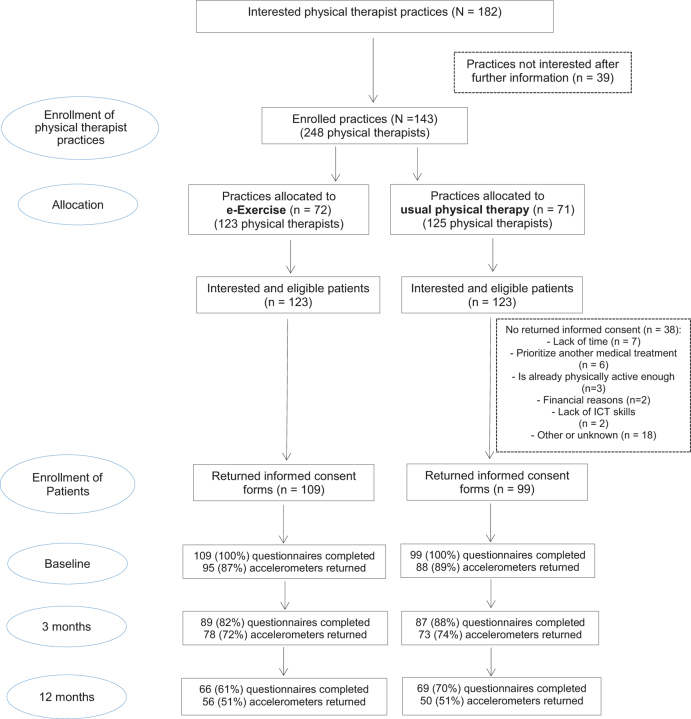
Setting: The setting included 143 primary care physical therapist practices.
Participants: The participants were 208 people who had hip/knee OA and were 40 to 80 years of age.
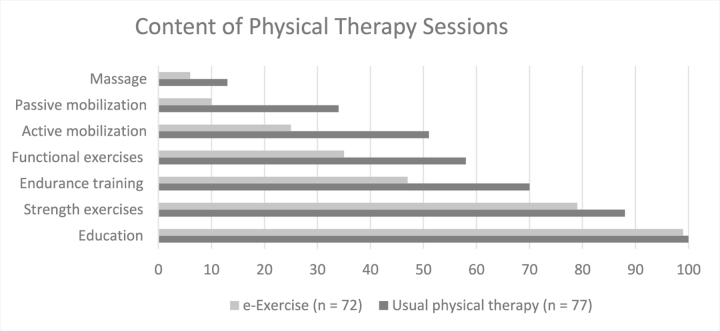
Intervention: e-Exercise is a 3-month intervention in which about 5 face-to-face physical therapy sessions were integrated with an online application consisting of graded activity, exercise, and information modules. Usual physical therapy was conducted according to the Dutch physical therapy guidelines on hip and knee OA.
Measurements: Primary outcomes, measured at baseline after 3 and 12 months, were physical functioning and free-living physical activity. Secondary outcome measures were pain, tiredness, quality of life, self-efficacy, and the number of physical therapy sessions.
Results: The e-Exercise group (n = 109) received, on average, 5 face-to-face sessions; the usual physical therapy group (n = 99) received 12. No significant differences in primary outcomes between the e-Exercise group and the usual physical therapy group were found. Within-group analyses for both groups showed a significant improvement in physical functioning. After 3 months, participants in the e-Exercise group reported an increase in physical activity; however, no objectively measured differences in physical activity were found. With respect to secondary outcomes, after 12 months, sedentary behavior significantly increased in the e-Exercise group compared with the usual physical therapy group. In both groups, there were significant improvements for pain, tiredness, quality of life, and self-efficacy.
Limitations: The response rate at 12 months was 65%.
Conclusions: The blended intervention, e-Exercise, was not more effective than usual physical therapy in people with hip/knee OA.
Figures
References
-
- Bijlsma JW, Berenbaum F, Lafeber FP. Osteoarthritis: an update with relevance for clinical practice. Lancet. 2011;377:2115–2126. - PubMed
-
- Dekker J, ed. Exercise and Physical Functioning in Osteoarthritis: Medical, Neuromuscular and Behavioral Perspectives. New York: Spinger-Verlag; 2013.
Publication types
MeSH terms
Associated data
LinkOut - more resources
Full Text Sources
Other Literature Sources
