


Effect of Low Back Pain Risk-Stratification Strategy on Patient Outcomes and Care Processes: the MATCH Randomized Trial in Primary Care
- PMID: 29790073
- PMCID: PMC6082187
- DOI: 10.1007/s11606-018-4468-9
Effect of Low Back Pain Risk-Stratification Strategy on Patient Outcomes and Care Processes: the MATCH Randomized Trial in Primary Care
Abstract
Background: The STarT Back strategy for categorizing and treating patients with low back pain (LBP) improved patients' function while reducing costs in England.
Objective: This trial evaluated the effect of implementing an adaptation of this approach in a US setting.
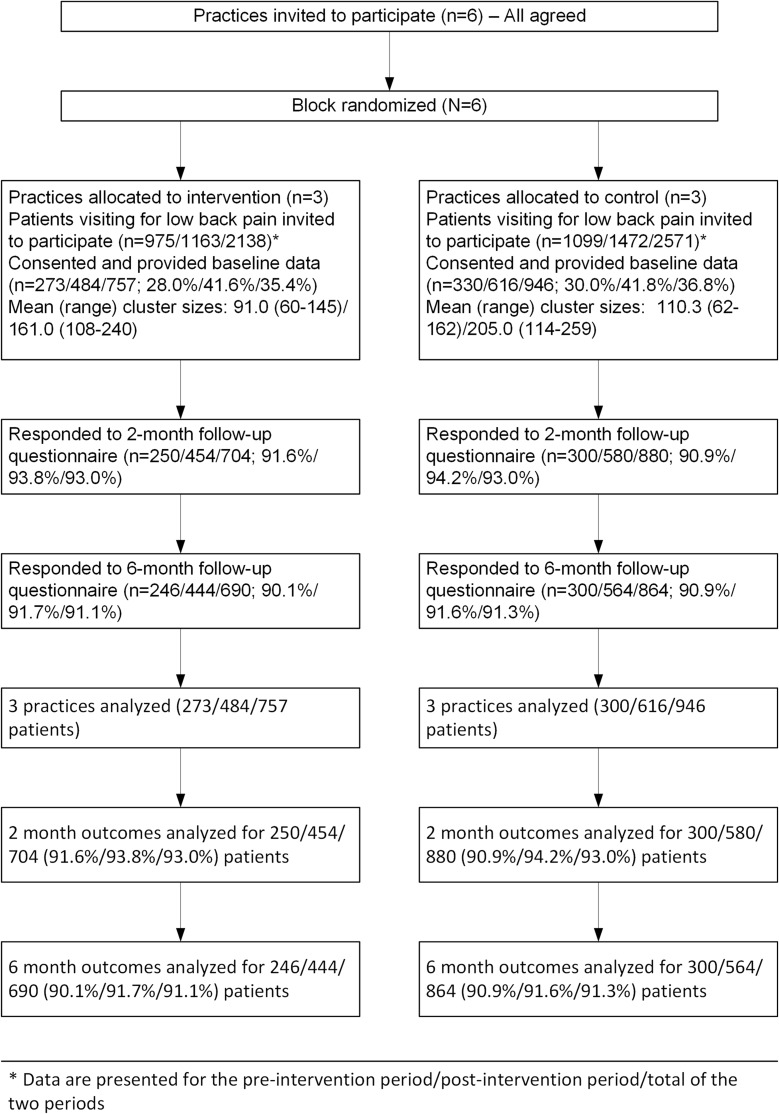
Design: The Matching Appropriate Treatments to Consumer Healthcare needs (MATCH) trial was a pragmatic cluster randomized trial with a pre-intervention baseline period. Six primary care clinics were pair randomized, three to training in the STarT Back strategy and three to serve as controls.
Participants: Adults receiving primary care for non-specific LBP were invited to provide data 2 weeks after their primary care visit and follow-up data 2 and 6 months (primary endpoint) later.
Interventions: The STarT Back risk-stratification strategy matches treatments for LBP to physical and psychosocial obstacles to recovery using patient-reported data (the STarT Back Tool) to categorize patients' risk of persistent disabling pain. Primary care clinicians in the intervention clinics attended six didactic sessions to improve their understanding LBP management and received in-person training in the use of the tool that had been incorporated into the electronic health record (EHR). Physical therapists received 5 days of intensive training. Control clinics received no training.
Main measures: Primary outcomes were back-related physical function and pain severity. Intervention effects were estimated by comparing mean changes in patient outcomes after 2 and 6 months between intervention and control clinics. Differences in change scores by trial arm and time period were estimated using linear mixed effect models. Secondary outcomes included healthcare utilization.
Key results: Although clinicians used the tool for about half of their patients, they did not change the treatments they recommended. The intervention had no significant effect on patient outcomes or healthcare use.
Conclusions: A resource-intensive intervention to support stratified care for LBP in a US healthcare setting had no effect on patient outcomes or healthcare use.
Trial registration: National Clinical Trial Number NCT02286141.
Keywords: STarT Back; low back pain; patient outcomes; primary care; risk-stratification.
Conflict of interest statement
The authors declare that they do not have a conflict of interest.
References
-
- Von Korff M, Franklin G. Responding to America's iatrogenic epidemic of prescription opioid addiction and overdose. Philadelphia: Wolters Kluwer Health, Inc.; 2016. - PubMed
-
- Boothby JL, Thorn BE, Stroud MW, Jensen MP. Coping with pain. In: Gatchel RJ, Turk DC, editors. Psychosocial factors in pain: critical perspectives. New York: Guilford Press; 1999. pp. 343–59.
Publication types
MeSH terms
Associated data
Grants and funding
LinkOut - more resources
Full Text Sources
Other Literature Sources
Medical
Miscellaneous
