. 2018 Sep 1;27(17):2978-2985.
doi: 10.1093/hmg/ddy197.

Syntrophin binds directly to multiple spectrin-like repeats in dystrophin and mediates binding of nNOS to repeats 16-17

Affiliations

Syntrophin binds directly to multiple spectrin-like repeats in dystrophin and mediates binding of nNOS to repeats 16-17

Marvin E Adams et al. Hum Mol Genet. .

Abstract

Mutation of the gene encoding dystrophin leads to Duchenne and Becker muscular dystrophy (DMD and BMD). Currently, dystrophin is thought to function primarily as a structural protein, connecting the muscle cell actin cytoskeleton to the extra-cellular matrix. In addition to this structural role, dystrophin also plays an important role as a scaffold that organizes an array of signaling proteins including sodium, potassium, and calcium channels, kinases, and nitric oxide synthase (nNOS). Many of these signaling proteins are linked to dystrophin via syntrophin, an adapter protein that is known to bind directly to two sites in the carboxyl terminal region of dystrophin. A search of the dystrophin sequence revealed three additional potential syntrophin binding sites (SBSs) within the spectrin-like repeat (SLR) region of dystrophin. Binding assays revealed that the site at SLR 17 bound specifically to the α isoform of syntrophin while the site at SLR 22 bound specifically to the β-syntrophins. The SLR 17 α-SBS contained the core sequence known to be required for nNOS-dystrophin interaction. In vitro and in vivo assays indicate that α-syntrophin facilitates the nNOS-dystrophin interaction at this site rather than nNOS binding directly to dystrophin as previously reported. The identification of multiple SBSs within the SLR region of dystrophin demonstrates that this region functions as a signaling scaffold. The signaling role of the SLR region of dystrophin will need to be considered for effective gene replacement or exon skipping based DMD/BMD therapies.


Figures
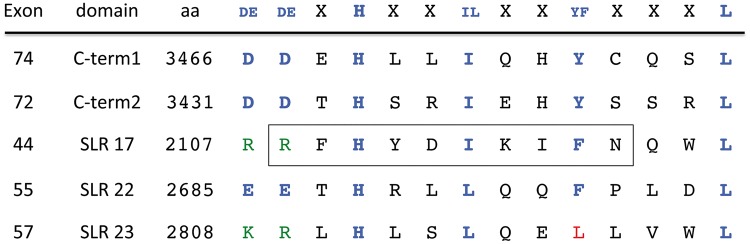
Figure 1.
Figure 1.
Dystrophin contains five SBS consensus sequences. In addition to the two known SBSs in the C-terminal region, dystrophin contains three SBSs located in the spectrin-like repeats (SLRs). The SBS located in SLR-17 encompasses the minimal sequence required for nNOS association with dystrophin (22) (boxed region).
Figure 2.
Figure 2.
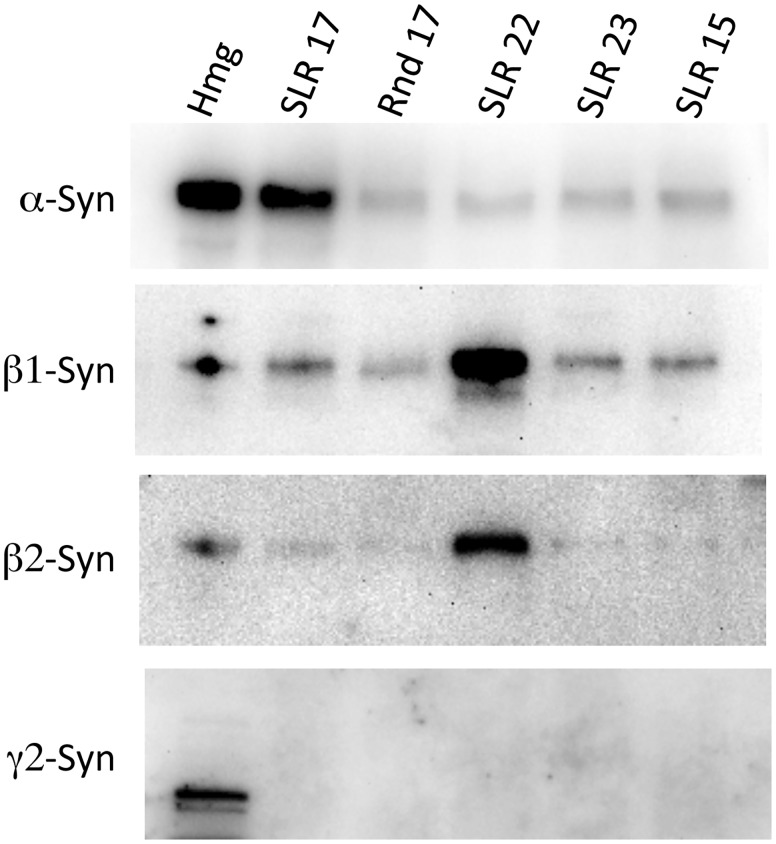
α- and β-Syntrophins bind specifically to different repeats. Peptides corresponding to the SBSs in SLRs were used to pull down syntrophins from mouse muscle homogenates. The associated syntrophins were identified by western blot. Hmg—muscle homogenate before pull down assay, Rnd 17—peptide from SLR-17 with amino acids in random order, SLR 15—negative control peptide with SLR 15 sequence that does not contain a SBS.
Figure 3.
Figure 3.
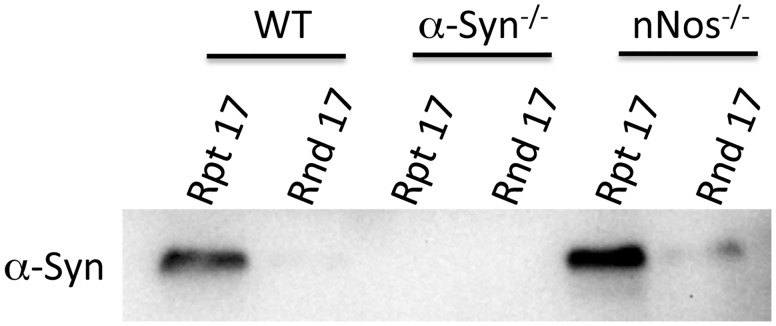
α-Syntrophin binding to SLR 17 does not require nNOS. The SLR-17 SBS peptide was used in mouse muscle homogenate pull down assays and α-syntrophin was detected by western blot. Homogenates were generated from C57bl6 (WT), α-syntrophin knockout (Snta−/−) and nNOS knockout (Nos1−/−) mice.
Figure 4.
Figure 4.
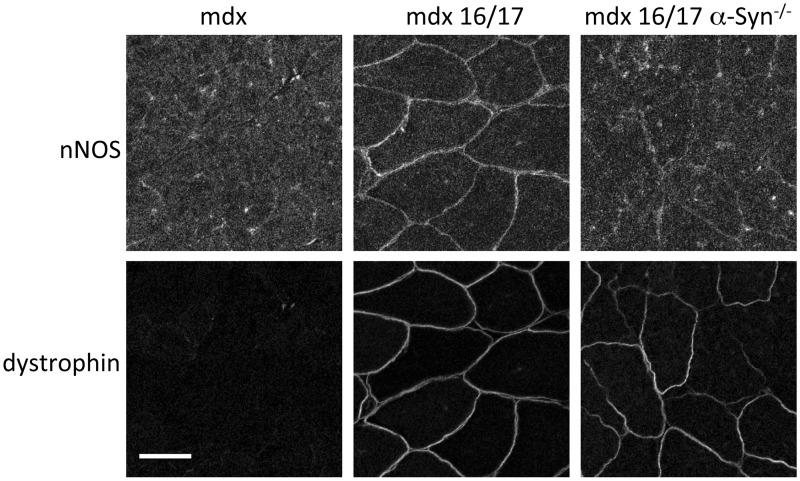
Restoration of nNOS to mdx sarcolemma by AAV-microdystrophin requires α-syntrophin. AAV-microdystrophin containing SLRs 16 and 17 was injected into the TA muscle of mdx and mdx/Snta−/− mice. Immunofluorescence of cryosectioned muscle showed that both treated strains expressed the microdystrophin but nNOS was only restored to the sarcolemma in the mdx strain that expressed α-syntrophin. Scale bar = 50 μm.
Figure 5.
Figure 5.
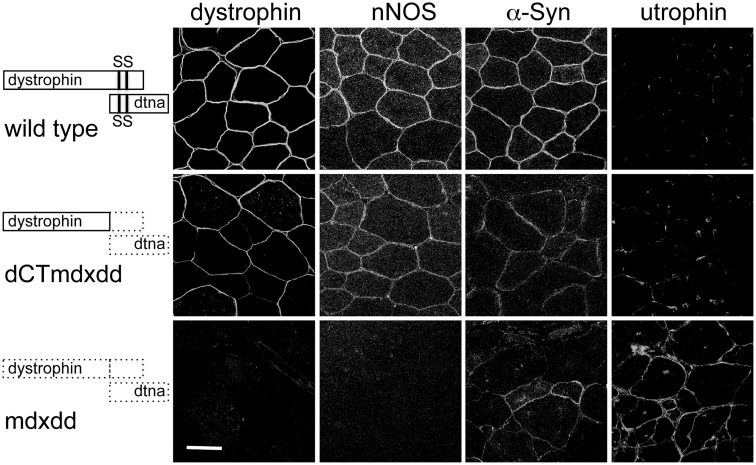
Both α-syntrophin and nNOS are restored to the mdx sarcolemma by a dystrophin transgene lacking the C-terminal SBSs and α-dystrobrevin. Immunofluorescence of gastrocnemious muscle cross sections shows that α-syntrophin and nNOS are restored to the sarcolemma of mdx mice expressing dystrophin lacking the C-terminal region (dCT) and lacking α-dystrobrevin (dd). Scale bar = 100 μm.
Figure 6.
Figure 6.
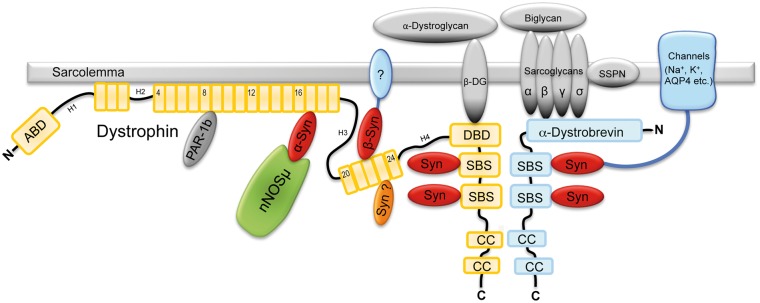
Model of syntrophin/dystrophin interactions. α-Syntrophin can bind to SLR-17 and to either C-terminal SBSs but only the α-syntrophin at SLR-17 binds nNOS. β1/β2-Syntrophins can bind to SLR-22 and to either C-terminal SBSs.

References

    1. Allen D.G., Whitehead N.P., Froehner S.C. (2016) Absence of dystrophin disrupts skeletal muscle signaling: roles of Ca2+, reactive oxygen species, and nitric oxide in the development of muscular dystrophy. Physiol. Rev., 96, 253–305. - PMC - PubMed
    1. Koenig M., Monaco A.P., Kunkel L.M. (1988) The complete sequence of dystrophin predicts a rod-shaped cytoskeletal protein. Cell, 53, 219–228. - PubMed
    1. Rybakova I.N., Amann K.J., Ervasti J.M. (1996) A new model for the interaction of dystrophin with F-actin. J. Cell Biol., 135, 661–671. - PMC - PubMed
    1. Belanto J.J., Olthoff J.T., Mader T.L., Chamberlain C.M., Nelson D.M., McCourt P.M., Talsness D.M., Gundersen G.G., Lowe D.A., Ervasti J.M. (2016) Independent variability of microtubule perturbations associated with dystrophinopathy. Hum. Mol. Genet., 25, 4951–4961. - PMC - PubMed
    1. Rezniczek G.A., Konieczny P., Nikolic B., Reipert S., Schneller D., Abrahamsberg C., Davies K.E., Winder S.J., Wiche G. (2007) Plectin 1f scaffolding at the sarcolemma of dystrophic (mdx) muscle fibers through multiple interactions with beta-dystroglycan. J. Cell Biol., 176, 965–977. - PMC - PubMed

Publication types