. 2018 Aug 1;122(2):251-265.
doi: 10.1093/aob/mcy058.

miR172 downregulates the translation of cleistogamy 1 in barley

Affiliations

miR172 downregulates the translation of cleistogamy 1 in barley

Nadia Anwar et al. Ann Bot. .

Abstract

Background and aims: Floret opening in barley is induced by the swelling of the lodicule, a trait under the control of the cleistogamy1 (cly1) gene. The product of cly1 is a member of the APETALA2 (AP2) transcription factor family, which inhibits lodicule development. A sequence polymorphism at the miR172 target site within cly1 has been associated with variation in lodicule development and hence with the cleistogamous phenotype. It was unclear whether miR172 actually functions in cly1 regulation and, if it does, which miR172 gene contributes to cleistogamy. It was also interesting to explore whether miR172-mediated cly1 regulation occurs at transcriptional level or at translational level.

Methods: Deep sequencing of small RNA identified the miR172 sequences expressed in barley immature spikes. miR172 genes were confirmed by computational and expression analysis. miR172 and cly1 expression profiles were determined by in situ hybridization and quantitative expression analysis. Immunoblot analysis provided the CLY1 protein quantifications. Definitive evidence of the role of miR172 in cleistogamy was provided by a transposon Ds-induced mutant of Hv-miR172a.

Key results: A small RNA analysis of the immature barley spike revealed three isomers, miR172a, b and c, of which miR172a was the most abundant. In situ hybridization analysis showed that miR172 and cly1 co-localize in the lodicule primordium, suggesting that these two molecules potentially interact with one another. Immunoblot analysis showed that the sequence polymorphism at the miR172 target site within cly1 reduced the abundance of the CLY1 protein, but not that of its transcript. In a Ds-induced mutant of Hv-miR172a, which generates no mature miR172a, the lodicules fail to grow, resulting in a very small lodicule.

Conclusions: Direct evidence is presented to show that miR172a acts to reduce the abundance of the CLY1 protein, which enables open flowering in barley.


Figures
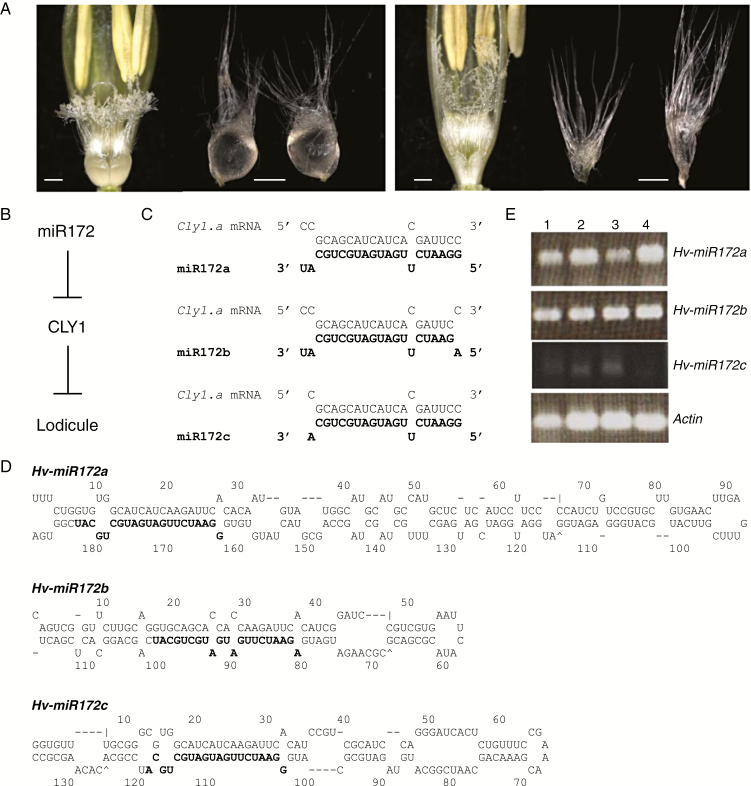
Fig. 1.
Fig. 1.
The barley inflorescence and the Hv-miR172 genes. (A) Variation in lodicule size at anthesis. (Left) AZ (non-cleistogamous). (Right) KNG (cleistogamous). Scale bar = 0.5 mm. (B) Scheme of proposed interaction between miR172 and CLY1 for lodicule development. The Cly1.a and cly1.b alleles both encode CLY1, which suppresses the development of lodicules. Expression of Cly1.a is negatively regulated by miR172, resulting in less suppression of lodicule development by CLY1. (C) Potential interactions between cly1 mRNA and miR172 isoforms in cultivar ‘Morex’. Bold letters indicate miR172 sequences that can potentially bind with cly1 mRNA sequence. (D) In silico predicted hairpin secondary structure of the miR172 precursors. Bold text indicates the mature miRNA sequence. Precursor sequence length and free folding energy (ΔG) for Hv-miR172a, b and c were, respectively, 189 nt and −92.80 kcal mol−1, 117 nt and −58.20 kcal mol−1 and 135 nt and −63.60 kcal mol−1. (E) RT–PCR-derived abundance of primary miR172s in the immature spikes at the awn primordium stage. Lane 1, AZ; lane 2, KNG; lane 3, ‘Morex’; lane 4, ‘Golden Promise’. Actin was the chosen reference sequence.
Fig. 2.
Fig. 2.
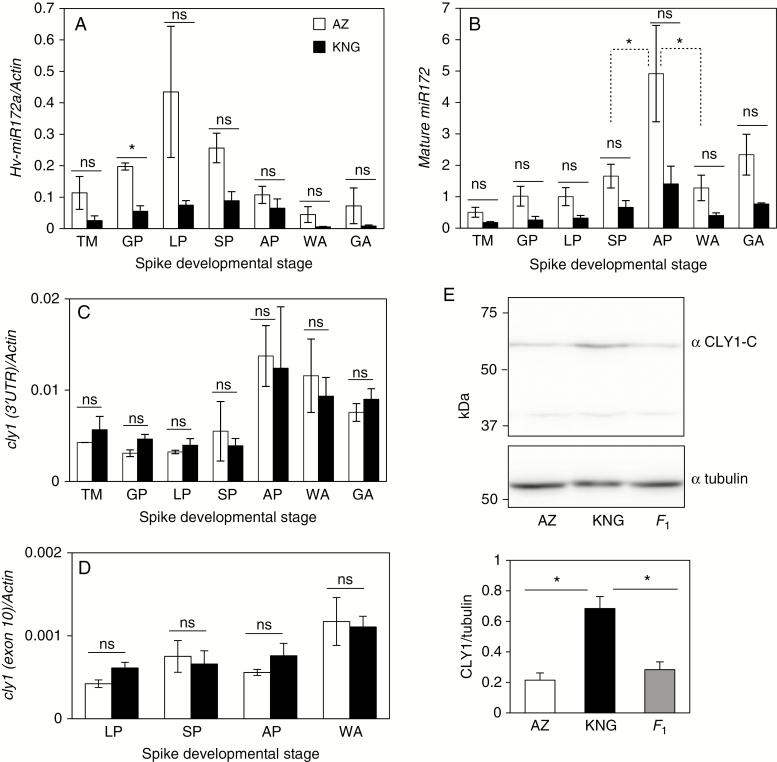
Expression of miR172 and cly1. (A–D) qRT–PCR-derived transcript abundance during spike development of (A) primary miR172a (B) mature miR172 (C) cly1 (3′-UTR) and (D) cly1 (exon 10). Actin was the chosen reference sequence. TM, triple mound stage; GP, glume primordium stage; LP, lemma primordium stage; SP, stamen primordium stage; AP awn primordium stage; WA, white anther stage; GA, green anther stage. Comparisons between SP and AP and between AP and WA for AZ are shown by the dashed lines in (B). Mean values for KNG were also significantly different between stages at the 5 % probability level. (E) CLY1 western blotting at the white anther stage (top) and abundance as determined by ratio of CLY1/tubulin abundance (bottom). α CLY1-C, anti-CLY1 C-terminal region; α tubulin, anti-tubulin. Values are mean and s.e. (n = 3 biological replications). *Means are significantly different at the 5 % probability level; ns, not significantly different.
Fig. 3.
Fig. 3.
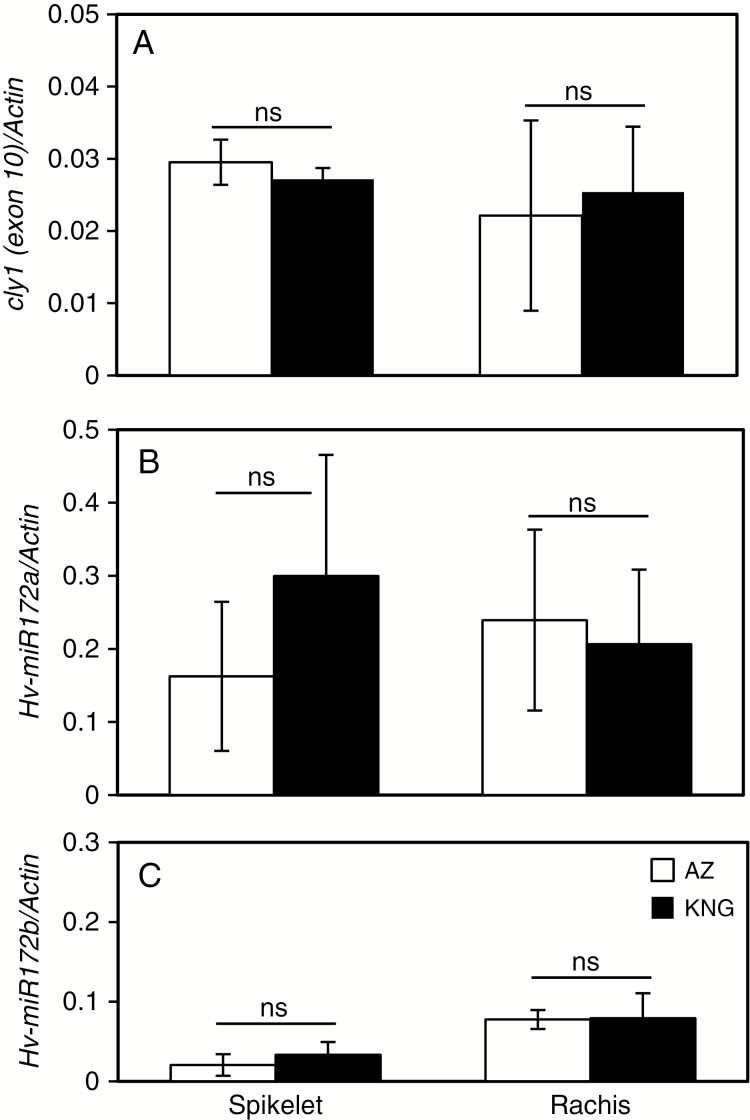
Abundance of cly1 and primary miR172 transcripts in the spikelet (flower) and rachis in immature spikes at awn primordium stage. The tissues were laser-microdissected (Supplementary Data Fig. S5). Values are mean and s.e. (n = 3 biological replications). ns, means are not significantly different at the 5 % probability level.
Fig. 4.
Fig. 4.
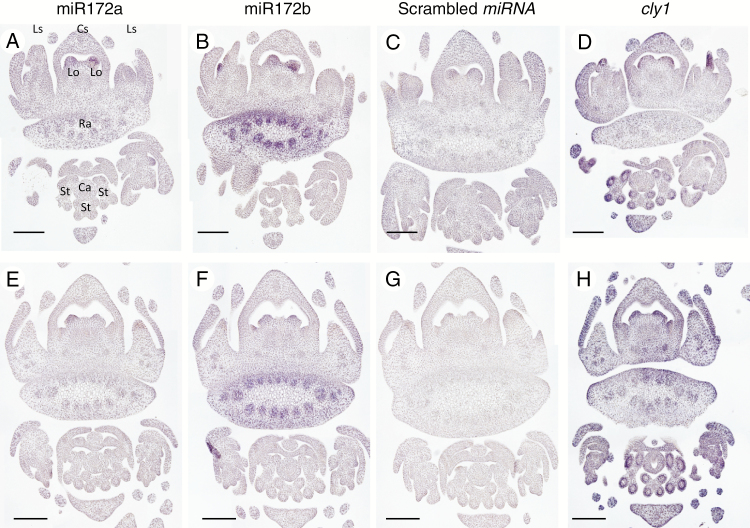
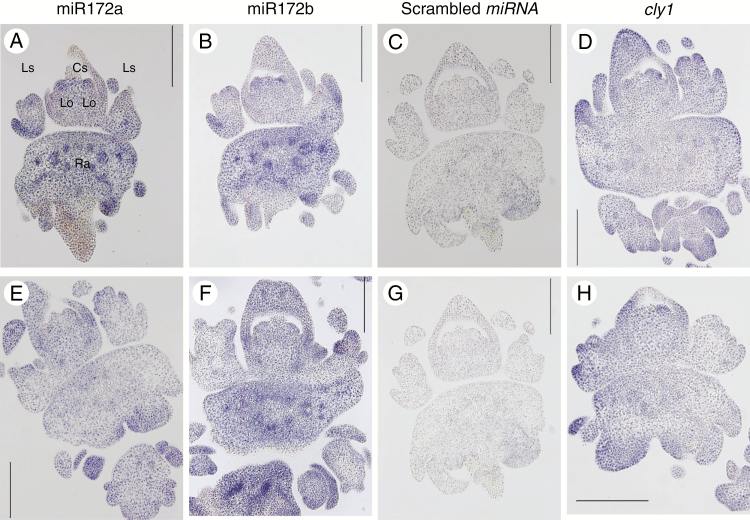
Localization of mature miR172s and cly1 by RNA in situ hybridization in the immature spike sampled at the awn primordium stage. Plant genotypes were AZ (Cly1.a) (A–D) and KNG (cly1.b) (E–H). Spike RNAs were hybridized with miR172a probe (A, E), miR172b probe (B, F), scrambled miRNA probe (negative control) (C, G) and cly1 probe (D, H). Cs, central spikelet; Ls, lateral spikelet; Lo, lodicule; Ra, rachis; Ca, carpel; St, stamen. Scale bars = 0.1 mm.
Fig. 5.
Fig. 5.
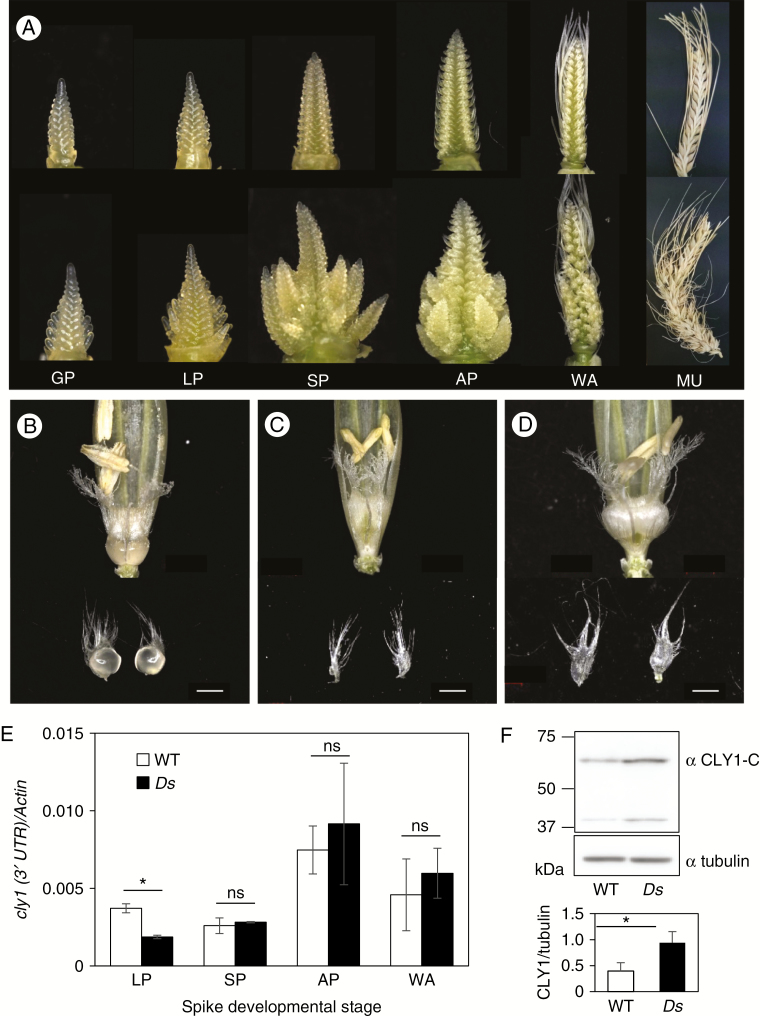
Effect of absence of miR172a on inflorescence phenotype and accumulation of CLY1. (A) miR172a/Cly1.a (top) and Ds-miR172a/Cly1.a (bottom) at stages from glume primordium (GP) to maturity (MU). LP, lemma primordium stage; SP, stamen primordium stage; AP, awn primordium stage; WA, white anther stage. (B–D) Variation in lodicule size at anthesis in (B) miR172a/Cly1.a homozygote (C) Ds-miR172a/Cly1.a homozygote and (D) miR172a/cly1.b homozygote. Scale bars = 1 mm. (E) qRT–PCR-derived transcript abundance of cly1. Actin was the reference transcript. (F) Western blot analysis of CLY1 in miR172a/Cly1.a (WT) and Ds-miR172a/Cly1.a (Ds) (top) and abundance as determined by ratio of CLY1/tubulin abundance (bottom). Values in (E) and (F) are mean and s.e. (n = 3 biological replications). *Means are significantly different at the 5 % probability level; ns, not significantly different.
Fig. 6.
Fig. 6.
Effect of absence of miR172a on accumulation of miR172 and cly1 transcripts in the immature spike sampled at the awn primordium stage. Plant genotypes were miR172a/Cly1.a (A–D) and Ds-miR172a/Cly1.a (E–H). Spike RNAs were hybridized with miR172a (A, E), miR172b (B, F), scrambled miRNA (negative control) (C, G) and cly1 (D, H). Cs, central spikelet; Ls, lateral spikelet; Lo, lodicule; Ra, rachis. Scale bars = 0.2 mm.
Fig. 7.
Fig. 7.
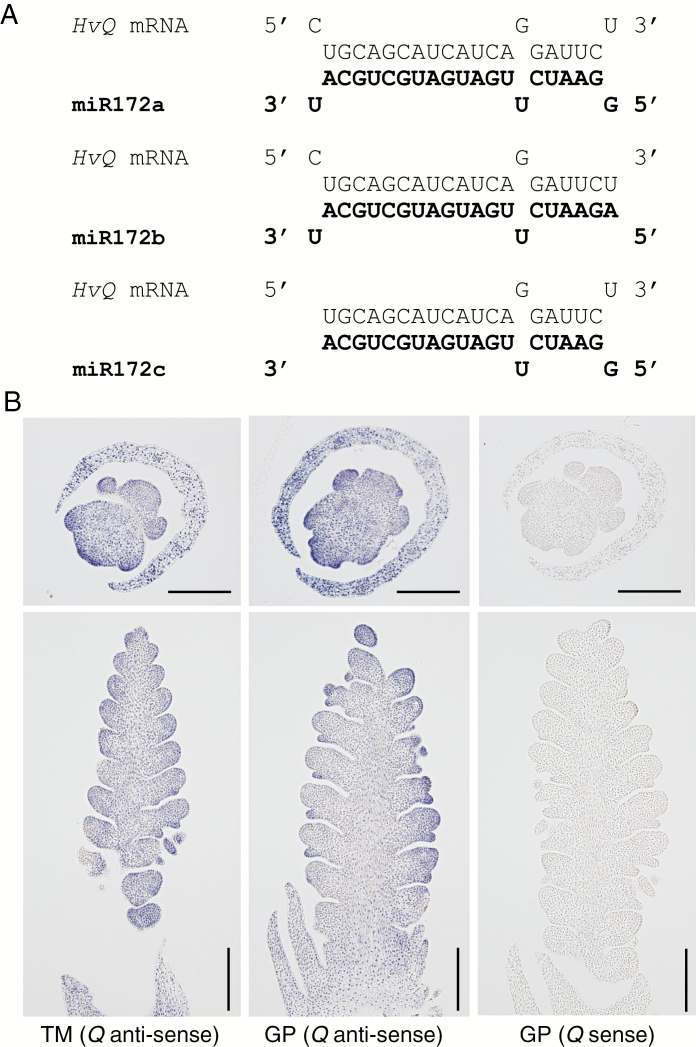
Interaction of barley Q with miR172. (A) Potential interactions between Q mRNA and miR172 isoforms (‘Morex’). (B) Localization of Q mRNA in the immature spike sampled at the triple mound (TM) and glume primordium (GP) stages in AZ, as detected by RNA in situ hybridization with an anti-sense and sense Q (3′-UTR) transcript. Scale bars = 0.2 mm in horizontal sections and 1 mm in longitudinal sections of immature spikes.
Fig. 8.
Fig. 8.
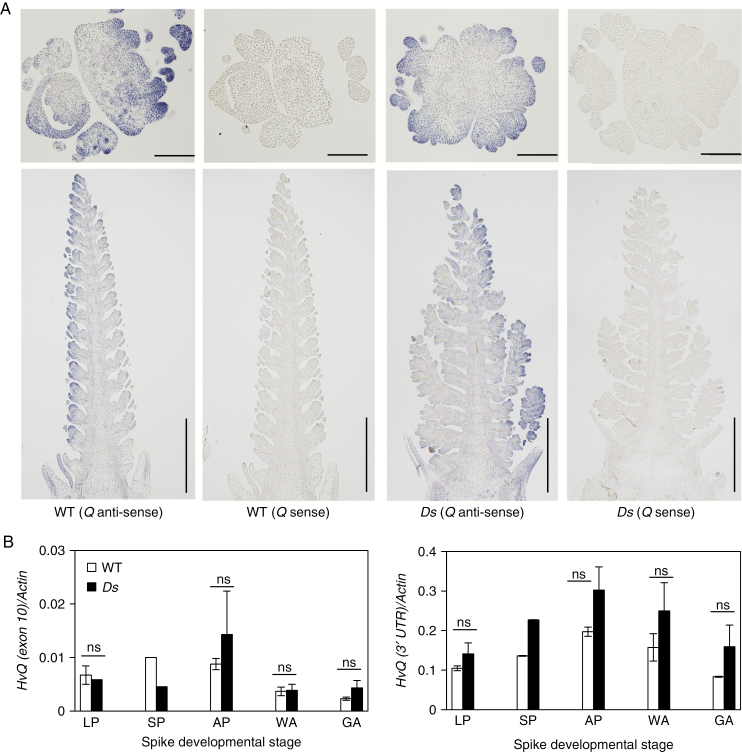
Expression of Q in immature barley spikes. (A) Localization of Q mRNA in an immature spike sampled at the awn primordium stage of WT (miR172a/Cly1) and Ds (Ds-miR172a/Cly1), as detected by in situ hybridization with an anti-sense and sense Q (3′-UTR) transcript. Scale bars = 0.2 mm in horizontal sections and 1 mm in longitudinal sections. (B) qRT–PCR-derived transcript abundance of Q during spike development in WT (miR172a/Cly1) and Ds (Ds-miR172a/Cly1). Values are mean and s.e. (n = 3 biological replications). LP, lemma primordium stage; SP, stamen primordium stage; AP, awn primordium stage; WA, white anther stage; GA, green anther stage. ns, means are not significantly different at the 5 % probability level.

References

    1. Abdel-Ghani AH, Parzies HK, Omary A, Geiger HH. 2004. Estimating the outcrossing rate of barley landraces and wild barley populations collected from ecologically different regions of Jordan. Theoretical and Applied Genetics 109: 588–595. - PubMed
    1. Ambros V, Lee RC, Lavanway A, Williams PT, Jewell D. 2003. MicroRNAs and other tiny endogenous RNAs in C. elegans. Current Biology 13: 807–818. - PubMed
    1. Aukerman MJ, Sakai H. 2003. Regulation of flowering time and floral organ identity by a microRNA and its APETALA2-like target genes. Plant Cell 15: 2730–2741. - PMC - PubMed
    1. Bartel B, Bartel DP. 2003. MicroRNAs: at the root of plant development. Plant Physiology 132: 709–717. - PMC - PubMed
    1. Bartel DP. 2004. MicroRNAs: genomics, biogenesis, mechanism, and function. Cell 116: 281–297 - PubMed

Publication types