. 2018 Jul;32(7):e13291.
doi: 10.1111/ctr.13291. Epub 2018 Jun 15.

Racial differences in completion of the living kidney donor evaluation process

Affiliations

Racial differences in completion of the living kidney donor evaluation process

Komal Kumar et al. Clin Transplant. 2018 Jul.

Abstract

Racial disparities in living donor kidney transplantation (LDKT) persist but the most effective target to eliminate these disparities remains unknown. One potential target could be delays during completion of the live donor evaluation process. We studied racial differences in progression through the evaluation process for 247 African American (AA) and 664 non-AA living donor candidates at our center between January 2011 and March 2015. AA candidates were more likely to be obese (38% vs 22%: P < .001), biologically related (66% vs 44%: P < .001), and live ≤50 miles from the center (64% vs 37%: P < .001) than non-AAs. Even after adjusting for these differences, AAs were less likely to progress from referral to donation (aHR for AA vs non-AA: 0.26 0.47 0.83; P = .01). We then assessed racial differences in completion of each step of the evaluation process and found disparities in progression from medical screening to in-person evaluation (aHR: 0.41 0.620.94; P = .02) and from clearance to donation (aHR: 0.28 0.510.91; P = .02), compared with from referral to medical screening (aHR: 0.78 1.021.33; P = .95) and from in-person evaluation to clearance (aHR: 0.59 0.931.44; P = .54). Delays may be a manifestation of the transplant candidate's social network, thus, targeted efforts to optimize networks for identification of donor candidates may help address LDKT disparities.

Keywords: donor candidates; listed candidates; living donation.


Conflict of interest statement

DISCLOSURE

The authors of this manuscript have no conflicts of interest to disclose as described by Clinical Transplantation.

Figures

Figure 1.
Figure 1.. Living donor candidate evaluation process.
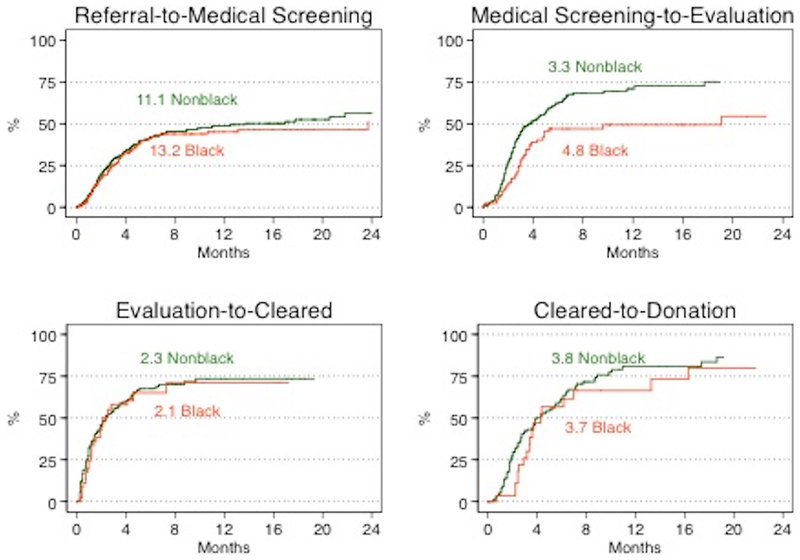
Among those who progressed to donation, the median time from referral to donation was 9.2 months (10.2 months AA vs. 8.9 months non-AA). Among those who made it to the next step, the median time from referral to medical screening was 2.2 months (2.5 months AA vs. 2.2 months non-AA), from medical screening to evaluation was 2.4 months (2.8 months AA vs. 2.3 months non-AA), from evaluation to clearance was 1.0 month (1.2 months AA vs. 0.9 months non-AA), and from clearance to transplant was 2.7 months (1.4 months AA vs. 1.0 months non-AA). Among those who were deemed ineligible, the median time from referral to donation was 4.3 months (3.7 months AA vs. 4.6 months non-AA). Among those who did not make it to the next step, the median time from referral to medical screening was 3.4 months (2.6 months AA vs. 3.7 months non-AA), from medical screening to evaluation was 3.9 months (5.3 months AA vs. 3.4 months non-AA), from evaluation to clearance was 2.9 month (4.5 months AA vs. 2.7 months non-AA), and from clearance to transplant was 3.3 months (3.0 months AA vs. 3.7 months non-AA).
Figure 2.
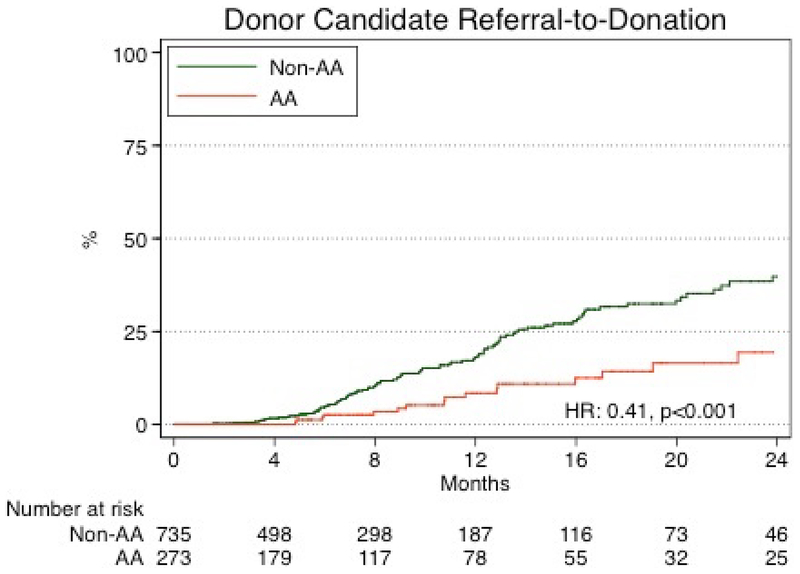
Figure 2.. Time from donor candidate referral to donation by race.
The 1-year and 2-year cumulative incidence of donation was 14% and 30% respectively. The 1-year and 2-year cumulative incidence of donation among AA donor candidates was 8.0% and 20%, respectively, in comparison to, 17% and 36% for non-AA donor candidates.
Figure 3.
Figure 3.
Time through the living donor evaluation process for donor candidates referred on behalf of a kidney transplant candidate by race and phase.

References

    1. Donors Recovered in the U.S. by Donor Type.
    1. Purnell TS, Hall YN, Boulware LE. Understanding and overcoming barriers to living kidney donation among racial and ethnic minorities in the United States. Adv Chronic Kidney Dis. 2012;19(4):244–51. - PMC - PubMed
    1. Purnell TS, Powe NR, Troll MU, Wang NY, Haywood C Jr., LaVeist TA, et al. Measuring and explaining racial and ethnic differences in willingness to donate live kidneys in the United States. Clin Transplant. 2013;27(5):673–83. - PMC - PubMed
    1. Weng FL, Reese PP, Mulgaonkar S, Patel AM. Barriers to living donor kidney transplantation among black or older transplant candidates. Clin J Am Soc Nephrol. 2010;5(12):2338–47. - PMC - PubMed
    1. Rodrigue JR. The “House Calls” Trial: A Randomized Controlled Trial to Reduce Racial Disparities in Live Donor Kidney Transplantation: Rationale and Design. Contemporary Clinical Trials. 2012;33(4). - PMC - PubMed

Publication types