. 2018 May 23;19(1):179.
doi: 10.1186/s12859-018-2212-4.

A website to identify shared genes in Saccharomyces cerevisiae homozygous deletion library screens

Affiliations

A website to identify shared genes in Saccharomyces cerevisiae homozygous deletion library screens

Mark D Temple. BMC Bioinformatics. .

Abstract

Background: The homozygous yeast deletion library includes approximately 4800 diploid strains each containing one deleted non-essential gene. Hundreds of publications have arisen through experimentation using this genome-wide biological resource. As part of this work over 677 genesets have been collated from these experiments representing the phenotypic responses of the library to a diverse set of chemical and physical challenges.

Description: A website called the Saccharomyces cerevisiae Homozygous Deletion Library Tools (ScHo DeLiTo-96) has been developed with the primary goal of browsing and identifying genes shared between these responsive phenotypes (available at yeastdb.org ). Geneset comparisons have been performed for each phenotype against all others to identify common genes. Genesets and other curated information are stored in a relational database and a website interface allows users to query and browse the data in an intuitive way to reveal commonality between selected phenotypic responses. The most commonly occurring genes in all of the stored phenotypes are highly over-represented in the GO slim term "cellular ion homeostasis" indicating that genes shared between phenotypes may highlight a common cellular response. Additionally, user derived genesets can be uploaded and intersected against the stored data to reveal common responses which may otherwise have been obscure.

Conclusion: These tools provide a simple method to perform niche enquiries between datasets derived from the yeast deletion library.

Keywords: Database; Deletion library; Saccharomyces cerevisiae; Venn intersection; Yeast.


Conflict of interest statement

Ethics approval and consent to participate

Not applicable.

Competing interests

The authors declare that they have no competing interests.

Publisher’s Note

Springer Nature remains neutral with regard to jurisdictional claims in published maps and institutional affiliations.

Figures
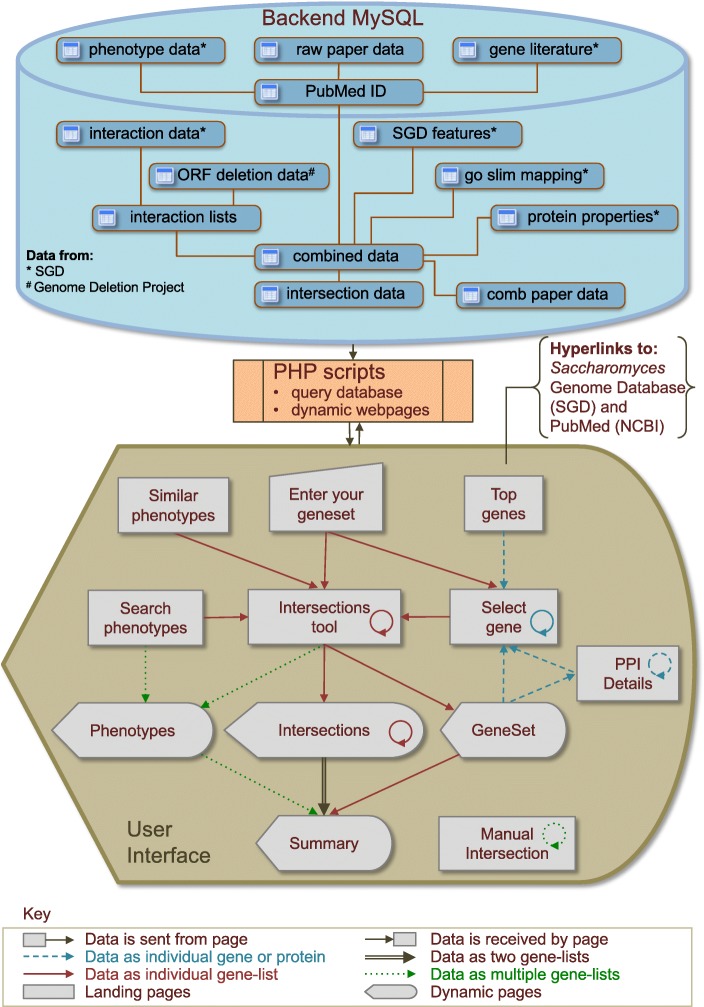
Fig. 1
Fig. 1
Workflow of the ScHo DeLiTo-96 pages. The database is compiled from various tab files curated by SGD and data curated from original publications. PHP scripts are used to pre-process these data into tables that are queried to produce the interactive webpages. Users can browse and select phenotypes or enter their own geneset through these webpages to begin intersection analyses towards identify common genes between phenotypes. Arrows indicate flow of data between webpage scripts, circular arrows indicate that data may by reloaded into the same page
Fig. 2
Fig. 2
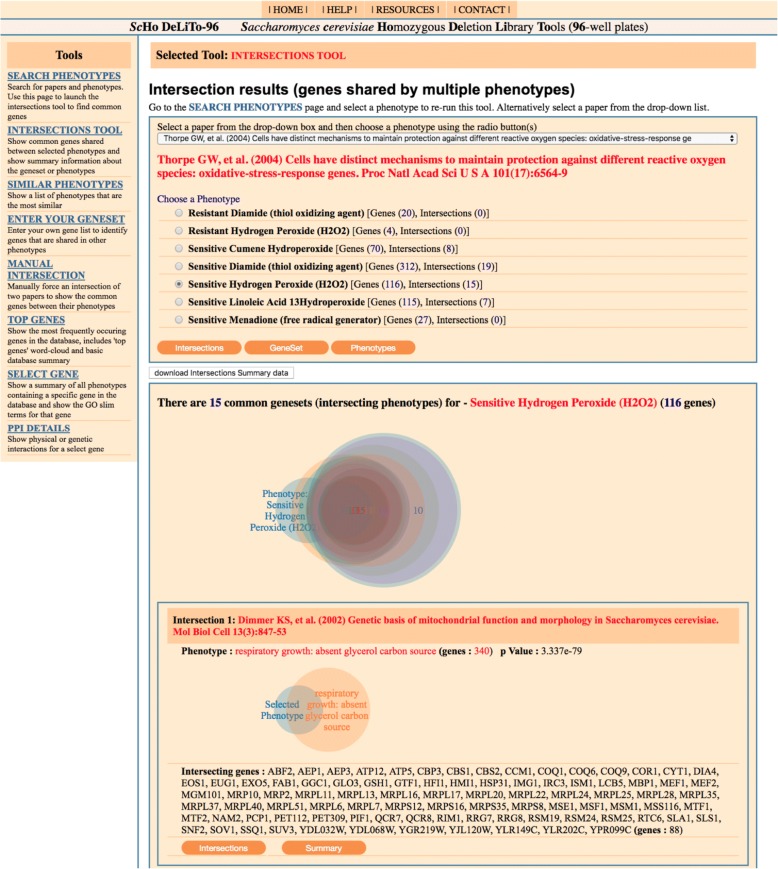
Screenshot of an enquiry from the ‘Intersections tool’ page. The selected paper reports 7 phenotypes and below these are three options (the ‘Intersections’, ‘GeneSet’ and ‘Phenotypes’ buttons) to further enquire about the selected phenotype. The page snippet shown is a result of the ‘Intersections’ option (which is shown by default). The selected ‘Sensitive Hydrogen Peroxide’ phenotype indicates that 15 other phenotypes in the database share common genes. Only the first of these is shown in the figure, having 88 common genes (from a total of 116 in the selected phenotype). Selection of the ‘GeneSet’ button provides further information itemised for each gene whereas the ‘Phenotypes’ button lists details shared across the phenotypes

References

    1. Winzeler EA, Shoemaker DD, Astromoff A, Liang H, Anderson K, Andre B, Bangham R, Benito R, Boeke JD, Bussey H, et al. Functional characterization of the S. Cerevisiae genome by gene deletion and parallel analysis. Science. 1999;285(5429):901–906. doi: 10.1126/science.285.5429.901. - DOI - PubMed
    1. Giaever G, Chu AM, Ni L, Connelly C, Riles L, Veronneau S, Dow S, Lucau-Danila A, Anderson K, Andre B, et al. Functional profiling of the Saccharomyces cerevisiae genome. Nature. 2002;418(6896):387–391. doi: 10.1038/nature00935. - DOI - PubMed
    1. Giaever G, Nislow C. The yeast deletion collection: a decade of functional genomics. Genetics. 2014;197(2):451–465. doi: 10.1534/genetics.114.161620. - DOI - PMC - PubMed
    1. Mulleder M, Capuano F, Pir P, Christen S, Sauer U, Oliver SG, Ralser M. A prototrophic deletion mutant collection for yeast metabolomics and systems biology. Nat Biotechnol. 2012;30(12):1176–1178. doi: 10.1038/nbt.2442. - DOI - PMC - PubMed
    1. Suter B, Auerbach D, Stagljar I. Yeast-based functional genomics and proteomics technologies: the first 15 years and beyond. BioTechniques. 2006;40(5):625–644. doi: 10.2144/000112151. - DOI - PubMed

Publication types

MeSH terms

Substances