


Health-related quality of life in multiple sclerosis: temperament outweighs EDSS
- PMID: 29792188
- PMCID: PMC5966924
- DOI: 10.1186/s12888-018-1719-6
Health-related quality of life in multiple sclerosis: temperament outweighs EDSS
Abstract
Background: The influence of personality on health-related quality of life in patients with multiple sclerosis has been the focus of previous studies showing that introversion and neuroticism were related with reduced health related quality of life. However, no data exist on the impact of temperament on quality of life in this patient group.
Methods: Between April 2014 and March 2016 139 multiple sclerosis patients were recruited from a specialized outpatient clinic of the general hospital of Vienna. Health-related quality of life was measured by "The Multiple Sclerosis International Quality of Life Questionnaire (MusiQol)", temperament by "Temperament Evaluation of Memphis, Pisa, Paris, and San Diego Questionnaire - Münster version" (briefTEMPS-M), and disability by the "Expanded disability status scale". All patients underwent a diagnostic psychiatric semi-structured interview (MINI).
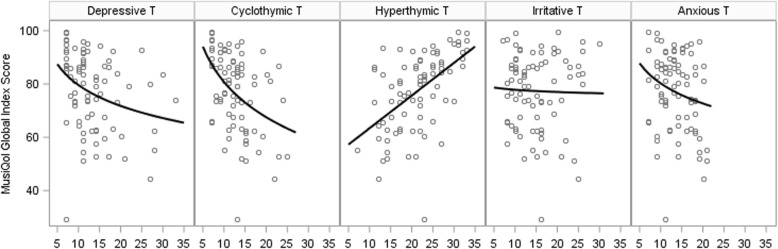
Results: Known predictors (like disease duration, EDSS, psychiatric co-morbidities, immunomodulatory treatments) explain the proportion of variation in the outcome of MusiQol global index score in 30.9% in multi-variable linear regression analysis. It increased respectively to 40.3, 42.5, and 45.8% if adding the depressive, cyclothymic, or hyperthymic temperament to the list of variables. An increase of depressive and cyclothymic temperament scores significantly reduced global index score of MusiQol (p = 0.005, p = 0.002, respectively), while the hyperthymic temperament significantly raised it (p < 0.001).
Conclusion: In MS patients, the depressive and cyclothymic temperament predict a lower and hyperthymic temperament an increased health-related quality of life, independent of current disability status, immunomodulatory treatments, and affective co-morbidities.
Keywords: Health-related quality of life; Multiple sclerosis; MusiQol; TEMPS; Temperament.
Conflict of interest statement
Ethics approval and consent to participate
The study was approved by the ethics committee of the Medical University of Vienna (EK1715/2013) and all patients gave written informed consent to participate. The study was conducted under the terms and conditions of the Declaration of Helsinki.
Competing interests
The authors declare that they have no competing interests.
Publisher’s Note
Springer Nature remains neutral with regard to jurisdictional claims in published maps and institutional affiliations.
Figures
Similar articles
-
The influence of affective temperaments and psychopathological traits on the definition of bipolar disorder subtypes: a study on bipolar I Italian national sample.J Affect Disord. 2012 Jan;136(1-2):e41-e49. doi: 10.1016/j.jad.2009.12.027. Epub 2010 Feb 2. J Affect Disord. 2012. PMID: 20129674
-
Studies on a German (Münster) version of the temperament auto-questionnaire TEMPS-A: construction and validation of the briefTEMPS-M.J Affect Disord. 2005 Mar;85(1-2):53-69. doi: 10.1016/S0165-0327(03)00102-2. J Affect Disord. 2005. PMID: 15780676
-
TEMPS-A (Rome): psychometric validation of affective temperaments in clinically well subjects in mid- and south Italy.J Affect Disord. 2008 Apr;107(1-3):63-75. doi: 10.1016/j.jad.2007.07.031. Epub 2007 Sep 19. J Affect Disord. 2008. PMID: 17884175
-
A comparative meta-analysis of TEMPS scores across mood disorder patients, their first-degree relatives, healthy controls, and other psychiatric disorders.J Affect Disord. 2016 May 15;196:32-46. doi: 10.1016/j.jad.2016.02.013. Epub 2016 Feb 12. J Affect Disord. 2016. PMID: 26897455 Review.
-
Quality of life in multiple sclerosis.J Med Life. 2010 Oct-Dec;3(4):352-8. J Med Life. 2010. PMID: 21254730 Free PMC article. Review.
Cited by
-
Age, motor dysfunction and neuropsychiatric symptoms impact quality of life in multiple sclerosis.Rev Bras Enferm. 2022 Jun 6;75(6):e20210207. doi: 10.1590/0034-7167-2021-0207. eCollection 2022. Rev Bras Enferm. 2022. PMID: 35674578 Free PMC article.
-
Importance of Coping Strategies on Quality of Life in People with Multiple Sclerosis: A Systematic Review.J Clin Med. 2024 Sep 18;13(18):5505. doi: 10.3390/jcm13185505. J Clin Med. 2024. PMID: 39336991 Free PMC article. Review.
-
Health-related Quality of Life of People with Multiple Sclerosis in Oman.Oman Med J. 2021 Nov 15;36(6):e318. doi: 10.5001/omj.2021.109. eCollection 2021 Nov. Oman Med J. 2021. PMID: 34804600 Free PMC article.
-
Quality of life in adults with multiple sclerosis: a systematic review.BMJ Open. 2020 Nov 30;10(11):e041249. doi: 10.1136/bmjopen-2020-041249. BMJ Open. 2020. PMID: 33257490 Free PMC article.
-
Transdiagnostic treatment of emotional disorders for women with multiple sclerosis: a randomized controlled trial.BMC Womens Health. 2020 Oct 31;20(1):245. doi: 10.1186/s12905-020-01109-z. BMC Womens Health. 2020. PMID: 33129298 Free PMC article. Clinical Trial.
References
-
- Benedict RH, Wahlig E, Bakshi R, Fishman I, Munschauer F, Zivadinov R, et al. Predicting quality of life in multiple sclerosis: accounting for physical disability, fatigue, cognition, mood disorder, personality, and behavior change. J Neurol Sci. 2005;231(1–2):29–34. doi: 10.1016/j.jns.2004.12.009. - DOI - PubMed
Publication types
MeSH terms
LinkOut - more resources
Full Text Sources
Other Literature Sources
Medical
Miscellaneous
