


Associations of discretionary screen time with mortality, cardiovascular disease and cancer are attenuated by strength, fitness and physical activity: findings from the UK Biobank study
- PMID: 29792209
- PMCID: PMC5966877
- DOI: 10.1186/s12916-018-1063-1
Associations of discretionary screen time with mortality, cardiovascular disease and cancer are attenuated by strength, fitness and physical activity: findings from the UK Biobank study
Abstract
Background: Discretionary screen time (time spent viewing a television or computer screen during leisure time) is an important contributor to total sedentary behaviour, which is associated with increased risk of mortality and cardiovascular disease (CVD). The aim of this study was to determine whether the associations of screen time with cardiovascular disease and all-cause mortality were modified by levels of cardiorespiratory fitness, grip strength or physical activity.
Methods: In total, 390,089 participants (54% women) from the UK Biobank were included in this study. All-cause mortality, CVD and cancer incidence and mortality were the main outcomes. Discretionary television (TV) viewing, personal computer (PC) screen time and overall screen time (TV + PC time) were the exposure variables. Grip strength, fitness and physical activity were treated as potential effect modifiers.
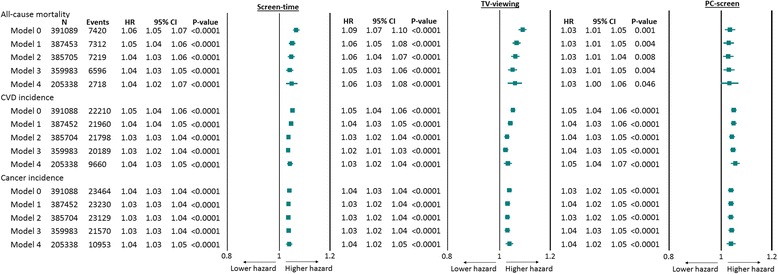
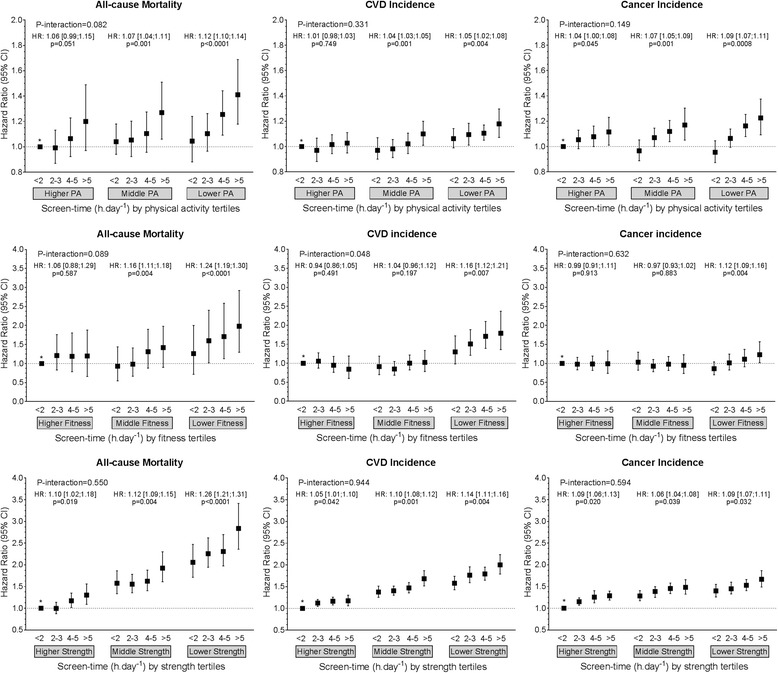
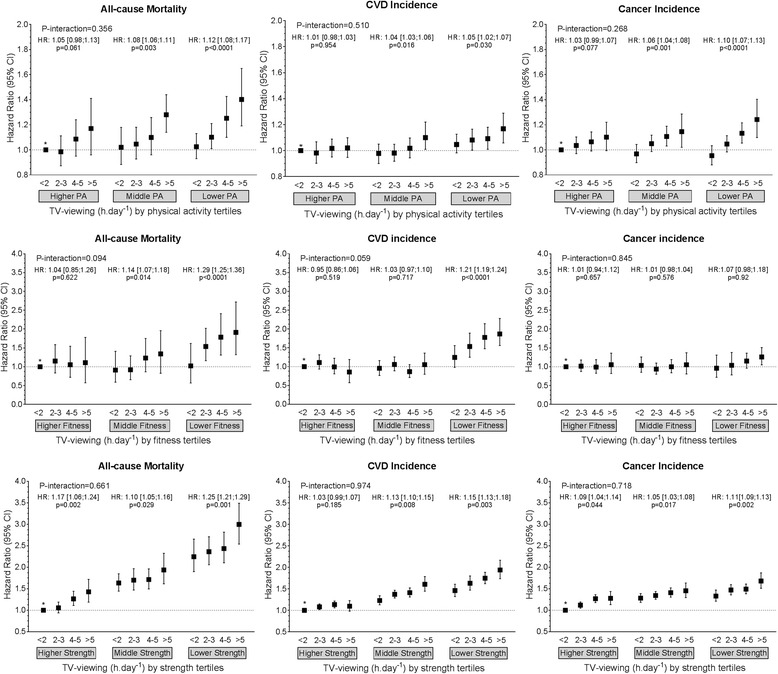
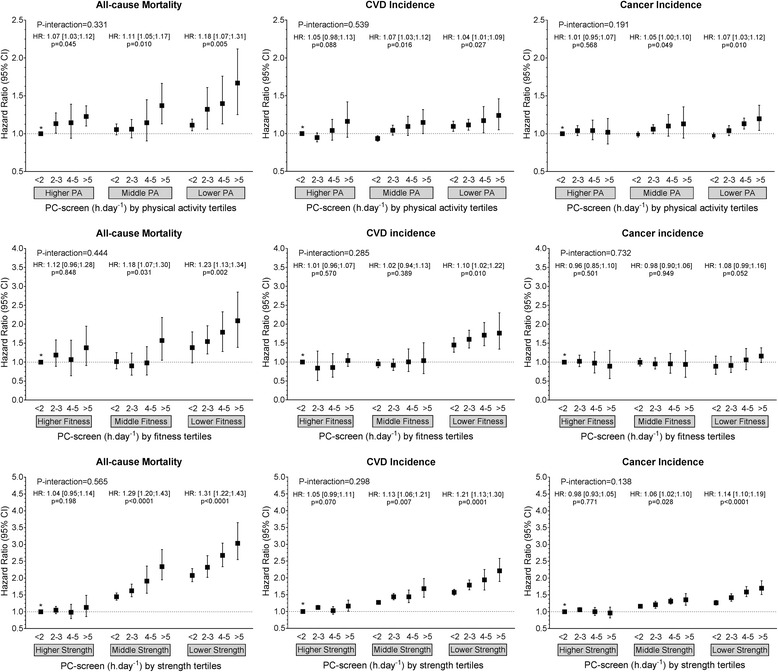
Results: Altogether, 7420 participants died, and there were 22,210 CVD events, over a median of 5.0 years follow-up (interquartile range 4.3 to 5.7; after exclusion of the first 2 years from baseline in the landmark analysis). All discretionary screen-time exposures were significantly associated with all health outcomes. The associations of overall discretionary screen time with all-cause mortality and incidence of CVD and cancer were strongest amongst participants in the lowest tertile for grip strength (all-cause mortality hazard ratio per 2-h increase in screen time (1.31 [95% confidence interval: 1.22-1.43], p < 0.0001; CVD 1.21 [1.13-1.30], p = 0.0001; cancer incidence 1.14 [1.10-1.19], p < 0.0001) and weakest amongst those in the highest grip-strength tertile (all-cause mortality 1.04 [0.95-1.14], p = 0.198; CVD 1.05 [0.99-1.11], p = 0.070; cancer 0.98 [0.93-1.05], p = 0.771). Similar trends were found for fitness (lowest fitness tertile: all-cause mortality 1.23 [1.13-1.34], p = 0.002 and CVD 1.10 [1.02-1.22], p = 0.010; highest fitness tertile: all-cause mortality 1.12 [0.96-1.28], p = 0.848 and CVD 1.01 [0.96-1.07], p = 0.570). Similar findings were found for physical activity for all-cause mortality and cancer incidence.
Conclusions: The associations between discretionary screen time and adverse health outcomes were strongest in those with low grip strength, fitness and physical activity and markedly attenuated in those with the highest levels of grip strength, fitness and physical activity. Thus, if these associations are causal, the greatest benefits from health promotion interventions to reduce discretionary screen time may be seen in those with low levels of strength, fitness and physical activity.
Keywords: Cardiovascular; Fitness; Mortality; Physical activity; Screen time; Screen-time; Strength.
Conflict of interest statement
Ethics approval and consent to participate
The UK Biobank study was approved by the North West Multi-Centre Research Ethics Committee (reference for UK Biobank is 16/NW/0274) and all participants provided written informed consent to participate in the UK Biobank study. The study protocol is available online (
Competing interests
The authors declare that they have no competing interests.
Publisher’s Note
Springer Nature remains neutral with regard to jurisdictional claims in published maps and institutional affiliations.
Figures
References
-
- Wilmot EG, Edwardson CL, Achana FA, Davies MJ, Gorely T, Gray LJ, Khunti K, Yates T, Biddle SJH. Sedentary time in adults and the association with diabetes, cardiovascular disease and death: systematic review and meta-analysis. Diabetologia. 2012;55(11):2895–2905. doi: 10.1007/s00125-012-2677-z. - DOI - PubMed
-
- Kodama S, Saito K, Tanaka S, Maki M, Yachi Y, Asumi M, Sugawara A, Totsuka K, Shimano H, Ohashi Y, et al. Cardiorespiratory Fitness as a Quantitative Predictor of All-Cause Mortality and Cardiovascular Events in Healthy Men and Women A Meta-analysis. JAMA. 2009;301(19):2024–2035. doi: 10.1001/jama.2009.681. - DOI - PubMed
Publication types
MeSH terms
Grants and funding
LinkOut - more resources
Full Text Sources
Other Literature Sources
Medical
Molecular Biology Databases
