. 2018 Jun 28;61(12):5269-5278.
doi: 10.1021/acs.jmedchem.8b00204. Epub 2018 Jun 15.

Docking Screens for Dual Inhibitors of Disparate Drug Targets for Parkinson's Disease

Affiliations

Docking Screens for Dual Inhibitors of Disparate Drug Targets for Parkinson's Disease

Mariama Jaiteh et al. J Med Chem. .

Abstract

Modulation of multiple biological targets with a single drug can lead to synergistic therapeutic effects and has been demonstrated to be essential for efficient treatment of CNS disorders. However, rational design of compounds that interact with several targets is very challenging. Here, we demonstrate that structure-based virtual screening can guide the discovery of multi-target ligands of unrelated proteins relevant for Parkinson's disease. A library with 5.4 million molecules was docked to crystal structures of the A2A adenosine receptor (A2AAR) and monoamine oxidase B (MAO-B). Twenty-four compounds that were among the highest ranked for both binding sites were evaluated experimentally, resulting in the discovery of four dual-target ligands. The most potent compound was an A2AAR antagonist with nanomolar affinity ( Ki = 19 nM) and inhibited MAO-B with an IC50 of 100 nM. Optimization guided by the predicted binding modes led to the identification of a second potent dual-target scaffold. The two discovered scaffolds were shown to counteract 6-hydroxydopamine-induced neurotoxicity in dopaminergic neuronal-like SH-SY5Y cells. Structure-based screening can hence be used to identify ligands with specific polypharmacological profiles, providing new avenues for drug development against complex diseases.


Conflict of interest statement

The authors declare no competing financial interest.

Figures
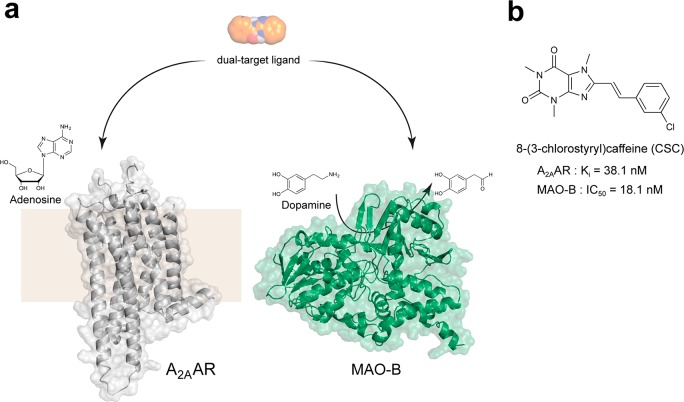
Figure 1
Figure 1
Targets for development of dual-target antiparkinson agents. (a) Crystal structures of the A2AAR (gray) and MAO-B (green) are shown as cartoons together with 2D representations of adenosine and dopamine. (b) 2D representation of CSC, a dual-target A2AAR and MAO-B inhibitor.
Figure 2
Figure 2
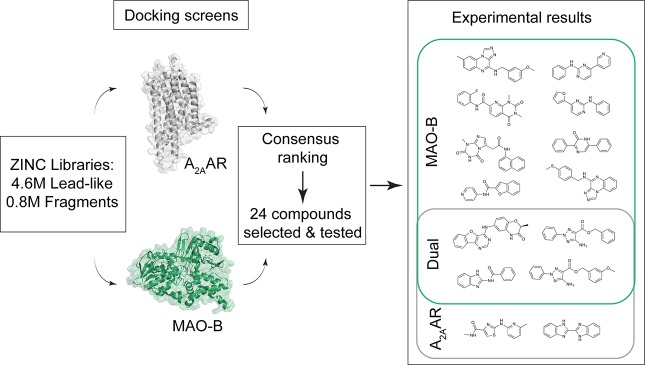
Overview of the structure-based screen for dual-target A2AAR/MAO-B ligands. The ZINC lead-like and fragment libraries were screened against A2AAR (gray) and MAO-B (green) crystal structures. Twenty-four top-ranked molecules were selected for experimental evaluation. Twelve and six compounds showed activity at MAO-B and A2AAR, respectively, and four of these displayed dual-activity (Table 1 and Table S4).
Figure 3
Figure 3
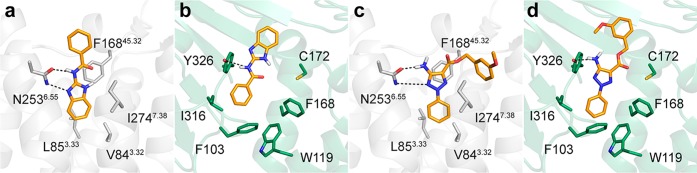
Predicted binding modes of two dual-target ligands: the docking poses of compounds 1 (a, b) and 3 (c, d) in the A2AAR (gray cartoon, PDB code 3PWH(27)) and MAO-B binding sites (green cartoon, PDB code 2V61(28)). Key binding site residues and the ligands are shown in sticks. Hydrogen bonds are shown as black dashed lines.
Figure 4
Figure 4
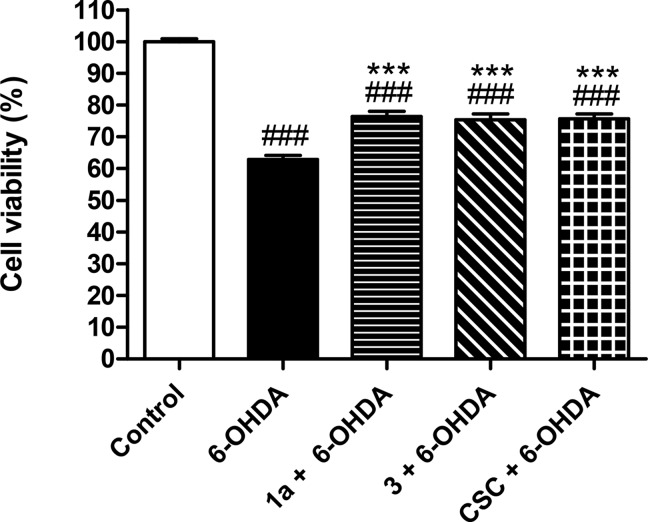
Viability assessment on human dopaminergic neuronal-like cells treated with 6-OHDA toxin. Cells were treated with 0.15 μM 1a, 3, or CSC for 3 h prior to addition of 20 μM 6-OHDA. After 24 h, resazurin was added for another 2 h, whereupon cell viability was assayed. Data are shown as the mean ± SEM and were analyzed using one-way ANOVA with Newman–Keuls multiple comparison test: (###) p < 0.001 versus control and (∗∗∗) p < 0.001 versus 6-OHDA alone.
Figure 5
Figure 5
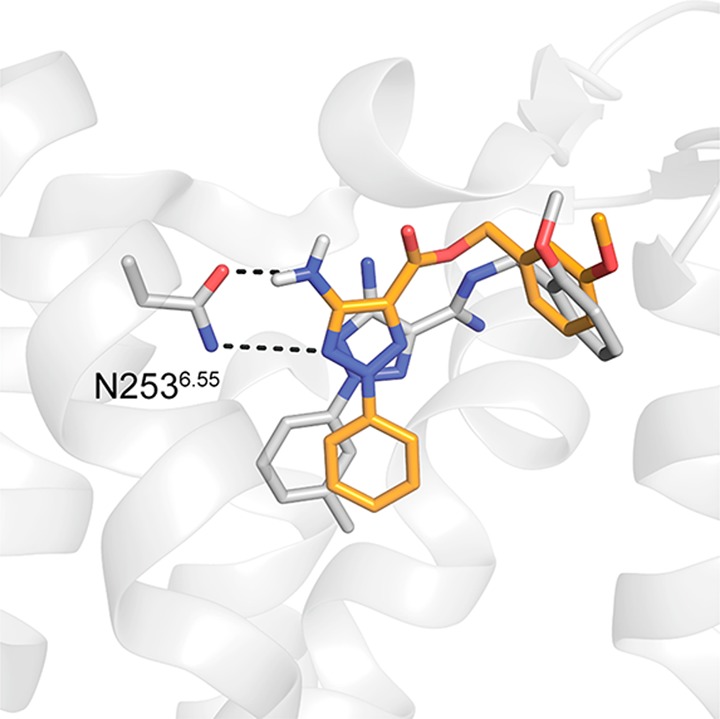
Comparison of the predicted binding mode of compound 3 to a crystal structure of a related antagonist in complex with the A2AAR. The dual-target ligand 3 is shown as sticks with orange carbon atoms. The cocrystallized antagonist (PDB code 5UIG(46)) is depicted in sticks with gray carbon atoms. The A2AAR is depicted as gray cartoons. Hydrogen bonds are shown as black dashed lines.

References

    1. Rang H. P. The Receptor Concept: Pharmacology’s Big Idea. Br. J. Pharmacol. 2006, 147, S9–S16. 10.1038/sj.bjp.0706457. - DOI - PMC - PubMed
    1. Roth B. L.; Sheffler D. J.; Kroeze W. K. Magic Shotguns versus Magic Bullets: Selectively Non-Selective Drugs for Mood Disorders and Schizophrenia. Nat. Rev. Drug Discovery 2004, 3, 353–359. 10.1038/nrd1346. - DOI - PubMed
    1. Anighoro A.; Bajorath J.; Rastelli G. Polypharmacology: Challenges and Opportunities in Drug Discovery. J. Med. Chem. 2014, 57, 7874–7887. 10.1021/jm5006463. - DOI - PubMed
    1. Cavalli A.; Bolognesi M. L.; Mìnarini A.; Rosini M.; Tumiatti V.; Recanatini M.; Melchiorre C. Multi-Target-Directed Ligands to Combat Neurodegenerative Diseases. J. Med. Chem. 2008, 51, 347–372. 10.1021/jm7009364. - DOI - PubMed
    1. Blair H. A.; Dhillon S. Safinamide: A Review in Parkinson’s Disease. CNS Drugs 2017, 31, 169–176. 10.1007/s40263-017-0408-1. - DOI - PubMed

Publication types

MeSH terms