


Cartilage calcification of the ankle joint is associated with osteoarthritis in the general population
- PMID: 29793463
- PMCID: PMC5968601
- DOI: 10.1186/s12891-018-2094-7
Cartilage calcification of the ankle joint is associated with osteoarthritis in the general population
Abstract
Background: Cartilage calcification (CC) is associated with osteoarthritis (OA) in weight-bearing joints, such as the hip and the knee. However, little is known about the impact of CC and degeneration on other weight-bearing joints, especially as it relates to the occurrence of OA in the ankles. The goal of this study is to analyse the prevalence of ankle joint cartilage calcification (AJ CC) and to determine its correlation with factors such as histological OA grade, age and BMI in the general population.
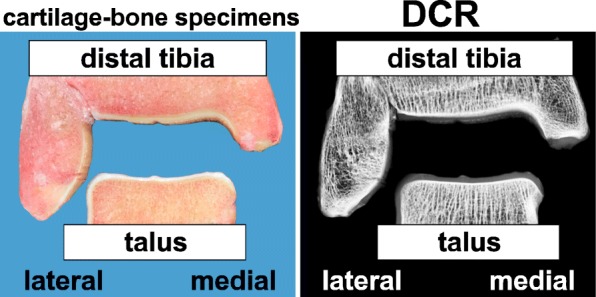
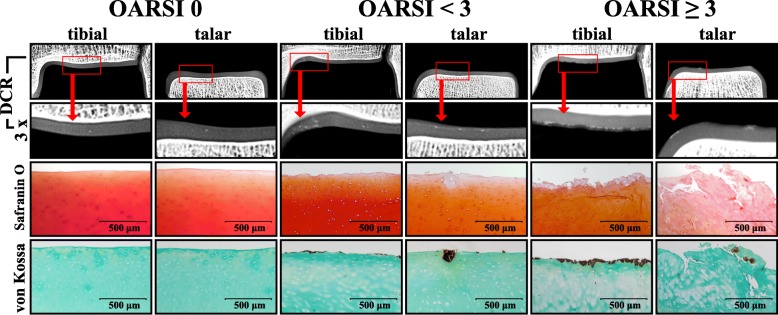
Methods: CC of the distal tibia and talus in 160 ankle joints obtained from 80 donors (mean age 62.4 years, 34 females, 46 males) was qualitatively and quantitatively analysed using high-resolution digital contact radiography (DCR). Correlations with factors, such as the joint's histological OA grade (OARSI score), donor's age and BMI, were investigated.
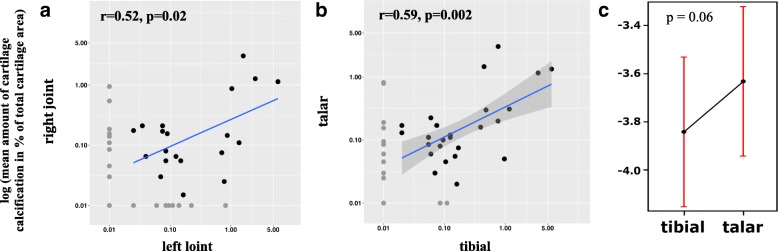
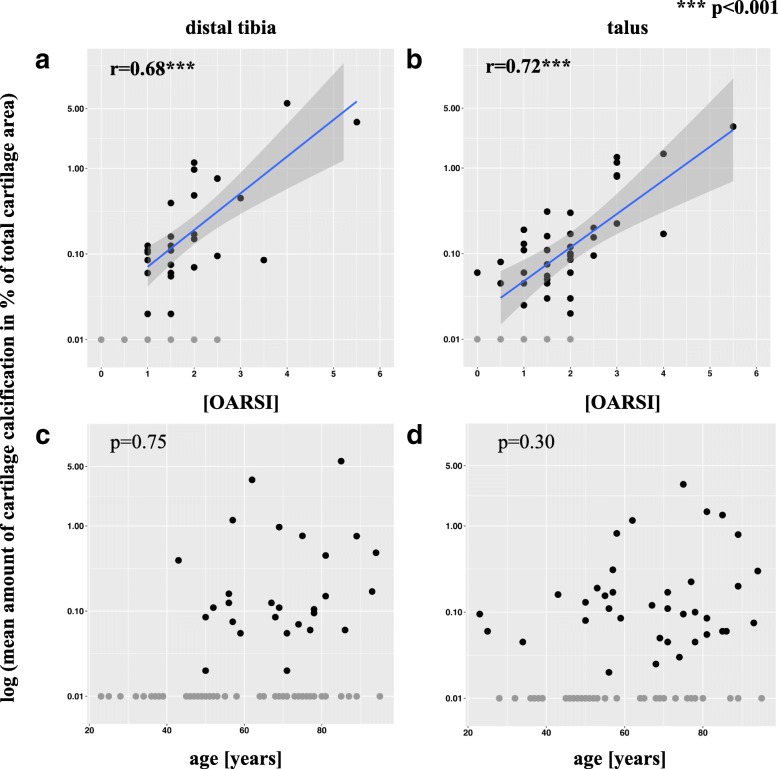
Results: The prevalence of AJ CC was 51.3% (95% CI [0.40, 0.63]), independent of gender (p = 0.18) and/or the joint's side (p = 0.82). CC of the distal tibia was detected in 35.0% (28/80) (95% CI [0.25, 0.47]) and talar CC in 47.5% (38/80) (95% CI [0.36, 0.59]) of all cases. Significant correlations were noted between the mean amount of tibial and talar CC (r = 0.59, p = 0.002), as well as between the mean amount of CC observed in one ankle joint with that of the contralateral side (r = 0.52, p = 0.02). Furthermore, although the amount of AJ CC observed in the distal tibia and talus correlated with the histological OA-grade of the joint (r = 0.70, p < 0.001 and r = 0.72, p < 0.001, respectively), no such correlation was seen in the general population with relation to age (p = 0.32 and p = 0.49) or BMI (p = 0.51 and p = 0.87).
Conclusion: The prevalence of AJ CC in the general population is much higher than expected. The relationship between the amount of AJ CC and OA, independent of the donors' age and BMI, indicates that CC may play a causative role in the development of OA in ankles.
Keywords: Ankle joint; Calcium crystals; Cartilage; Cartilage calcification; Chondrocalcinosis; Osteoarthritis.
Conflict of interest statement
Ethics approval and consent to participate
This cross-sectional study was approved by the Ethics Committee of the Medical Association Hamburg, Germany (Ärztekammer Hamburg, PV 4570), and was carried out in accordance with existing regulations set by the University Medical Center Hamburg-Eppendorf. Written informed consent for the removal and use of joints for scientific purposes was obtained from the family members.
Competing interests
All authors have disclosed all financial and personal relationships that could potentially and inappropriately influence this work. The authors declare that they have no competing interests.
Publisher’s Note
Springer Nature remains neutral with regard to jurisdictional claims in published maps and institutional affiliations.
Figures
References
-
- Felson DT. The epidemiology of osteoarthritis: prevalence and risk factors. In: Kuettner KE, Goldberg VM, editors. Osteoarthritis Disorders. Rosemont, IL: American Academy Orthopedic Surgeons; 1995. p. 13e24.
-
- Peyron JG. The epidemiology of osteoarthritis. In: Moskowitz RW, Howell DS, Goldberg VM, Mankin HJ, editors. Osteoarthritis. Diagnosis and Treatment. Philadelphia, PA: WB Saunders; 1984. pp. 9–27.
-
- Lindsjö U. Operative treatment of ankle fracture-dislocations: a follow-up study of 306/321 consecutive cases. Clin Orthop Relat Res. 1985;199:28–38. - PubMed
MeSH terms
LinkOut - more resources
Full Text Sources
Other Literature Sources
Medical
