


The long-term economic impacts of arthritis through lost productive life years: results from an Australian microsimulation model
- PMID: 29793478
- PMCID: PMC5968603
- DOI: 10.1186/s12889-018-5509-3
The long-term economic impacts of arthritis through lost productive life years: results from an Australian microsimulation model
Abstract
Background: While the direct (medical) costs of arthritis are regularly reported in cost of illness studies, the 'true' cost to indivdiuals and goverment requires the calculation of the indirect costs as well including lost productivity due to ill-health.
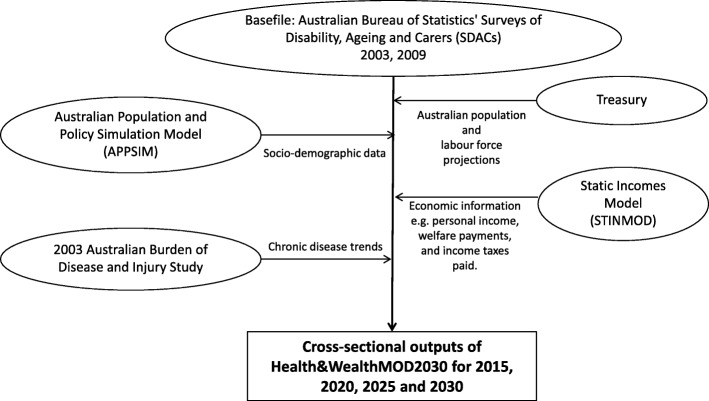
Methods: Respondents aged 45-64 in the ABS Survey of Disability, Ageing and Carers 2003, 2009 formed the base population. We projected the indirect costs of arthritis using Health&WealthMOD2030 - Australia's first microsimulation model on the long-term impacts of ill-health in older workers - which incorporated outputs from established microsimulation models (STINMOD and APPSIM), population and labour force projections from Treasury, and chronic conditions trends for Australia. All costs of arthritis were expressed in real 2013 Australian dollars, adjusted for inflation over time.
Results: We estimated there are 54,000 people aged 45-64 with lost PLYs due to arthritis in 2015, increasing to 61,000 in 2030 (13% increase). In 2015, people with lost PLYs are estimated to receive AU$706.12 less in total income and AU$311.67 more in welfare payments per week than full-time workers without arthritis, and pay no income tax on average. National costs include an estimated loss of AU$1.5 billion in annual income in 2015, increasing to AU$2.4 billion in 2030 (59% increase). Lost annual taxation revenue was projected to increase from AU$0.4 billion in 2015 to $0.5 billion in 2030 (56% increase). We projected a loss in GDP of AU$6.2 billion in 2015, increasing to AU$8.2 billion in 2030.
Conclusions: Significant costs of arthritis through lost PLYs are incurred by individuals and government. The effectiveness of arthritis interventions should be judged not only on healthcare use but quality of life and economic wellbeing.
Keywords: Arthritis; Arthritis management; GDP; Income; Indirect costs; Labour force participation; Microsimulation; Taxation; Welfare payments.
Conflict of interest statement
Ethics approval and consent to participate
Use of SDACs 2003 and 2009 were approved by the ABS Microdata Review Panel. Data used in this study are de-identified data, and survey respondents have consented to participating in the national surveys.
The data used in this study are from Health&WealthMOD2030, a microsimulation model assembled by the authors from the SDACs 2003 and 2009, STINMOD, APPSIM, population and labour force growth data from Treasury and disease trends data from the 2003 Australian Burden of Disease and Injury Study. The SDACs 2003 and 2009 are openly available through the Australian Bureau of Statistics.
Competing interests
The authors declare that they have no competing interests.
Publisher’s Note
Springer Nature remains neutral with regard to jurisdictional claims in published maps and institutional affiliations.
Figures
References
-
- Global Burden of Disease Study 2013 Collaborators Global, regional, and national incidence, prevalence, and years lived with disability for 301 acute and chronic diseases and injuries in 188 countries, 1990–2013: a systematic analysis for the global burden of disease study 2013. Lancet. 2015;386(9995):743–800. doi: 10.1016/S0140-6736(15)60692-4. - DOI - PMC - PubMed
-
- Commonwealth of Australia . 2015 intergenerational report: Australia in 2055. Canberra: The Commonwealth of Australia; 2015.
-
- Bere RC, Bucerzan I. Cluster analysis on cohesion policy towards Europe 2020 strategy for smart, sustainable and inclusive growth. Rom Stat Rev. 2015;63(4):95–111.
-
- Access Economics Pty Ltd for Arthritis Australia . Painful realities: the economic impact of arthritis in Australia. Adelaide: Arthritis Australia; 2007.
MeSH terms
Grants and funding
LinkOut - more resources
Full Text Sources
Other Literature Sources
Medical
