Review
. 2018 May 24;6(1):94.
doi: 10.1186/s40168-018-0485-5.

The contribution of culturomics to the repertoire of isolated human bacterial and archaeal species

Affiliations
Review

The contribution of culturomics to the repertoire of isolated human bacterial and archaeal species

Melhem Bilen et al. Microbiome. .

Abstract

After a decade of research and metagenomic analyses, our knowledge of the human microbiota appears to have reached a plateau despite promising results. In many studies, culture has proven to be essential in describing new prokaryotic species and filling metagenomic gaps. In 2015, only 2172 different prokaryotic species were reported to have been isolated at least once from the human body as pathogens or commensals. In this review, we update the previous repertoire by reporting the different species isolated from the human body to date, increasing it by 28% to reach a total of 2776 species associated with human beings. They have been classified into 11 different phyla, mostly the Firmicutes, Proteobacteria, Bacteroidetes, and Actinobacteria. Finally, culturomics contributed up to 66.2% towards updating this repertoire by reporting 400 species, of which 288 were novel. This demonstrates the need to continue the culturing work, which seems essential in order to decipher the hidden human microbial content.

Keywords: Culturomics; Gut; Human microbiota; Isolation; New species; Prokaryotes.


Conflict of interest statement

Ethics approval and consent to participate

Not applicable.

Competing interests

The authors declare that they have no competing interests.

Publisher’s Note

Springer Nature remains neutral with regard to jurisdictional claims in published maps and institutional affiliations.

Figures
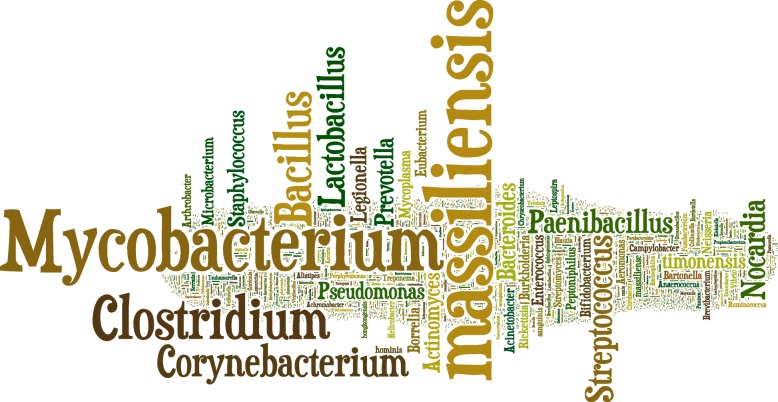
Fig. 1
Fig. 1
All 2776 species isolated at least once from humans by culture. Using the online tool wordle (www.wordle.net), the size of the name of each species is proportional to the number of times it occurs in the repertoire
Fig. 2
Fig. 2
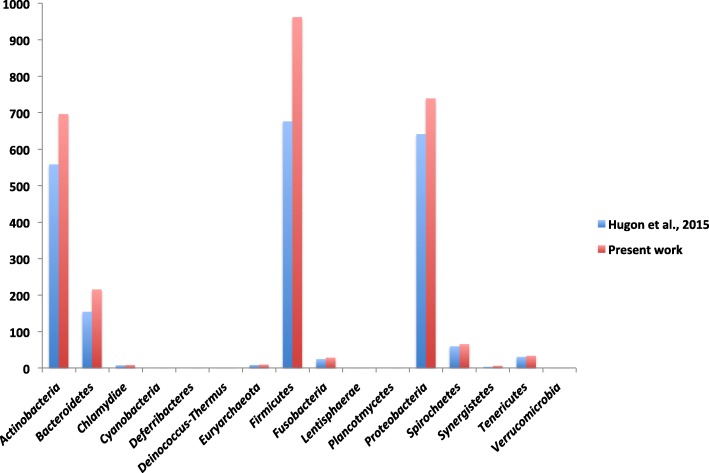
Distribution of bacterial species reported in this repertoire according to their phylum, based on the NCBI taxonomy classification with the highest category being clustered in the Firmicutes phylum. Cyanobacteria, Deferribacteres, Spirochaetes, Synergistetes, and Tenericutes represent minority phyla in this repertoire, with 1, 1, 1, 3, 3, and 3 different species, respectively
Fig. 3
Fig. 3
All 2776 species isolated at least once from humans using culture. Using the online tool wordle (www.wordle.net), the size of the name of each species is proportional to the number of times it occurs in the database. In this image, only the species name was taken into consideration, excluding the genus
Fig. 4
Fig. 4
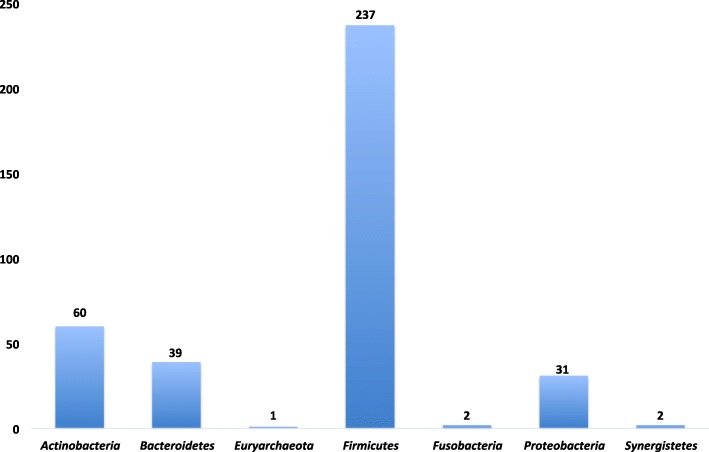
Distribution of bacterial species isolated from the gut using culturomics, according to the phylum to which they belong, based on the NCBI taxonomy classification, with the highest clustering in the Firmicutes phylum
Fig. 5
Fig. 5
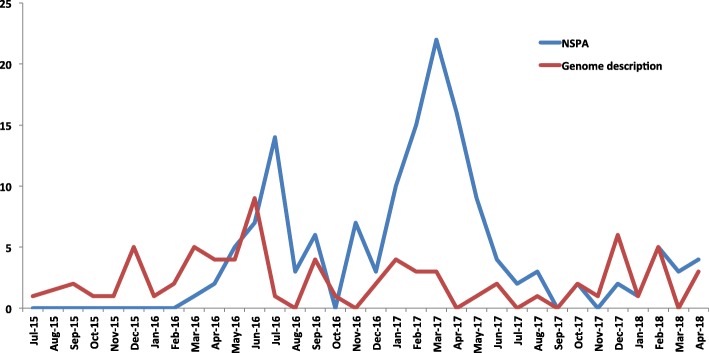
Number of reported species isolated for the first time in humans by culturomics using the new species announcement format compared to the full description format

References

    1. Whitman WB, Coleman DC, Wiebe WJ. Prokaryotes: the unseen majority. Proc Natl Acad Sci U S A. 1998;95:6578–6583. doi: 10.1073/pnas.95.12.6578. - DOI - PMC - PubMed
    1. Antranikian G, Vorgias CE, Bertoldo C. Extreme environments as a resource for microorganisms and novel biocatalysts. Adv Biochem Eng Biotechnol. 2005;96:219–262. - PubMed
    1. Horner-Devine MC, Carney KM, Bohannan BJM. An ecological perspective on bacterial biodiversity. Proc Biol Sci. 2004;271:113–122. doi: 10.1098/rspb.2003.2549. - DOI - PMC - PubMed
    1. Curtis TP, Sloan WT, Scannell JW. Estimating prokaryotic diversity and its limits. Proc Natl Acad Sci U S A. 2002;99:10494–10499. doi: 10.1073/pnas.142680199. - DOI - PMC - PubMed
    1. Locey KJ, Lennon JT. Scaling laws predict global microbial diversity. Proc Natl Acad Sci U S A. 2016;113:5970–5975. doi: 10.1073/pnas.1521291113. - DOI - PMC - PubMed

Publication types

MeSH terms

LinkOut - more resources