


Global population-level association between herpes simplex virus 2 prevalence and HIV prevalence
- PMID: 29794495
- PMCID: PMC5991180
- DOI: 10.1097/QAD.0000000000001828
Global population-level association between herpes simplex virus 2 prevalence and HIV prevalence
Abstract
Background: Our objective was to assess the population-level association between herpes simplex virus 2 (HSV-2) and HIV prevalence.
Methods: Reports of HSV-2 and HIV prevalence were systematically reviewed and synthesized following PRISMA guidelines. Spearman rank correlation ((Equation is included in full-text article.)) was used to assess correlations. Risk ratios (RRHSV-2/HIV) and odds ratios (ORHSV-2/HIV) were used to assess HSV-2/HIV epidemiologic overlap. DerSimonian-Laird random-effects meta-analyses were conducted.
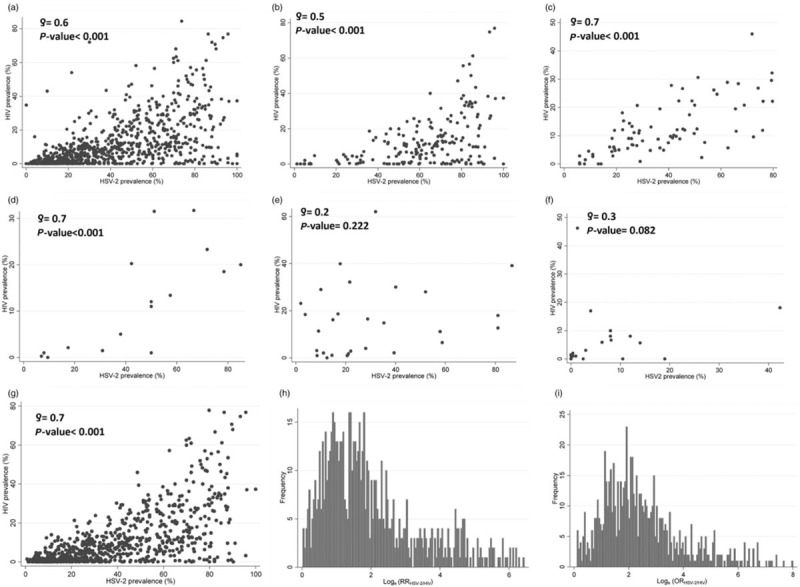
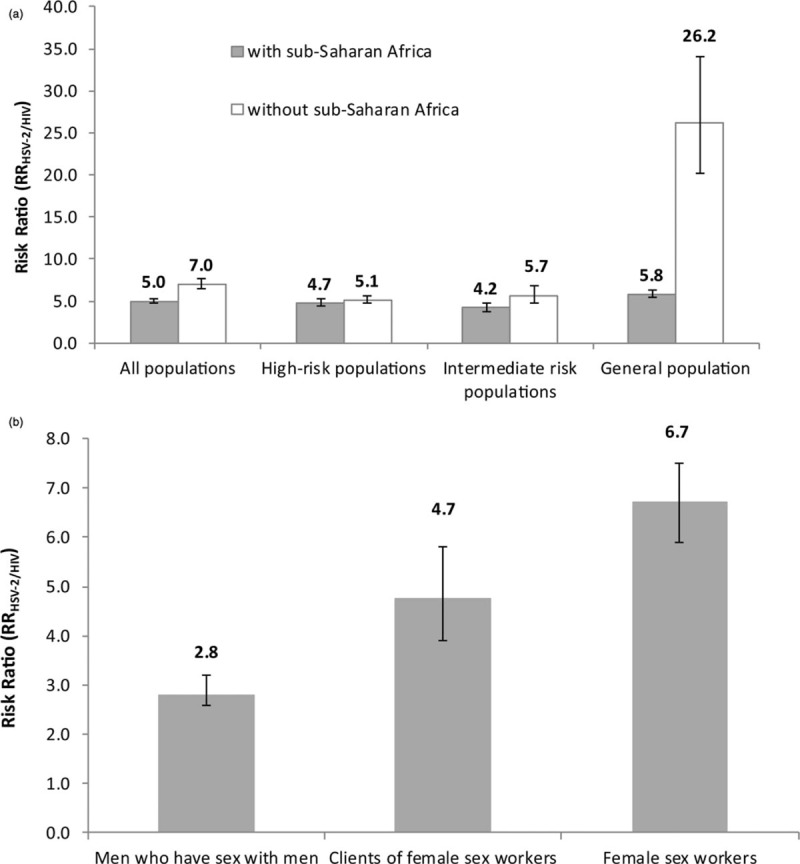
Results: In total, 939 matched HSV-2/HIV prevalence measures were identified from 77 countries. HSV-2 prevalence was consistently higher than HIV prevalence. Strong HSV-2/HIV prevalence association was found for all data ((Equation is included in full-text article.) = 0.6, P < 0.001), all data excluding people who inject drugs (PWID) and children ((Equation is included in full-text article.) = 0.7, P < 0.001), female sex workers ((Equation is included in full-text article.) = 0.5, P < 0.001), and MSM ((Equation is included in full-text article.) = 0.7, P < 0.001). No association was found for PWID ((Equation is included in full-text article.) = 0.2, P = 0.222) and children ((Equation is included in full-text article.) = 0.3, P = 0.082). A threshold effect was apparent where HIV prevalence was limited at HSV-2 prevalence less than 20%, but grew steadily with HSV-2 prevalence for HSV-2 prevalence greater than 20%. The overall pooled mean RRHSV-2/HIV was 5.0 (95% CI 4.7-5.3) and ORHSV-2/HIV was 9.0 (95% CI 8.4-9.7). The RRHSV-2/HIV and ORHSV-2/HIV showed similar patterns that conveyed inferences about HSV-2 and HIV epidemiology.
Conclusion: HSV-2 and HIV prevalence are strongly associated. HSV-2 prevalence can be used as a proxy 'biomarker' of HIV epidemic potential, acting as a 'temperature scale' of the intensity of sexual risk behavior that drive HIV transmission. HSV-2 prevalence can be used to identify populations and/or sexual networks at high-risk of future HIV expansion, and help prioritization, optimization, and resource allocation of cost-effective prevention interventions.
Figures

References
-
- Abu-Raddad LJ, Akala FA, Semini I, Riedner G, Wilson D, Tawil O. Characterizing the HIV/AIDS epidemic in the Middle East and North Africa: time for strategic action. Middle East and North Africa HIV/AIDS Epidemiology Synthesis Project. World Bank/UNAIDS/WHO Publication. Washington DC: The World Bank Press; 2010.
-
- UNAIDS. Prevention Gap Report. Joint United Nations Programme on HIV/AIDS, Geneva, Switzerland, July 2016. Available at: http://www.unaids.org/sites/default/files/media_asset/2016-prevention-ga... [Accessed October 2016]
Publication types
MeSH terms
LinkOut - more resources
Full Text Sources
Other Literature Sources
Medical
