Review
. 2018 Aug;31(4):407-414.
doi: 10.1097/ACO.0000000000000616.

An overview of the cannabinoid type 2 receptor system and its therapeutic potential

Affiliations
Review

An overview of the cannabinoid type 2 receptor system and its therapeutic potential

Bihua Bie et al. Curr Opin Anaesthesiol. 2018 Aug.

Abstract

Purpose of review: This narrative review summarizes recent insights into the role of the cannabinoid type 2 (CB2) receptor as potential therapeutic target in neuropathic pain and neurodegenerative conditions.

Recent findings: The cannabinoid system continues to receive attention as a therapeutic target. The CB2 receptor is primarily expressed on glial cells only when there is active inflammation and appears to be devoid of undesired psychotropic effects or addiction liability. The CB2 receptor has been shown to have potential as a therapeutic target in models of diseases with limited or no currently approved therapies, such as neuropathic pain and neurodegenerative conditions such as Alzheimer's disease.

Summary: The functional involvement of CB2 receptor in neuropathic pain and other neuroinflammatory diseases highlights the potential therapeutic role of drugs acting at the CB2 receptor.


Conflict of interest statement

Conflicts of interest

MN and JFF are cofounders of NeuroTherapia, a spin-off company created by Cleveland Clinic Innovations. MN and JFF have not received payments from NeuroTherapia. As inventors of the technology, they and Cleveland Clinic are entitled to future royalty payments. JW and BB declare no competing interests.

Figures

Figure 1
Figure 1
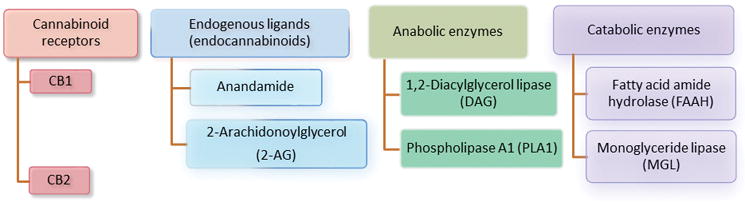
Components of the endogenous cannabinoid system. The cannabinoid (CB) receptors CB1 and CB2 belong to the G-protein-coupled receptor superfamily, coupled to Gi/o proteins and, under certain conditions, coupled to Gs. CB1 receptors are expressed mainly in the brain and CB2 are expressed mostly in the peripheral immune system and in the CNS in the hippocampal CA2/3 pyramidal neurons and glial cells. The endocannabinoid system also includes two arachidonic acid derivatives ligands (anandamide and 2-arachidonoylglycerol) [1], two enzymes responsible for synthesizing endogenous ligands (1,2-diacylglcerol lipase and phospholipase A), and two enzymes responsible for the metabolism of endogenous ligands (fatty acid amide hydrolase and monoglyceride lipase).
Figure 2
Figure 2
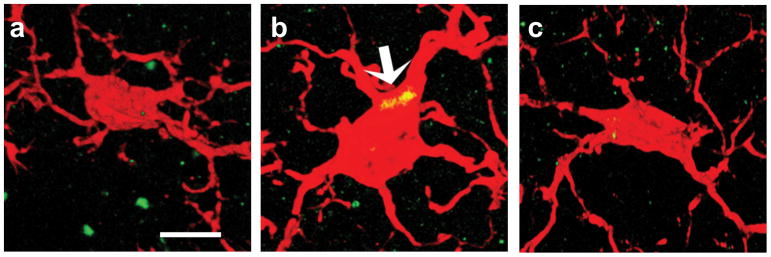
Cannabinoid type 2 (CB2) receptors are expressed in reactive microglia in different neuroinflammatory and neurodegenerative conditions such as neuropathic pain and Alzheimer’s disease. The figure depicts 3D immunofluorescence confocal images of the microglial marker ionized calcium binding adaptor molecule (1 Iba1) (red) and the immunosignal of cannabinoid type 2 (CB2) receptor (green) in microglia; the colocalization of CB2 and microglia is shown in yellow. No substantial CB2 expression is seen in the healthy microglia (a), but increased expression of CB2 is seen in reactive microglia (arrow, b). Note the change from a highly branched and ramified morphology under normal physiological conditions to an amoeboid form in the presence of neuroinflammation. Treatment with a selective CB2 agonist, 1-(3-benzyl-3-methyl-2,3-dihydro-1-benzofuran-6-yl)carbonyl) piperidine (MDA7) restored microglial function and normal morphology (c). Scale bar = 10 μm.
Figure 3
Figure 3
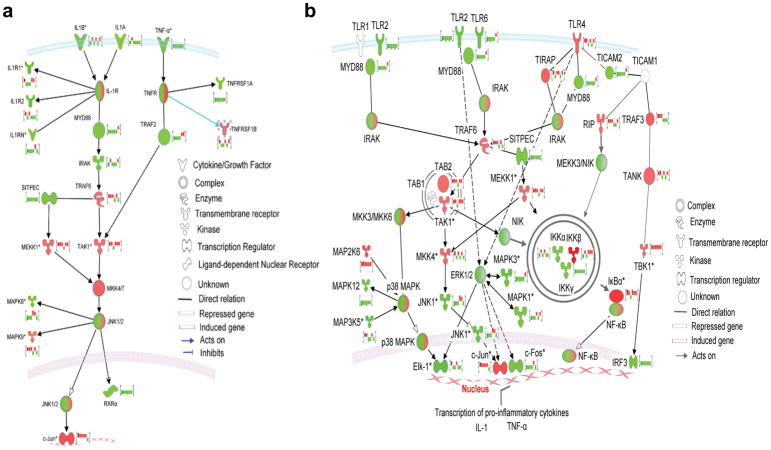
(a) Modulation of interleukein-1 (IL-1) and tumor necrosis factor-alpha (TNF-α) pathways by a selective CB2 agonist, 1-(3-benzyl-3-methyl-2,3-dihydro-1-benzofuran-6-yl)carbonyl) piperidine (MDA7) (generated by Ingenuity pathway analysis using comparison analysis between the 6 arrays). The brightness of node colors is proportional to the fold changes of gene expression levels. Color indicates up-regulated (red) and down-regulated (green) genes. In addition fold change expression bar charts of the six arrays have been included for each gene. In the IL-1 pathway, a complex is formed including IL-1R-associated kinases (IRAK) and the adapter protein MyD88. IRAK is rapidly phosphorylated and associates with TNF receptor-associated factor 6 (TRAF6); this association is necessary for downstream IL-1-induced translocation of signaling molecules to the nucleus, which ultimately leads to expression of genes that mediate inflammation and, frequently, tissue destruction. MDA7 acts by inhibiting IL-1 and TNF-α decreased expression of MyD88 and TNF receptor-associated factor 2 (TRAF2). (b) Signaling cascades initiated via toll-like receptor 2 (TLR2)- and TLR4-dependent activation and its modulation by MDA7. In addition fold change expression bar charts of the six arrays have been included for each gene. Engagement of TLR2 on the cell surface as a heterodimer with either TLR1 or TLR6 leads to recruitment of the adaptor protein MyD88 and interaction with TIR-domain-containing adaptor protein (TIRAP) via death-domain interactions. Phosphorylated IL-1 receptor-associated kinase (IRAK), together with TNF receptor-associated factor 6 (TRAF6), dissociates from the receptor, and then TRAF6 interacts with TAK1 binding protein 1 (TAB1)—induces autophosphorylation of the transforming growth factor β (TGFβ)-activating kinase (TAK1), and TAB2. This leads to phosphorylation of the IκBα-kinase (IKK) complex (IKKα, IKKβ, and IKKγ) and mitogen-activated protein kinases (MAPK), such as c-Jun NH2-terminal kinase (JNK), inducing the nuclear translocation of NF-κB and subsequent induction of target genes such as TNFα and ILs. The transcriptional activity of NF-κB is tightly regulated by its association with the inhibitory IκB that sequesters NF-κB in the cytosol. Beneficial effects of MDA7 include modulation of general genes that will ultimately inhibit phosphorylation of IκB proteins by the IKKs and prevention of IκB degradation. TLR4-MyD88-independent pathway activation involves signaling through the Toll-interleukin-1 receptor (TIR) adaptor TRIF (also known as TICAM1), TRIF-related adaptor molecule (TRAM; also known as TICAM2), TRAF3, receptor-interacting protein (RIP) and the transcription factor interferon regulatory factor 3 (IRF3). The green and red bar charts and shading represent the respective differential gene modulation (repression or induction, respectively) by MDA7. The numbers represent fold change. (Reproduced from Xu et al.[73] with permission).

References

    1. Felder CC, Glass M. Cannabinoid receptors and their endogenous agonists. Annu Rev Pharmacol Toxicol. 1998;38:179–200. - PubMed
    1. Matsuda LA, Lolait SJ, Brownstein MJ, Young AC, Bonner TI. Structure of a cannabinoid receptor and functional expression of the cloned cDNA. Nature. 1990;346:561–4. - PubMed
    1. Cota D, Marsicano G, Tschop M, Grubler Y, Flachskamm C, Schubert M, et al. The endogenous cannabinoid system affects energy balance via central orexigenic drive and peripheral lipogenesis. J Clin Invest. 2003;112:423–31. - PMC - PubMed
    1. Osei-Hyiaman D, DePetrillo M, Pacher P, Liu J, Radaeva S, Batkai S, et al. Endocannabinoid activation at hepatic CB1 receptors stimulates fatty acid synthesis and contributes to diet-induced obesity. J Clin Invest. 2005;115:1298–305. - PMC - PubMed
    1. Cavuoto P, McAinch AJ, Hatzinikolas G, Janovska A, Game P, Wittert GA. The expression of receptors for endocannabinoids in human and rodent skeletal muscle. Biochemical and biophysical research communications. 2007;364:105–10. - PubMed