. 2018 May 23;8(1):8059.
doi: 10.1038/s41598-018-26313-8.

Impact of the griffithsin anti-HIV microbicide and placebo gels on the rectal mucosal proteome and microbiome in non-human primates

Affiliations

Impact of the griffithsin anti-HIV microbicide and placebo gels on the rectal mucosal proteome and microbiome in non-human primates

Lauren Girard et al. Sci Rep. .

Abstract

Topical microbicides are being explored as an HIV prevention method for individuals who practice receptive anal intercourse. In vivo studies of these microbicides are critical to confirm safety. Here, we evaluated the impact of a rectal microbicide containing the antiviral lectin, Griffithsin (GRFT), on the rectal mucosal proteome and microbiome. Using a randomized, crossover placebo-controlled design, six rhesus macaques received applications of hydroxyethylcellulose (HEC)- or carbopol-formulated 0.1% GRFT gels. Rectal mucosal samples were then evaluated by label-free tandem MS/MS and 16 S rRNA gene amplicon sequencing, for proteomics and microbiome analyses, respectively. Compared to placebo, GRFT gels were not associated with any significant changes to protein levels at any time point (FDR < 5%), but increased abundances of two common and beneficial microbial taxa after 24 hours were observed in HEC-GRFT gel (p < 2E-09). Compared to baseline, both placebo formulations were associated with alterations to proteins involved in proteolysis, activation of the immune response and inflammation after 2 hours (p < 0.0001), and increases in beneficial Faecalibacterium spp. after 24 hours in HEC placebo gel (p = 4.21E-15). This study supports the safety profile of 0.1% GRFT gel as an anti-HIV microbicide and demonstrates that current placebo formulations may associate with changes to rectal proteome and microbiota.


Conflict of interest statement

The authors declare no competing interests.

Figures
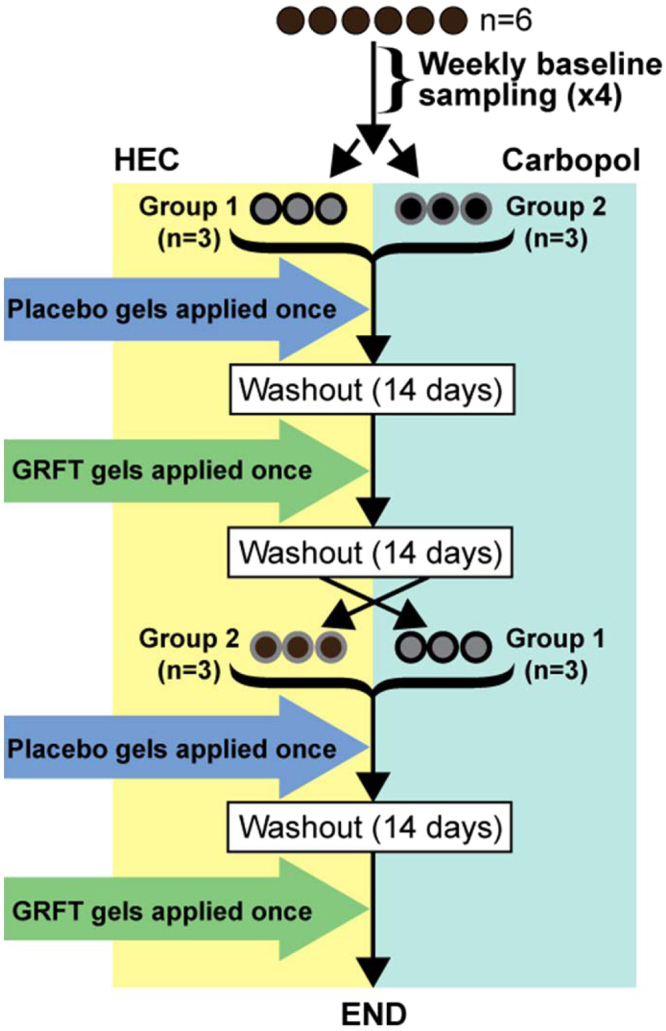
Figure 1
Figure 1
An outline of the PREVENT study in rhesus macaques. Baseline samples were collected from six rhesus macaques prior to dividing the macaques into two groups (Group 1 and Group 2). Macaques were then treated once intra-rectally with placebo gels, followed by a washout period of 14 days, and subsequently treated intra-rectally with GRFT 0.1% gels. The formulation applied was dependent on group assignment. After another 14-day washout period, there was a mid-trial crossover point in which the two groups switched gel formulations. The placebo and 0.1% GRFT gel application process was repeated.
Figure 2
Figure 2
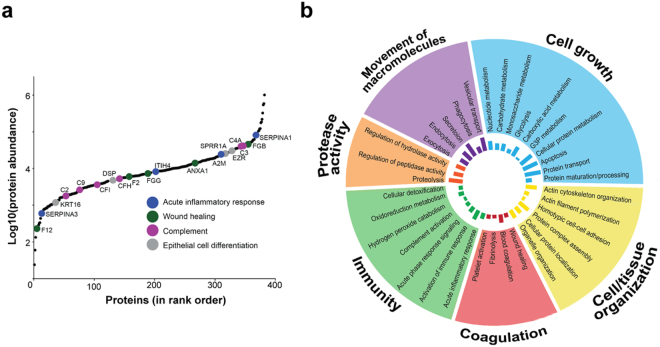
Diversity of the rectal mucosal proteome observed by mass spectrometry. (a) Log Rank plot of protein abundances shows rectal proteome coverage spans greater than 4 orders of magnitude. Immune proteins belonging to specific pathways are indicated in dark blue (acute inflammatory response), dark green (wound healing), pink (complement) and grey (epithelial cell differentiation); (b) Radial chart of the top biological processes in the rectal mucosa of rhesus macaques in our study according to DAVID Functional Annotation v6.8. The innermost bar chart represents the number of proteins involved in each process. Processes are grouped into broader categories, which include cell growth, cell/tissue organization, coagulation, immunity, protease activity and movement of macromolecules.
Figure 3
Figure 3
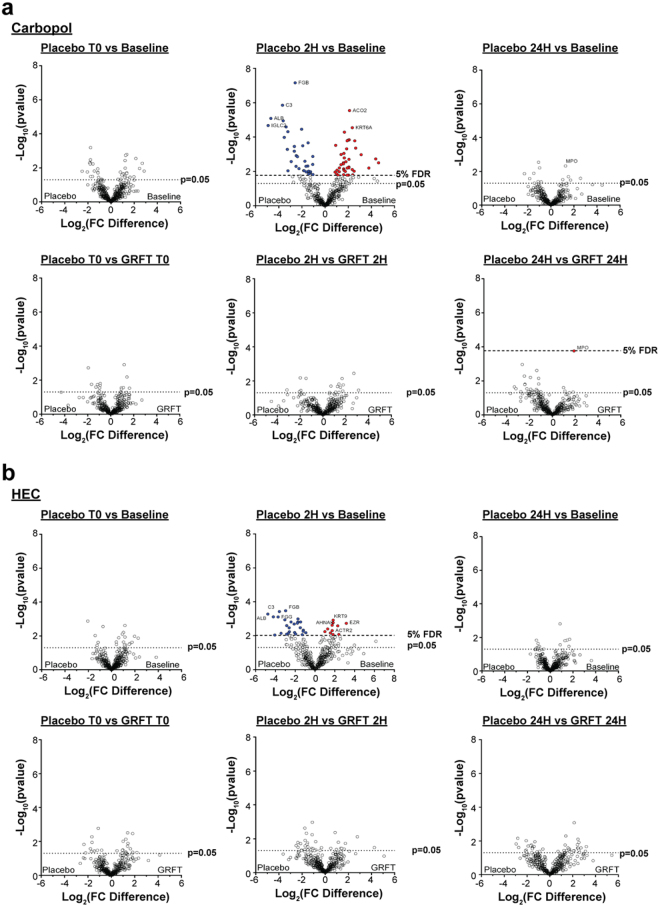
Changes to the rectal mucosal proteome after application of either drug (0.1% GRFT) or placebo using either hydroxyethylcellulose (HEC) or carbopol formulations. Volcano plots display the log2-fold change values of protein expression along the x-axis and −log p-value (as determined by paired t tests) along the y-axis. Dashed lines indicate the cut off for p = 0.05 and the 5% false discovery rate (FDR) where applicable. Blue and red points represent proteins that were significantly over- and under-abundantly expressed in placebo-treated samples, respectively (threshold < 5% FDR). Significant effects were observed 2 hours post-placebo gel application for both carbopol and HEC gels, where 19.9% and 9.4% of proteins were differentially expressed, respectively (upper middle panels of a and b). Other than relatively higher levels of Myeloperoxidase at 24 hours post-GRFT 0.1% gel application in the carbopol formulation (a, bottom right), 0.1% GRFT gels did not elicit any significant changes in rectal mucosal protein expression (threshold = FDR 5%).
Figure 4
Figure 4
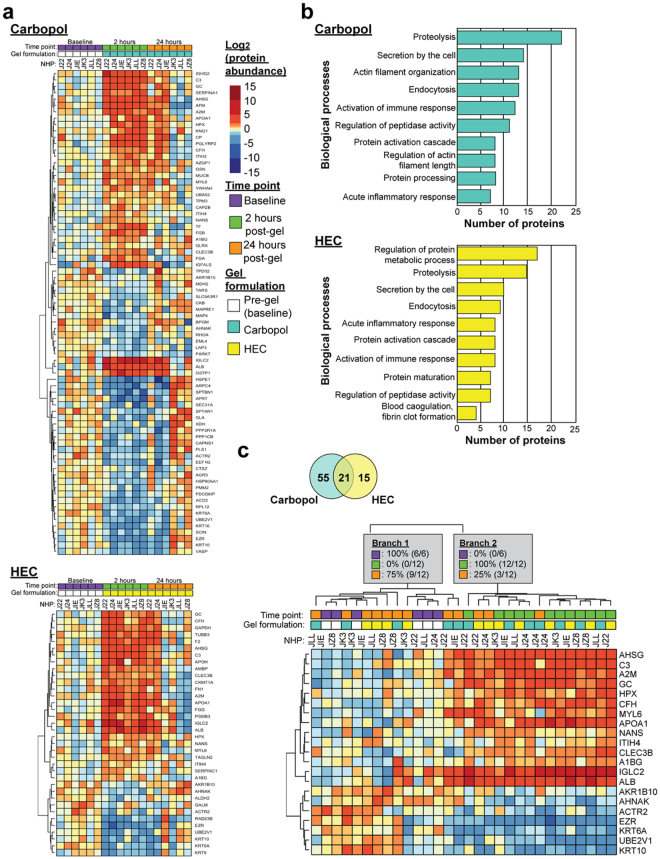
Transient placebo gel-induced effects to the rectal mucosal proteome 2 hours post application in rhesus macaques. Heatmaps display the log2-fold change values of protein abundance, with darker colours representing stronger changes. Non-human primate (NHP) identifiers are indicated along the top border of the heatmaps. (a) Protein abundance values that were altered 2 hours post-gel application compared to baseline (5% FDR cut off). Baseline, 2 hours, and 24 hours post-gel application time points are indicated in purple, green and orange, respectively. Samples treated with carbopol placebo and HEC placebo are differentiated by turquoise and yellow, respectively. (b) Top biological processes associated with altered proteins 2 hours post-placebo gel application, as determined by DAVID v6.8 for carbopol and HEC formulations. Biological functions are listed along the left y-axis and the number of proteins identified in each pathway is indicated along the x-axis. (c) Venn-diagram representing the number of altered proteins overlapping between HEC and carbopol placebo gel treatments. Heatmap displaying the 21 proteins commonly affected 2 hours post- HEC and carbopol placebo gel application. The samples clustered into two distinct branches, with all of the samples collected 2 hours post-application clustering together into branch 2.
Figure 5
Figure 5
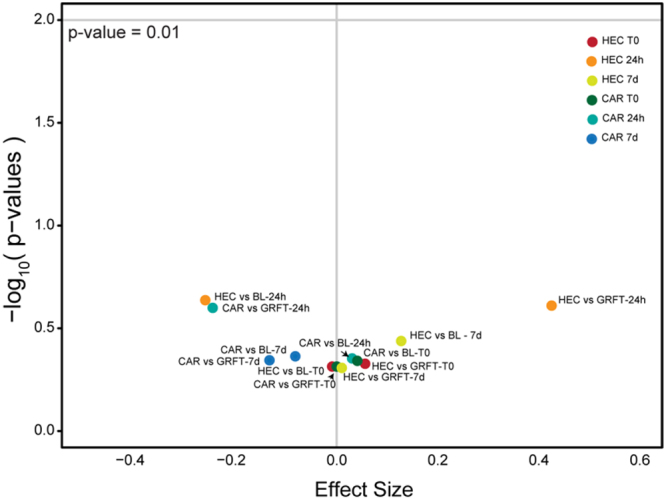
Effects of HEC and carbopol placebo gel or 0.1% GRFT gels on Shannon diversity of rhesus macaque rectal microbiota. Volcano plot displays the effect sizes of compared treatments or placebos on Shannon diversity values on the x-axis and the −log10 p-values on the y-axis. The gray horizontal line indicates p-value of 0.01. There were no significant effects on the Shannon diversity of rhesus macaque rectal microbiota detected.
Figure 6
Figure 6
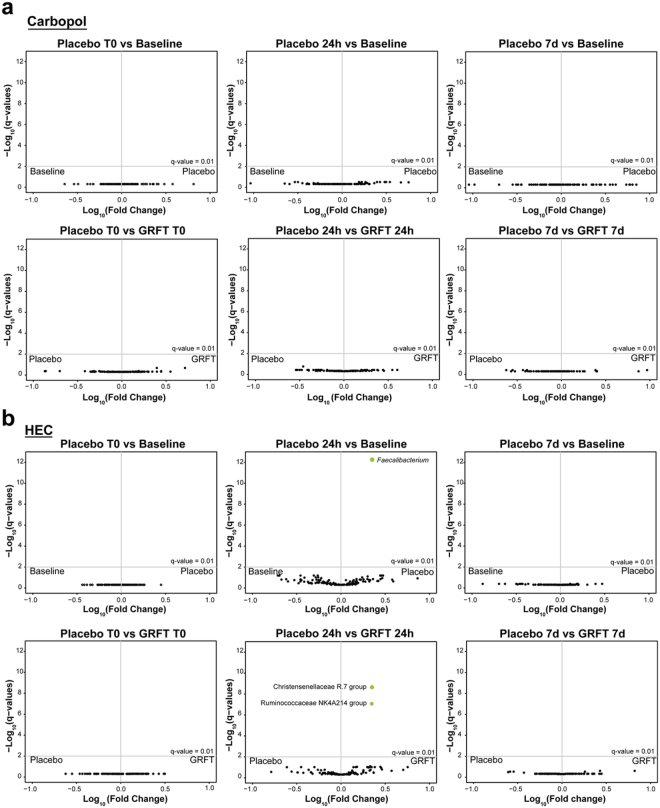
Changes in the rectal microbiota after application of either drug (0.1% GRFT) or placebo using either HEC or carbopol formulations. Volcano plots display the log10-fold change in relative abundances of each detected bacterial taxon along the x-axis and -log10 of the q-values (as determined by Bayesian logistic-normal paired models) along the y-axis. The gray horizontal lines indicate q-value of 0.01. Green points represent taxa for which relative abundances were significantly increased for the treatment (placebo or GRFT) indicated in the right panel of each window. Significant effects were observed 24 h post HEC placebo gel application relative to baseline samples (b), and 24 h post-GRFT-HEC gel relative to 24 h post-HEC placebo gel applications (b). No significant effects were observed in any other bacterial taxa or treatments.

References

    1. Patel P, et al. Estimating per-act HIV transmission risk: a systematic review. AIDS. 2014;28:1–11. doi: 10.1097/QAD.0000000000000298. - DOI - PMC - PubMed
    1. Beyrer C, et al. Global epidemiology of HIV infection in men who have sex with men. Lancet. 2012;380:367–377. doi: 10.1016/S0140-6736(12)60821-6. - DOI - PMC - PubMed
    1. Beyrer C, et al. The increase in global HIV epidemics in MSM. AIDS. 2013;27:2665–2678. doi: 10.1097/01.aids.0000432449.30239.fe. - DOI - PubMed
    1. UN Joint Programme on HIV/AIDS (UNAIDS). Global AIDS update 2016. 1–13 (2016).
    1. Baral SD, et al. Worldwide burden of HIV in transgender women: a systematic review and meta-analysis. Lancet Infect Dis. 2012;13:214–222. doi: 10.1016/S1473-3099(12)70315-8. - DOI - PubMed

Publication types

MeSH terms