. 2018 May 23;8(1):8065.
doi: 10.1038/s41598-018-25665-5.

Concentration-dependent protein loading of extracellular vesicles released by Histoplasma capsulatum after antibody treatment and its modulatory action upon macrophages

Affiliations

Concentration-dependent protein loading of extracellular vesicles released by Histoplasma capsulatum after antibody treatment and its modulatory action upon macrophages

Ludmila Matos Baltazar et al. Sci Rep. .

Abstract

Diverse pathogenic fungi secrete extracellular vesicles (EV) that contain macromolecules, including virulence factors that can modulate the host immune response. We recently demonstrated that the binding of monoclonal antibodies (mAb) modulates how Histoplasma capsulatum load and releases its extracellular vesicles (EV). In the present paper, we addressed a concentration-dependent impact on the fungus' EV loading and release with different mAb, as well as the pathophysiological role of these EV during the host-pathogen interaction. We found that the mAbs differentially regulate EV content in concentration-dependent and independent manners. Enzymatic assays demonstrated that laccase activity in EV from H. capsulatum opsonized with 6B7 was reduced, but urease activity was not altered. The uptake of H. capsulatum by macrophages pre-treated with EV, presented an antibody concentration-dependent phenotype. The intracellular killing of yeast cells was potently inhibited in macrophages pre-treated with EV from 7B6 (non-protective) mAb-opsonized H. capsulatum and this inhibition was associated with a decrease in the reactive-oxygen species generated by these macrophages. In summary, our findings show that opsonization quantitatively and qualitatively modifies H. capsulatum EV load and secretion leading to distinct effects on the host's immune effector mechanisms, supporting the hypothesis that EV sorting and secretion are dynamic mechanisms for a fine-tuned response by fungal cells.


Conflict of interest statement

The authors declare no competing interests.

Figures

Figure 1
Figure 1
Protein and sterol quantification in EV from H. capsulatum. Yeast cells were incubated with or without 6 and 20 μg/mL of 6B7 and 7B6 mAb. The EV protein content was determined by BCA assay (A). EV sterol quantification was performed using Amplex reagent kit (B). Graphs represent means and standard deviation from at least two independent EV isolations and all the analyses were performed in duplicate. *p ≤ 0.05, compared to the untreated control group. #p ≤ 0.05, compared to the groups 6B7 and 7B6 at 6 µg/mL. ϕp ≤0.05, compared to 6B7 mAb treatment at 20 µg/mL.
Figure 2
Figure 2
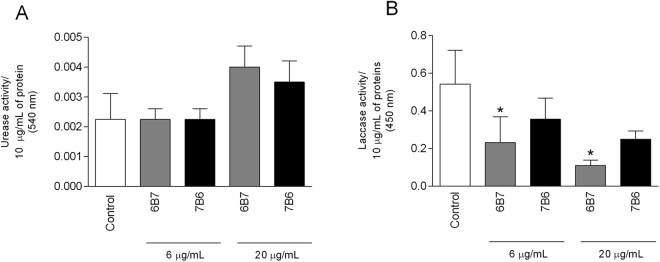
Enzymatic activity of EV virulence factors resulting from fungal opsonization with mAb. Yeast cells were incubated with or without 6 and 20 μg/mL of 6B7 or 7B6 mAb. After EV isolation, urease (A) and laccase (B) activities were measured as described in Methods. Graphs represent means and standard deviation of at least two independent experiments and all the analyses were performed in duplicate. *p ≤ 0.05 compared to control EV.
Figure 3
Figure 3
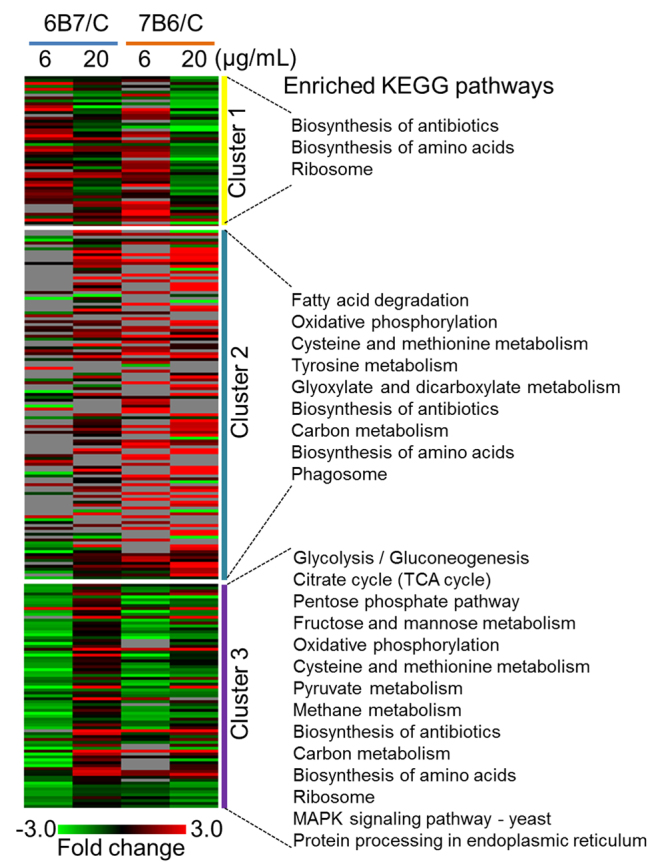
Heatmap of proteins differentially abundant in response to treatment with 6 or 20 µg/mL of 6B7 and 7B6 mAb against Hsp60. The heatmap was generated using Multiexperiment Viewer and clustered by K-means based on the abundance profiles. The significantly enriched functions (p ≤ 0.05 by Fisher’s exact test, 2 folds enrichment compared to the genome background) are listed for each cluster. Gray spots represent hits below the limit of quantification.
Figure 4
Figure 4
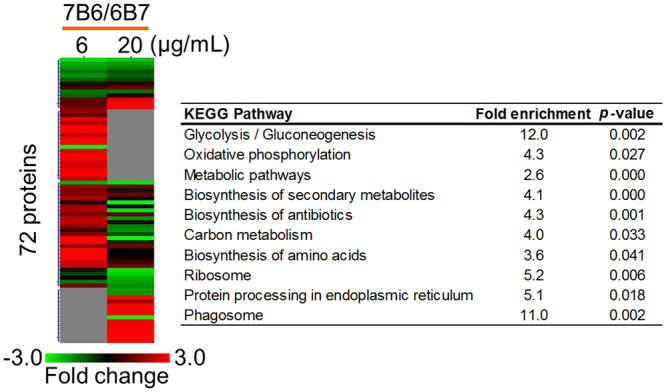
Heatmap of proteins differentially abundant in EV in response to treatment of H. capsulatum with 6B7 and 7B6 mAb against Hsp60. The heatmap was generated using Multiexperiment Viewer and clustered by hierarchical clustering based on the abundance profiles. The significantly enriched functions (p ≤ 0.05 by Fisher’s exact test, 2 folds enrichment compared to the genome background) are listed for each cluster. The gray spot represents hits below the limit of quantification.
Figure 5
Figure 5
Phagocytosis and killing of H. capsulatum by EV-treated macrophages. BMDMs were treated for 1 hour with EV from H. capsulatum opsonized or not with 6 or 20 μg/mL of 6B7 or 7B6 mAb prior to the in vitro challenge with H. capsulatum-GFP (m.o.i. 1:5). After 1 hour, phagocytosis was analyzed by flow cytometry (A). To evaluate intracellular killing, after the phagocytosis time, and removal of extracellular yeast cells, macrophages were incubated for additional 2 hours and then lysed. Lysates were plated onto BHI-agar plates and colonies were counted. Graphs show the mean and standard errors from 3 independent experiments performed in triplicates. *p < 0.05; **p < 0.01; ***p < 0.001; ****p < 0.0001 compared to untreated cells, and +p < 0.05 compared to control EV, by Student’s t-test; Cytochalasin B (10 μM).
Figure 6
Figure 6
Reactive oxygen species generation by EV-treated macrophages. BMDMs were loaded with H2DCFDA and then treated or not with EV from H. capsulatum opsonized or not with 6 or 20 μg/mL of 6B7 or 7B6 mAb, prior to the incubation with H. capsulatum yeast cells. ROS generation was measured in a microplate reader 2 hours after the incubation of the yeast cells. Graphs show the mean and standard errors from 2 independent experiments performed in quadruples. ****p < 0.0001 compared to macrophages without EV treatment. +p < 0.05; ++p < 0.01 and ++++p < 0.0001 compared to macrophages treated with control EV, by One-way ANOVA followed by Tukey’s multiple comparisons test.

References

    1. Woods JP. Histoplasma capsulatum molecular genetics, pathogenesis, and responsiveness to its environment. Fungal genetics and biology: FG & B. 2002;35:81–97. doi: 10.1006/fgbi.2001.1311. - DOI - PubMed
    1. Nosanchuk JD, Gacser A. Histoplasma capsulatum at the host-pathogen interface. Microbes and infection. 2008;10:973–977. doi: 10.1016/j.micinf.2008.07.011. - DOI - PMC - PubMed
    1. Kauffman CA. Histoplasmosis: a clinical and laboratory update. Clinical microbiology reviews. 2007;20:115–132. doi: 10.1128/CMR.00027-06. - DOI - PMC - PubMed
    1. Allendoerfer R, Deepe GS., Jr. Infection with Histoplasma capsulatum: Host-fungus interface. Revista iberoamericana de micologia. 1998;15:256–260. - PubMed
    1. Mihu MR, Nosanchuk JD. Histoplasma virulence and host responses. International journal of microbiology. 2012;2012:268123. doi: 10.1155/2012/268123. - DOI - PMC - PubMed

Publication types

MeSH terms