


Prenatal n-3 long-chain fatty acid status and offspring metabolic health in early and mid-childhood: results from Project Viva
- PMID: 29795533
- PMCID: PMC5968023
- DOI: 10.1038/s41387-018-0040-2
Prenatal n-3 long-chain fatty acid status and offspring metabolic health in early and mid-childhood: results from Project Viva
Abstract
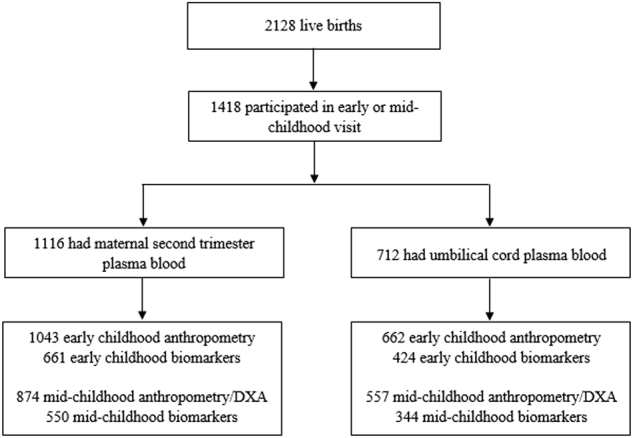
Higher maternal and biomarker levels of n-3 long-chain polyunsaturated fatty acids (LCPUFAs) have been associated with improved perinatal outcomes and may also influence offspring metabolic health. Past studies were not powered to examine metabolic outcomes and few have specifically targeted metabolically vulnerable populations. We examined the associations of prenatal n-3 LCPUFA status with markers of metabolic health in early and mid-childhood in the full population as well as stratified by maternal glucose tolerance. Our data consisted of 1418 mother-child dyads from Project Viva, a longitudinal, prospective pre-birth cohort enrolled in eastern Massachusetts. We assessed maternal dietary intake of fish and n-3 LCPUFA in mid-pregnancy using a validated food frequency questionnaire. N-3 LCPUFA levels were quantified in maternal second trimester and umbilical cord plasma using liquid-gas chromatography. We assessed offspring anthropometry, adiposity, and blood pressure at early (median age: 3.2 years) and mid-childhood (median age: 7.7 years); and assayed blood samples collected at these visits for metabolic biomarkers. We report here multivariable effect estimates and 95% CI. Early childhood BMI z-score was on average 0.46 (1.03) units and waist circumference 51.3 (3.7) cm. At mid-childhood these measures were 0.39 (1.00) units and 60.0 (8.3) cm, respectively. Higher cord plasma DHA levels were associated with lower BMI z-score ((Q)uartile 4 vs. Q1: -0.21, 95% CI: -0.38, -0.03), waist circumference (Q4 vs. Q1: -0.63, 95% CI: -1.27, 0.00 cm), and leptin levels (Q4 vs. Q1: -0.36, 95% CI: -0.77, 0.05 ng/mL) in early childhood. These associations were strongest and reached significance in offspring of women with isolated hyperglycemia vs. better or worse glycemic status. Higher maternal DHA + EPA (Q4 vs. Q1: -1.59, 95% CI: -2.80, -0.38 μg/mL) and fish (≥3 vs. 0 portions/week: -2.18, 95% CI: -3.90, -0.47 μg/mL) intake was related to lower adiponectin in early childhood. None of these associations persisted with mid-childhood outcomes. We did not find associations with any of the other outcomes. This study supports early and possibly transient effects of prenatal n-3 LCPUFA status on anthropometric measures and adipokine levels. It also raises the possibility that offspring of women with isolated hyperglycemia derive the most benefits from higher n-3 LCPUFA status.
Conflict of interest statement
The authors declare that they have no conflict of interest.
Figures
References
-
- Hussain A, et al. A maternal diet of fatty fish reduces body fat of offspring compared with a maternal diet of beef and a post-weaning diet of fish improves insulin sensitivity and lipid profile in adult C57BL/6 male mice. Acta Physiol. (Oxf.). 2013;209:220–234. - PubMed
-
- Sardinha FL, Fernandes FS, Tavares do Carmo MG, Herrera E. Sex-dependent nutritional programming: fish oil intake during early pregnancy in rats reduces age-dependent insulin resistance in male, but not female, offspring. Am. J. Physiol. Regul. Integr. Comp. Physiol. 2013;304:R313–R320. doi: 10.1152/ajpregu.00392.2012. - DOI - PubMed
Publication types
MeSH terms
Substances
Grants and funding
LinkOut - more resources
Full Text Sources
Other Literature Sources
Medical
Research Materials
Miscellaneous
