


A Cross-Training Program Does Not Alter Self-Reported Physical Activity Levels in Elementary School Children
- PMID: 29795738
- PMCID: PMC5955328
- DOI: 10.70252/EMTM9196
A Cross-Training Program Does Not Alter Self-Reported Physical Activity Levels in Elementary School Children
Abstract
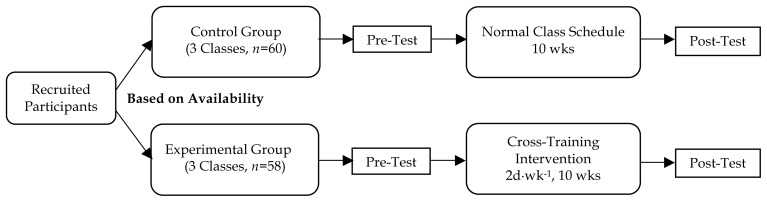
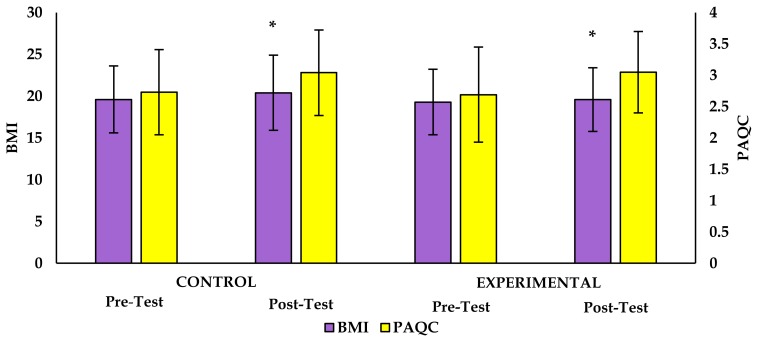
The purpose of the study was to examine the effects of a school-based cross-training program on body mass index (BMI), attitudes toward physical activity (ATPA), and physical activity (PA) levels of children in the 4th and 5th grades. Children (N = 118) were divided into control (n = 60) and experimental (n = 58) groups based on class availability. While the control group continued academic classes as usual, the experimental group participated in cross-training involving resistance training (RT), calisthenics, and stretching twice a week for 10 weeks. Pre- and post-intervention measures included height, mass, ATPA, and PA. BMI was calculated and ATPA and PA levels were assessed via questionnaire. The groups did not differ significantly (p > .05) for either pre- or post-intervention regarding BMI, ATPA, and PA. However, BMI and PA levels significantly increased over time for both groups (p ≤ .05). Overall, cross-training in a school setting may be a safe and enjoyable option for physical activity participation. BMI and PA increases were likely the result of the natural growth process and seasonal weather pattern changes, respectively. Nevertheless, the cross-training did not detract from PA levels and may have led to an overall increase in PA levels. As subdomain analyses revealed decreased attitude toward health and fitness in the experimental group, shorter programs involving RT with various protocols are recommended.
Keywords: Fitness; motivation; pediatric; resistance exercise; weight lifting.
Figures
References
-
- American College of Sports Medicine. ACSM’s guidelines for exercise testing and prescription. Ninth Edition. Philadelphia: LWW; 2014. - PubMed
-
- Ames C. Classrooms: Goals, structures, and student motivation. J Educ Psychol. 1992;84(3):261–271.
-
- Andersen LB, Harro M, Sardinha LB, Froberg K, Ekelund U, Brage S, et al. Physical activity and clustered cardiovascular risk in children: a cross-sectional study (The European Youth Heart Study) Lancet. 2006;368(9532):299–304. - PubMed
-
- Bailey RC, Olson J, Pepper SL, Porszasz J, Barstow TJ, Cooper DM. The level and tempo of children’s physical activities: an observational study. Med Sci Sports Exerc. 1995;27(7):1033–1041. - PubMed
-
- Benson AC, Torode ME, Fiatarone Singh MA. The effect of high-intensity progressive resistance training on adiposity in children: a randomized controlled trial. Int J Obes. 2008;32(6):1016–1027. - PubMed
LinkOut - more resources
Full Text Sources