


Type I and Type II Error Rates and Overall Accuracy of the Revised Parallel Analysis Method for Determining the Number of Factors
- PMID: 29795828
- PMCID: PMC5965641
- DOI: 10.1177/0013164414546566
Type I and Type II Error Rates and Overall Accuracy of the Revised Parallel Analysis Method for Determining the Number of Factors
Abstract
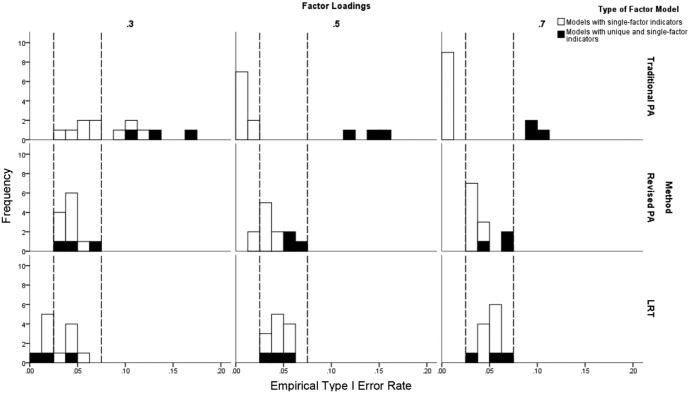
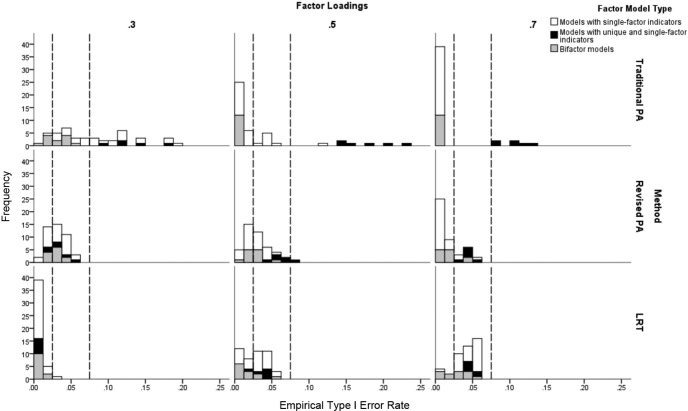
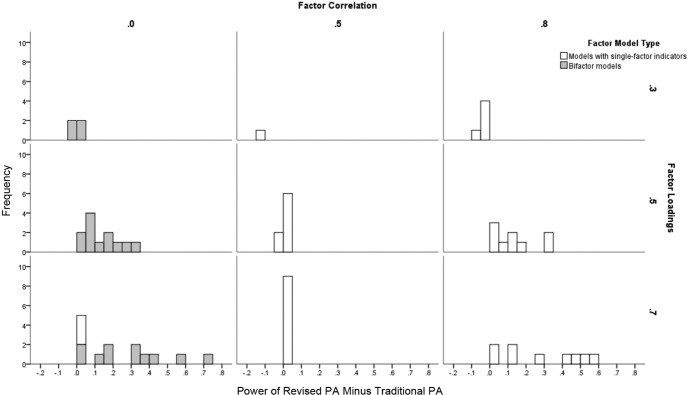
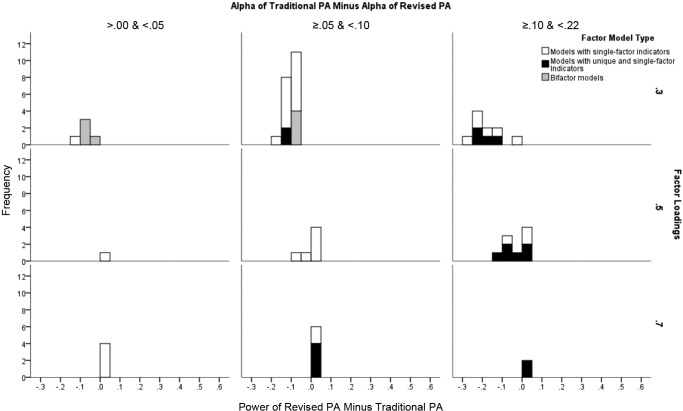
Traditional parallel analysis (T-PA) estimates the number of factors by sequentially comparing sample eigenvalues with eigenvalues for randomly generated data. Revised parallel analysis (R-PA) sequentially compares the kth eigenvalue for sample data to the kth eigenvalue for generated data sets, conditioned on k- 1 underlying factors. T-PA and R-PA are conceptualized as stepwise hypothesis-testing procedures and, thus, are alternatives to sequential likelihood ratio test (LRT) methods. We assessed the accuracy of T-PA, R-PA, and LRT methods using a Monte Carlo approach. Although no method was uniformly more accurate across all 180 conditions, the PA approaches outperformed LRT methods overall. Relative to T-PA, R-PA tended to perform better within the framework of hypothesis testing and to evidence greater accuracy in conditions with higher factor loadings.
Keywords: factor analysis; parallel analysis; revised parallel analysis.
Conflict of interest statement
Declaration of Conflicting Interests: The author(s) declared no potential conflicts of interest with respect to the research, authorship, and/or publication of this article.
Figures
References
-
- Bradley J. V. (1978). Robustness? British Journal of Mathematical and Statistical Psychology, 31, 144-152.
-
- Buja A., Eyuboglu N. (1992). Remarks on parallel analysis. Multivariate Behavioral Research, 27, 509-540. - PubMed
-
- Cattell R. B. (1966). The scree test for the number of factors. Multivariate Behavioral Research, 1, 245-276. - PubMed
-
- Crawford A., Green S. B., Levy R., Lo W.-J., Scott L., Svetina D. S., Thompson M. S. (2010). Evaluation of parallel analysis methods for determining the number of factors. Educational and Psychological Measurement, 70, 885-901.
LinkOut - more resources
Full Text Sources
Other Literature Sources