


Does structural integrity following rotator cuff repair affect functional outcomes and pain scores? A meta-analysis
- PMID: 29796103
- PMCID: PMC5960875
- DOI: 10.1177/1758573217731548
Does structural integrity following rotator cuff repair affect functional outcomes and pain scores? A meta-analysis
Abstract
Background: To assess whether the integrity of rotator cuff repairs has an impact on functional outcomes, as well as pain scores, after surgery.
Methods: Systematic review and meta-analyses performed for Level Ι, ΙΙ and ΙΙΙ studies that presented functional outcome scores and radiological assessment of integrity following rotator cuff repair. Extracted data included patient demographics, functional outcome scores [Constant Score, University of California at Los Angeles (UCLA) shoulder score, American Shoulder and Elbow Surgeons (ASES) shoulder score, visual analogue scale (VAS) Pain score], as well as assessment of repair integrity on radiological investigations. A meta-analysis was performed using weighted means and a random effects model.
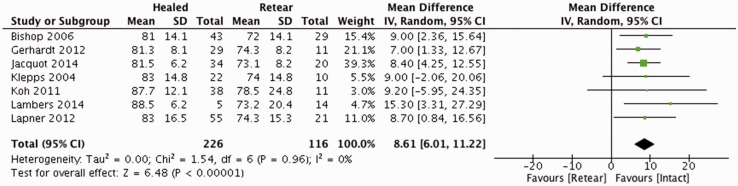
Results: Twelve studies were included in the final analysis. Average re-tear rate for the 800 included patients was 22% at a mean follow-up of 27.5 months after surgery. Patients with intact repairs had a significantly higher Constant Score (8.61 points, p < 0.00001), UCLA shoulder score (2.96 points, p < 0.0001) and ASES shoulder score (9.49 points, p < 0.0006). Patients with intact repairs also reported lower pain VAS Pain scores by 0.62 points (p < 0.0004).
Conclusions: Our results show better functional outcome and pain scores in patients with intact rotator cuffs at follow-up when compared to those that have re-torn. This difference is equivalent to the published Minimal Clinically Important Difference for the ASES but not Constant Scores. This review has also highlighted that shoulder strength in patients with intact cuff repairs is likely to be greater than in patients with a failed repair.
Keywords: functional outcome; integrity; re-tear; repair; rotator cuff.
Figures



References
-
- Uhthoff HK, Loehr J, Sarkar K. The pathogenesis of rotator cuff tears. In: Takagishi N. (ed). The shoulder, Tokyo: Professional PostGraduate Services, 1987, pp. 211–212.
-
- Lehman C, Cuomo F, Kummer FJ, Zuckerman JD. The incidence of full thickness rotator cuff tears in large cadaveric population. Bull Hosp Jt Dis 1995; 54: 30–31. - PubMed
-
- Kim KC, Shin HD, Lee WY. Repair integrity and functional outcomes after arthroscopic suture-bridge rotator cuff repair. J Bone Joint Surg Am 2012; 94: e48–e48. - PubMed
-
- Lindley K, Jones GL. Outcomes of arthroscopic versus open rotator cuff repair: a systematic review of the literature. Am J Orthop 2010; 39: 592–600. - PubMed
-
- Prasathaporn N, Kuptniratsaikul S, Kongrukgreatiyos K. Single-row repair versus double-row repair of full thickness rotator cuff tears. Arthroscopy 2011; 27: 978–85. - PubMed
Publication types
LinkOut - more resources
Full Text Sources
Other Literature Sources
Medical