


Self-reported sex differences in high-functioning adults with autism: a meta-analysis
- PMID: 29796237
- PMCID: PMC5960195
- DOI: 10.1186/s13229-018-0216-6
Self-reported sex differences in high-functioning adults with autism: a meta-analysis
Abstract
Background: Sex differences in autistic symptomatology are believed to contribute to the mis- and missed diagnosis of many girls and women with an autism spectrum condition (ASC). Whilst recent years have seen the emergence of clinical and empirical reports delineating the profile of young autistic girls, recognition of sex differences in symptomatology in adulthood is far more limited.
Methods: We chose here to focus on symptomatology as reported using a screening instrument, the Ritvo Autism Asperger Diagnostic Scale-Revised (RAADS-R). In a meta-analysis, we pooled and analysed RAADS-R data from a number of experimental groups. Analysis of variance (ANOVA) searched for the presence of main effects of Sex and Diagnosis and for interactions between these factors in our sample of autistic and non-autistic adults.
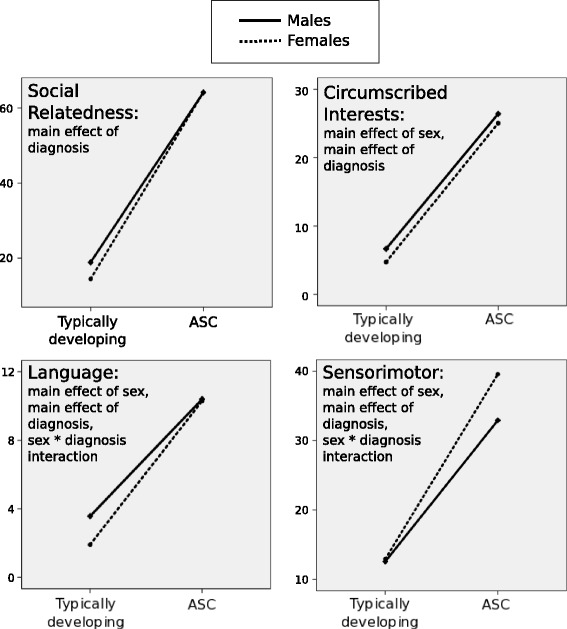
Results: In social relatedness and circumscribed interests, main effects of Diagnosis revealed that as expected, autistic adults reported significantly greater lifetime prevalence of symptoms in these domains; an effect of Sex, in circumscribed interests, also suggested that males generally reported more prevalent symptoms than females. An interaction of Sex and Diagnosis in language symptomatology revealed that a normative sex difference in language difficulties was attenuated in autism. An interaction of Sex and Diagnosis in the sensorimotor domain revealed the opposite picture: a lack of sex differences between typically developing men and women and a greater prevalence of sensorimotor symptoms in autistic women than autistic men.
Conclusions: We discuss the literature on childhood sex differences in relation to those which emerged in our adult sample. Where childhood sex differences fail to persist in adulthood, several interpretations exist, and we discuss, for example, an inherent sampling bias that may mean that only autistic women most similar to the male presentation are diagnosed. The finding that sensorimotor symptomatology is more highly reported by autistic women is a finding requiring objective confirmation, given its potential importance in diagnosis.
Keywords: Gender; RAADS-R; Self-report; Sex.
Conflict of interest statement
Data collection by the researchers at Bournemouth University was ethically approved by Bournemouth University’s ethics panel (for TD controls). The clinic we collaborated with, Dorset NHS Community Adult Asperger Service (CAAS), had previously received NHS approval to collect RAADS-R data. In the course of data collection, participants were told that their data could be used in scientific papers and gave their consent to go forward. The researchers were granted access to raw scores of autistic people but no personal or identifying information, and consent was granted by the clinic for us to publish our findings.Consent to publish data in an anonymous form was obtained from each participant.The authors declare that they have no competing interests.Springer Nature remains neutral with regard to jurisdictional claims in published maps and institutional affiliations.
Figures
References
-
- Werling DMDM, Geschwind DHDH. Sex differences in autism spectrum disorders. Curr Opin Neurol [Internet] 2013;26:146–153. Available from: http://journals.lww.com/co-neurology/Abstract/2013/04000/Sex_differences..., http://www.pubmedcentral.nih.gov/articlerender.fcgi?artid=4164392&to... - PMC - PubMed
-
- Rutherford M, McKenzie K, Johnson T, Catchpole C, O’Hare A, McClure I, et al. Gender ratio in a clinical population sample, age of diagnosis and duration of assessment in children and adults with autism spectrum disorder. Autism [Internet]. 2016;20(5):628–34. Available from: http://www.ncbi.nlm.nih.gov/pubmed/26825959. - PubMed
-
- Loomes R, Hull L, Mandy WPL. What is the male-to-female ratio in autism spectrum disorder? A systematic review and meta-analysis. J Am Acad Child Adolesc Psychiatry [Internet] 2017;56:466–474. Available from: http://www.ncbi.nlm.nih.gov/pubmed/28545751%0A, http://linkinghub.elsevier.com/retrieve/pii/S0890856717301521 - PubMed
-
- Lai M-C, Lombardo M V., Auyeung B, Chakrabarti B, Baron-Cohen S. Sex/gender differences and autism: setting the scene for future research. J. Am. Acad. Child Adolesc. Psychiatry [Internet]. Elsevier; 2015 [cited 2014 Dec 18];54:11–24. Available from: https://www.jaacap.org/article/S0890-8567(14)00725-4/abstract - PMC - PubMed
Publication types
MeSH terms
LinkOut - more resources
Full Text Sources
Other Literature Sources
Miscellaneous
