


Tai Chi for Reducing Dual-task Gait Variability, a Potential Mediator of Fall Risk in Parkinson's Disease: A Pilot Randomized Controlled Trial
- PMID: 29796338
- PMCID: PMC5960860
- DOI: 10.1177/2164956118775385
Tai Chi for Reducing Dual-task Gait Variability, a Potential Mediator of Fall Risk in Parkinson's Disease: A Pilot Randomized Controlled Trial
Abstract
Objectives: To assess the feasibility and inform design features of a fully powered randomized controlled trial (RCT) evaluating the effects of Tai Chi (TC) in Parkinson's disease (PD) and to select outcomes most responsive to TC assessed during off-medication states.
Design: Two-arm, wait-list controlled RCT.
Settings: Tertiary care hospital.
Subjects: Thirty-two subjects aged 40-75 diagnosed with idiopathic PD within 10 years.
Interventions: Six-month TC intervention added to usual care (UC) versus UC alone.
Outcome measures: Primary outcomes were feasibility-related (recruitment rate, adherence, and compliance). Change in dual-task (DT) gait stride-time variability (STV) from baseline to 6 months was defined, a priori, as the clinical outcome measure of primary interest. Other outcomes included: PD motor symptom progression (Unified Parkinson's Disease Rating Scale [UPDRS]), PD-related quality of life (PDQ-39), executive function (Trail Making Test), balance confidence (Activity-Specific Balance Confidence Scale, ABC), and Timed Up and Go test (TUG). All clinical assessments were made in the off-state for PD medications.
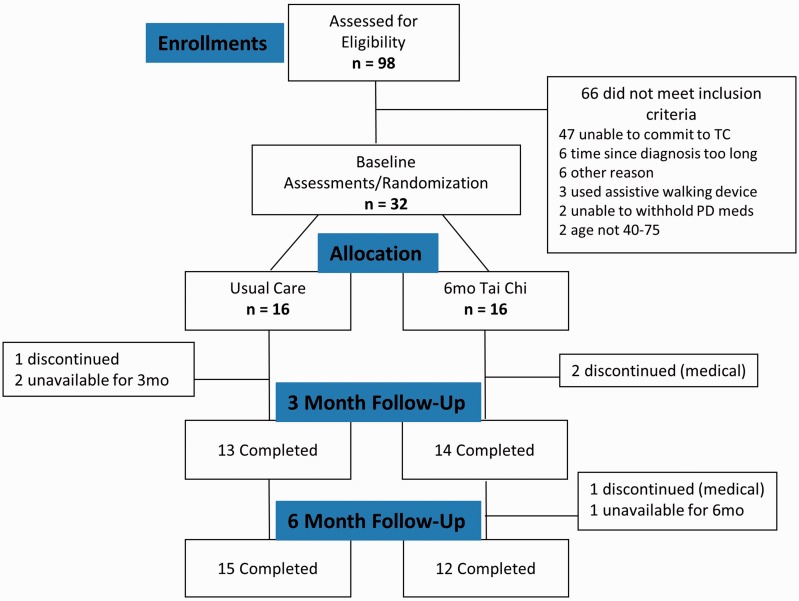
Results: Thirty-two subjects were enrolled into 3 sequential cohorts over 417 days at an average rate of 0.08 subjects per day. Seventy-five percent (12/16) in the TC group vs 94% (15/16) in the UC group completed the primary 6-month follow-up assessment. Mean TC exposure hours overall: 52. No AEs occurred during or as a direct result of TC exercise. Statistically nonsignificant improvements were observed in the TC group at 6 months in DT gait STV (TC [20.1%] vs UC [-0.1%] group [effect size 0.49; P = .47]), ABC, TUG, and PDQ-39. UPDRS progression was modest and very similar in TC and UC groups.
Conclusions: Conducting an RCT of TC for PD is feasible, though measures to improve recruitment and adherence rates are needed. DT gait STV is a sensitive and logical outcome for evaluating the combined cognitive-motor effects of TC in PD.
Keywords: Parkinson’s disease; Tai Chi; dual-task performance; feasibility; gait analysis; randomized trial.
Figures

References
-
- Ascherio A, Schwarzschild MA. The epidemiology of Parkinson’s disease: risk factors and prevention. Lancet Neurol. 2016;15(12):1257–1272. - PubMed
-
- de Lau LM, Breteler MM. Epidemiology of Parkinson’s disease. Lancet Neurol. 2006;5(6):525–535. - PubMed
-
- Neurological Disorders: Public Health Challenges. Geneva, Switzerland: World Health Organization; 2006.
Grants and funding
LinkOut - more resources
Full Text Sources
Other Literature Sources
