


National Trends in Demographics and Outcomes Following Cervical Fusion for Cervical Spondylotic Myelopathy
- PMID: 29796372
- PMCID: PMC5958486
- DOI: 10.1177/2192568217722562
National Trends in Demographics and Outcomes Following Cervical Fusion for Cervical Spondylotic Myelopathy
Abstract
Study design: Retrospective trends analysis.
Objectives: Cervical fusion is a common adjunctive surgical modality used in the treatment of cervical spondylotic myelopathy (CSM). The purpose of this study was to quantify national trends in patient demographics, hospital characteristics, and outcomes in the surgical management of CSM.
Methods: This was a retrospective study that used the National Inpatient Sample. The sample included all patients over 18 years of age with a diagnosis of CSM who underwent cervical fusion from 2003 to 2013. The outcome measures were in-hospital mortality, length of stay, and hospital charges. Chi-square tests were performed to compare categorical variables. Independent t tests were performed to compare continuous variables.
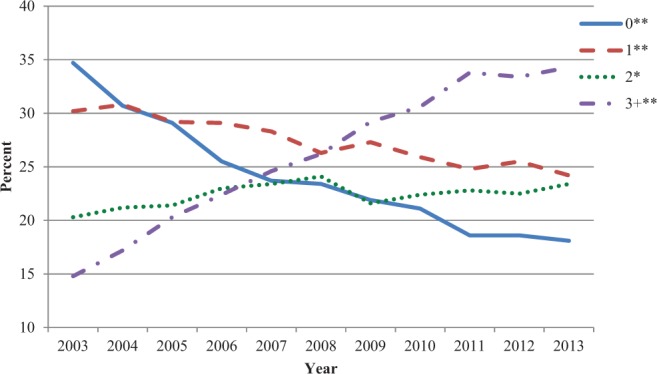
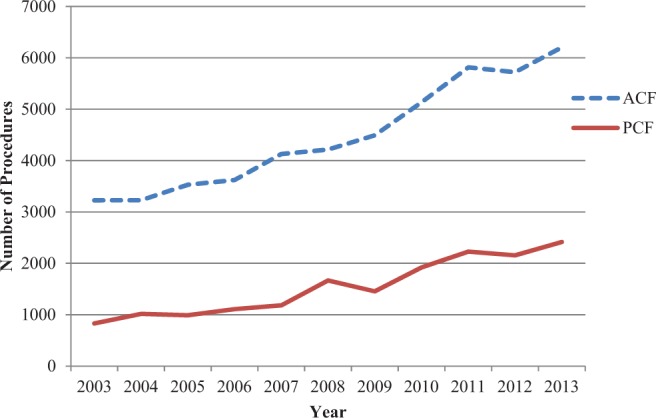
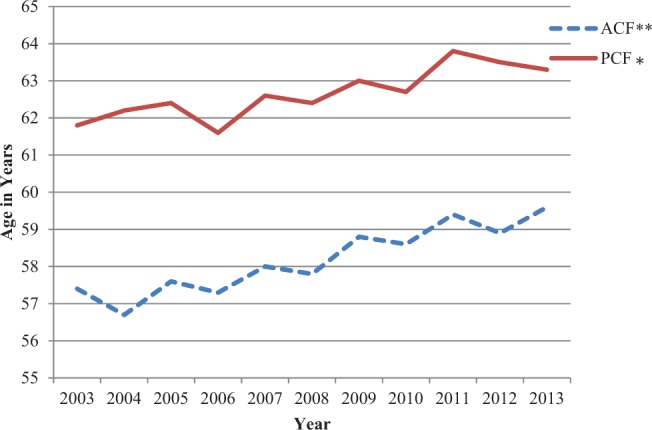
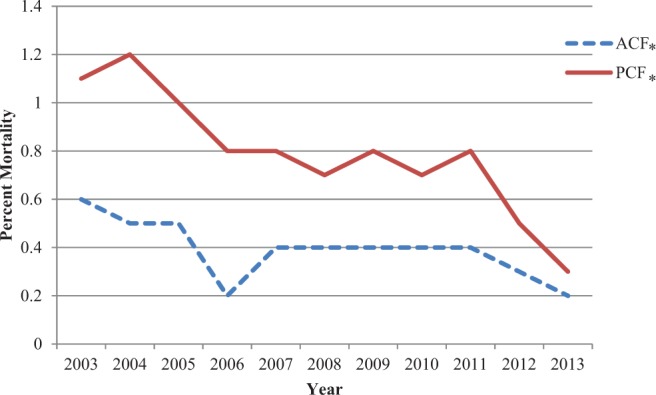
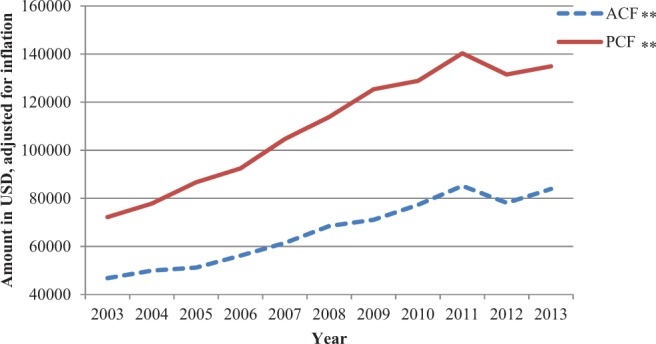
Results: We identified 62 970 patients with CSM who underwent cervical fusion from 2003 to 2013. The number of fusions performed per year in the treatment of CSM increased from 3879 to 8181. The average age of all fusion patients increased from 58.2 to 60.6 years (P < .001). Length of stay did not change significantly from a mean of 3.7 days. In-hospital mortality decreased from 0.6% to 0.3% (P < .01). Hospital charges increased from $49 445 to $92 040 (P < .001).
Conclusions: This study showed a dramatic increase in cervical fusions to treat CSM from 2003 to 2013 concomitant with increasing age of the patient population. Despite increases in average age and number of comorbidities, length of stay remained constant and a decrease in mortality was seen across the study period. However, hospital charges increased dramatically.
Keywords: NIS; National Inpatient Sample; anterior cervical fusion; cervical spondylotic myelopathy; hospital charges; mortality; posterior cervical fusion; trends.
Conflict of interest statement
Declaration of Conflicting Interests: The author(s) declared no potential conflicts of interest with respect to the research, authorship, and/or publication of this article.
Figures
References
-
- Iyer A, Azad TD, Tharin S. Cervical spondylotic myelopathy. Clin Spine Surg. 2016;29:408–414. - PubMed
-
- Wang MC, Kreuter W, Wolfla CE, Maiman DJ, Deyo RA. Trends and variations in cervical spine surgery in the United States: Medicare beneficiaries, 1992 to 2005. Spine (Phila Pa 1976). 2009;34:955–961. - PubMed
-
- Lebl DR, Bono CM. Update on the diagnosis and management of cervical spondylotic myelopathy. J Am Acad Orthop Surg. 2015;23:648–660. - PubMed
-
- Rao RD, Gourab K, David KS. Operative treatment of cervical spondylotic myelopathy. J Bone Joint Surg Am. 2006;88:1619–1640. - PubMed
Grants and funding
LinkOut - more resources
Full Text Sources
Other Literature Sources
