


Multiplex proteomics for prediction of major cardiovascular events in type 2 diabetes
- PMID: 29796748
- PMCID: PMC6061158
- DOI: 10.1007/s00125-018-4641-z
Multiplex proteomics for prediction of major cardiovascular events in type 2 diabetes
Abstract
Aims/hypothesis: Multiplex proteomics could improve understanding and risk prediction of major adverse cardiovascular events (MACE) in type 2 diabetes. This study assessed 80 cardiovascular and inflammatory proteins for biomarker discovery and prediction of MACE in type 2 diabetes.
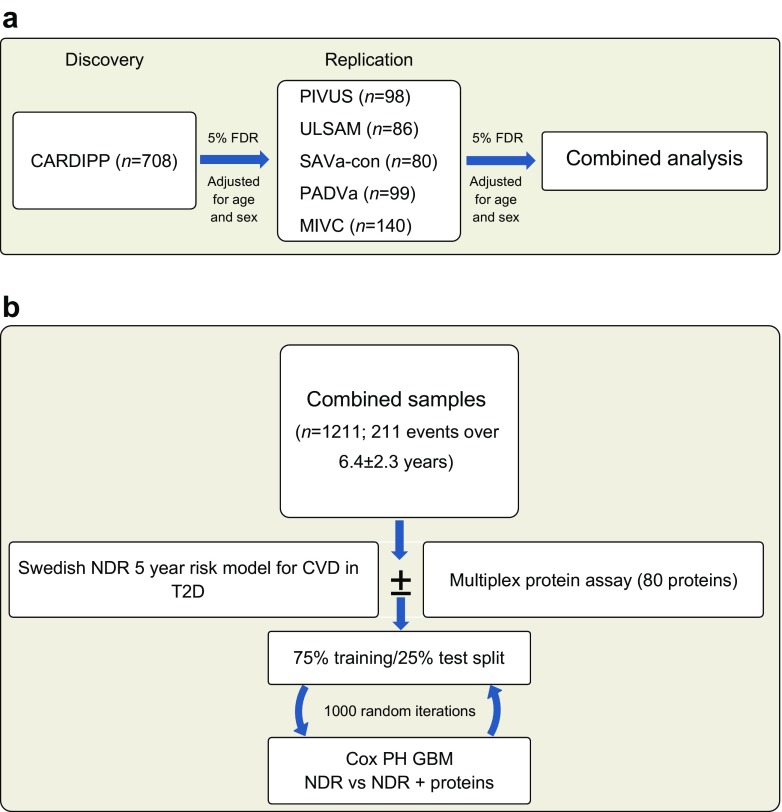
Methods: We combined data from six prospective epidemiological studies of 30-77-year-old individuals with type 2 diabetes in whom 80 circulating proteins were measured by proximity extension assay. Multivariable-adjusted Cox regression was used in a discovery/replication design to identify biomarkers for incident MACE. We used gradient-boosted machine learning and lasso regularised Cox regression in a random 75% training subsample to assess whether adding proteins to risk factors included in the Swedish National Diabetes Register risk model would improve the prediction of MACE in the separate 25% test subsample.
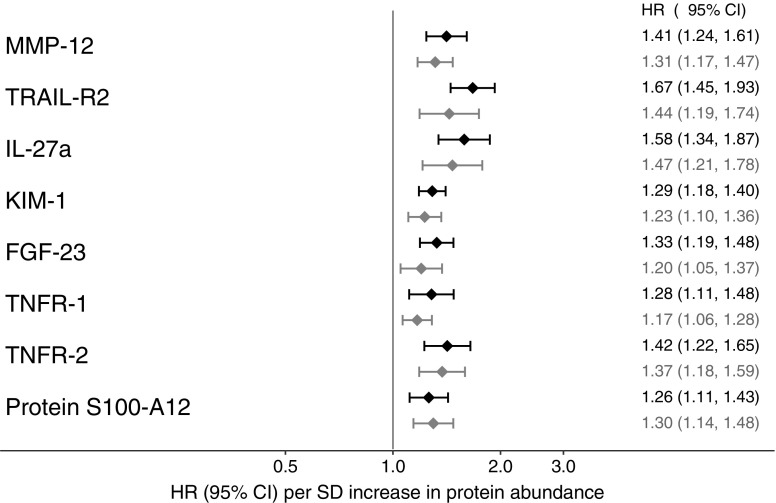
Results: Of 1211 adults with type 2 diabetes (32% women), 211 experienced a MACE over a mean (±SD) of 6.4 ± 2.3 years. We replicated associations (<5% false discovery rate) between risk of MACE and eight proteins: matrix metalloproteinase (MMP)-12, IL-27 subunit α (IL-27a), kidney injury molecule (KIM)-1, fibroblast growth factor (FGF)-23, protein S100-A12, TNF receptor (TNFR)-1, TNFR-2 and TNF-related apoptosis-inducing ligand receptor (TRAIL-R)2. Addition of the 80-protein assay to established risk factors improved discrimination in the separate test sample from 0.686 (95% CI 0.682, 0.689) to 0.748 (95% CI 0.746, 0.751). A sparse model of 20 added proteins achieved a C statistic of 0.747 (95% CI 0.653, 0.842) in the test sample.
Conclusions/interpretation: We identified eight protein biomarkers, four of which are novel, for risk of MACE in community residents with type 2 diabetes, and found improved risk prediction by combining multiplex proteomics with an established risk model. Multiprotein arrays could be useful in identifying individuals with type 2 diabetes who are at highest risk of a cardiovascular event.
Keywords: Biomarkers; Major adverse cardiovascular event; Proteomics; Risk; Type 2 diabetes.
Conflict of interest statement
EI is a scientific advisor for Olink Proteomics for projects unrelated to the present study. The company had no influence over the design, analysis or interpretation of data in the present study, and did not provide any funding for the study. JÄ has received lecturing fees from AstraZeneca unrelated to the present project. The authors report that there are no other duality of interests associated with their contribution to this manuscript.
Figures
References
-
- International Diabetes Federation . IDF Diabetes Atlas. 8. Brussels: International Diabetes Federation; 2017. - PubMed
Publication types
MeSH terms
Substances
Grants and funding
LinkOut - more resources
Full Text Sources
Other Literature Sources
Medical
Research Materials
Miscellaneous
