


Cross-education does not accelerate the rehabilitation of neuromuscular functions after ACL reconstruction: a randomized controlled clinical trial
- PMID: 29796857
- PMCID: PMC6060748
- DOI: 10.1007/s00421-018-3892-1
Cross-education does not accelerate the rehabilitation of neuromuscular functions after ACL reconstruction: a randomized controlled clinical trial
Abstract
Purpose: Cross-education reduces quadriceps weakness 8 weeks after anterior cruciate ligament (ACL) surgery, but the long-term effects are unknown. We investigated whether cross-education, as an adjuvant to the standard rehabilitation, would accelerate recovery of quadriceps strength and neuromuscular function up to 26 weeks post-surgery.
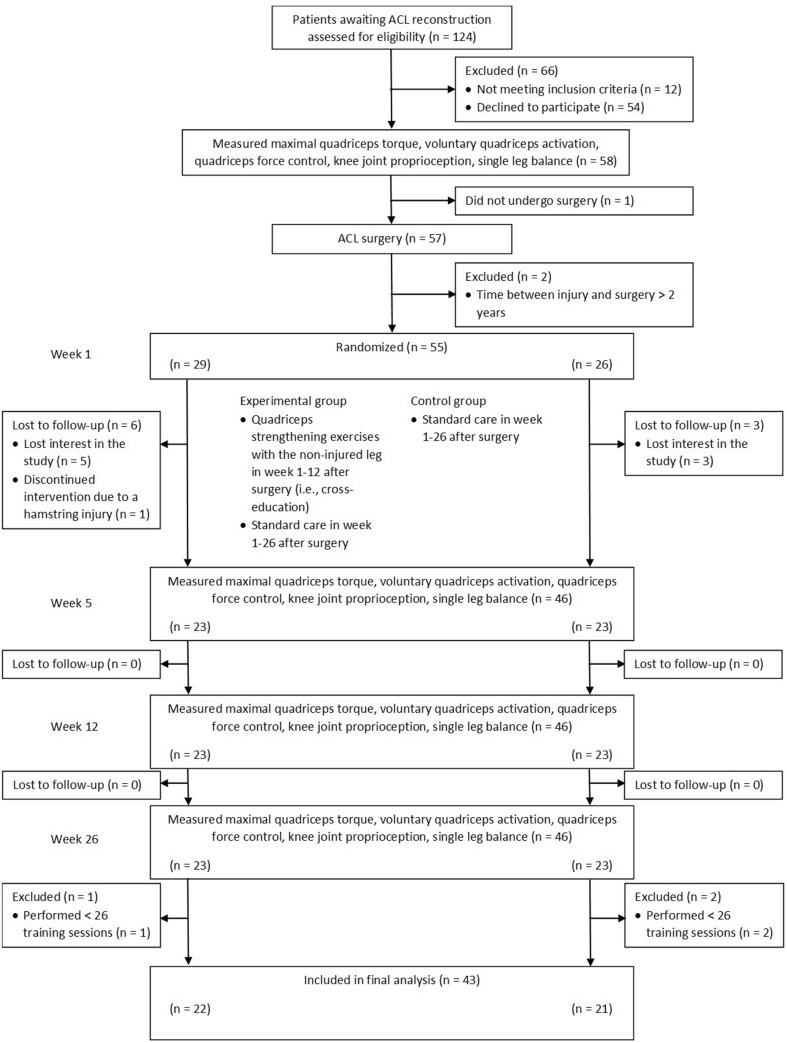
Methods: Group allocation was randomized. The experimental (n = 22) and control (n = 21) group received standard rehabilitation. In addition, the experimental group strength trained the quadriceps of the non-injured leg in weeks 1-12 post-surgery (i.e., cross-education). Primary and secondary outcomes were measured in both legs 29 ± 23 days prior to surgery and at 5, 12, and 26 weeks post-surgery.
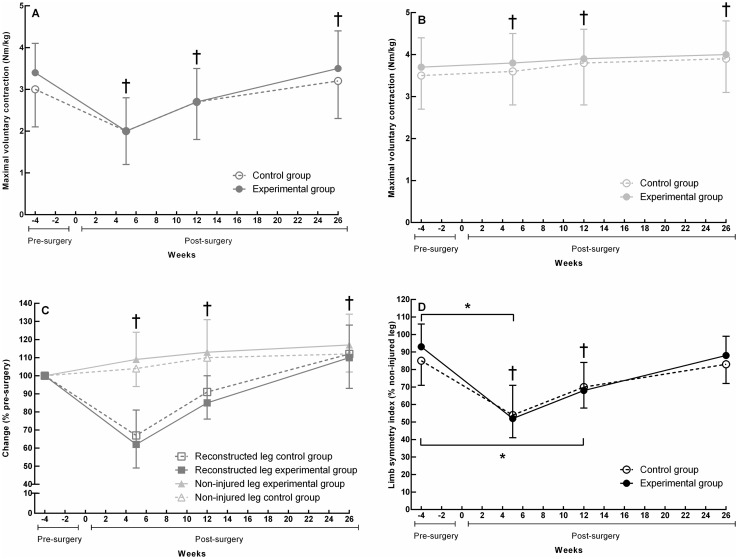
Results: The primary outcome showed time and cross-education effects. Maximal quadriceps strength in the reconstructed leg decreased 35% and 12% at, respectively, 5 and 12 weeks post-surgery and improved 11% at 26 weeks post-surgery, where strength of the non-injured leg showed a gradual increase post-surgery up to 14% (all p ≤ 0.015). Limb symmetry deteriorated 9-10% more for the experimental than control group at 5 and 12 weeks post-surgery (both p ≤ 0.030). One of 34 secondary outcomes revealed a cross-education effect: Voluntary quadriceps activation of the reconstructed leg was 6% reduced for the experimental vs. control group at 12 weeks post-surgery (p = 0.023). Both legs improved force control (22-34%) and dynamic balance (6-7%) at 26 weeks post-surgery (all p ≤ 0.043). Knee joint proprioception and static balance remained unchanged.
Conclusion: Standard rehabilitation improved maximal quadriceps strength, force control, and dynamic balance in both legs relative to pre-surgery but adding cross-education did not accelerate recovery following ACL reconstruction.
Keywords: Force control; Maximal voluntary force; Postural stability; Proprioception; Strength training; Twitch interpolation.
Conflict of interest statement
Conflict of interest
The authors declare that they have no conflict of interest.
Ethical approval
All procedures performed in studies involving human participants were in accordance with the ethical standards of the institutional and/or national research committee and with the 1964 Helsinki declaration and its later amendments or comparable ethical standards.
Informed consent
Informed consent was obtained from all individual participants included in the study.
Figures
References
Publication types
MeSH terms
Grants and funding
LinkOut - more resources
Full Text Sources
Other Literature Sources
Medical
