


Effects of meta-tetrahydroxyphenylchlorin photodynamic therapy on isogenic colorectal cancer SW480 and SW620 cells with different metastatic potentials
- PMID: 29796953
- PMCID: PMC6133037
- DOI: 10.1007/s10103-018-2524-7
Effects of meta-tetrahydroxyphenylchlorin photodynamic therapy on isogenic colorectal cancer SW480 and SW620 cells with different metastatic potentials
Abstract
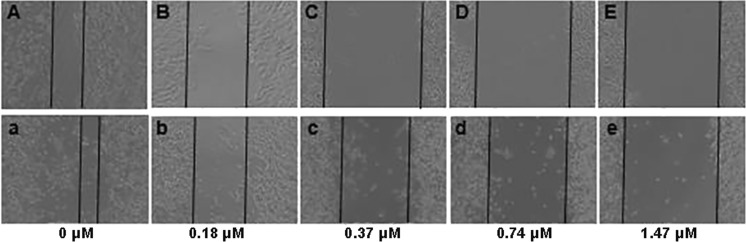
The aim of this study is to investigate the antitumor effects and possible mechanisms of meta-tetrahydroxyphenylchlorin-mediated photodynamic therapy (m-THPC-PDT) on human primary (SW480) and metastatic (SW620) colon cancer cell lines. SW480 and SW620 cells were incubated with various concentrations of m-THPC, followed by photodynamic irradiation. Subcellular localization of m-THPC in cells was observed with confocal laser scanning microscopy (CLSM). Photocytotoxicity of m-THPC in the two cells was investigated by using MTT assay. The flow cytometry was employed to detect the cell apoptosis. The migration and long-term recovery ability were determined by scratch test and colony formation assay respectively. CLSM showed that m-THPC was mainly distributed within the endoplasmic reticulum (ER) and lysosome of SW480 cells and within the lysosome and mitochondria of SW620 cells. m-THPC-PDT induced a dose-dependent and light energy-dependent cytotoxicity in SW480 and SW620 cells. Apoptosis rate was approximately 65 and 25% in SW480 and SW620 respectively when the concentration of m-THPC increased to 11.76 μM. However, the rate of necrotic cells had no significant changes in two cell lines. The colony formation and migration ability of the two cell lines were decreased with m-THPC-PDT treatment in a dose-dependent manner. PDT with m-THPC not only could effectively inhibit cell proliferation and decrease migration ability and colony formation ability, but also could effectively kill SW480 and SW620 cells in a dose-dependent manner in vitro. These results suggest that m-THPC is a promising sensitizer that warrants further development and extensive studies towards clinical use of colorectal cancer.
Keywords: Apoptosis; Cell death; Colorectal cancer; Meta-tetrahydroxyphenylchlorin; Photodynamic therapy.
Conflict of interest statement
Conflict of interest
The authors declare that they have no conflict of interest.
Ethical approval
This article does not contain any studies with human participants or animals performed by any of the authors.
Figures


References
-
- Dai Z, Zheng RS, Zou XN, ZHand SW, Zeng HM, Li N, Chen WQ. Analysis and prediction of colorectal cancer incidence trend in China. Zhonghua Yu Fang Yi Xue Za Zhi. 2012;46(7):598–603. - PubMed
-
- Nitsche U, Maak M, Schuster T, Künzli B, Langer R, Slotta-Huspenina J, Janssen KP, Friess H, Rosenberg R. Prediction of prognosis is not improved by the seventh and latest edition of the TNM classification for colorectal cancer in a single-center collective. Ann Surg. 2011;254(5):793–800. doi: 10.1097/SLA.0b013e3182369101. - DOI - PubMed
-
- Verwaal VJ, van Ruth S, de Bree E, van Sloothen GW, van Tinteren H, Boot H, Zoetmulder FA. Randomized trial of cytoreduction and hyperthermic intraperitoneal chemotherapy versus systemic chemotherapy and palliative surgery in patients with peritoneal carcinomatosis of colorectal cancer. J Clin Oncol. 2003;21(20):3737–3743. doi: 10.1200/JCO.2003.04.187. - DOI - PubMed
MeSH terms
Substances
Grants and funding
LinkOut - more resources
Full Text Sources
Other Literature Sources
Medical
