


Targeted mutation screening of 292 candidate genes in 38 children with inborn haematological cytopenias efficiently identifies novel disease-causing mutations
- PMID: 29797310
- PMCID: PMC6079646
- DOI: 10.1111/bjh.15389
Targeted mutation screening of 292 candidate genes in 38 children with inborn haematological cytopenias efficiently identifies novel disease-causing mutations
Abstract
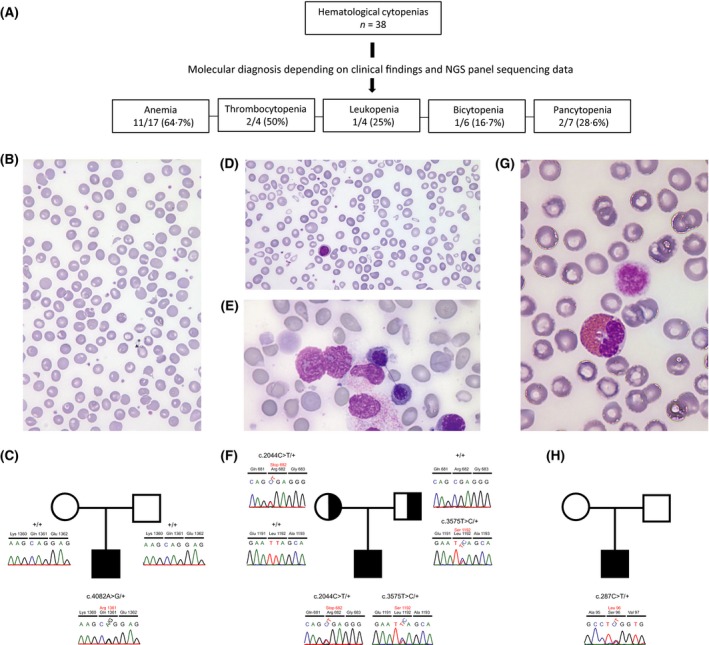
Establishing a precise diagnosis is essential in inborn haematological cytopenias to enable appropriate treatment decisions and avoid secondary organ damage. However, both diversity and phenotypic overlap of distinct disease entities may make the identification of underlying genetic aetiologies by classical Sanger sequencing challenging. Instead of exome sequencing, we established a systematic next generation sequencing-based panel targeting 292 candidate genes and screened 38 consecutive patients for disease-associated mutations. Efficient identification of the underlying genetic cause in 17 patients (44·7%), including 13 novel mutations, demonstrates that this approach is time- and cost-efficient, enabling optimal management and genetic counselling.
Keywords: clinical haematology; genetic disorders; immunodeficiency; paediatric haematology.
© 2018 The Authors. British Journal of Haematology published by John Wiley & Sons Ltd and British Society for Haematology.
Figures
References
-
- Agarwal, A.M. , Nussenzveig, R.H. , Reading, N.S. , Patel, J.L. , Sangle, N. , Salama, M.E. , Prchal, J.T. , Perkins, S.L. , Yaish, H.M. & Christensen, R.D. (2016) Clinical utility of next‐generation sequencing in the diagnosis of hereditary haemolytic anaemias. British Journal of Haematology, 174, 806–814. - PubMed
-
- Albuisson, J. , Murthy, S.E. , Bandell, M. , Coste, B. , Louis‐Dit‐Picard, H. , Mathur, J. , Feneant‐Thibault, M. , Tertian, G. , de Jaureguiberry, J.P. , Syfuss, P.Y. , Cahalan, S. , Garcon, L. , Toutain, F. , Simon Rohrlich, P. , Delaunay, J. , Picard, V. , Jeunemaitre, X. & Patapoutian, A. (2013) Dehydrated hereditary stomatocytosis linked to gain‐of‐function mutations in mechanically activated PIEZO1 ion channels. Nature Communications, 4, 1884. - PMC - PubMed
-
- Buck, D. , Malivert, L. , de Chasseval, R. , Barraud, A. , Fondaneche, M.C. , Sanal, O. , Plebani, A. , Stephan, J.L. , Hufnagel, M. , le Deist, F. , Fischer, A. , Durandy, A. , de Villartay, J.P. & Revy, P. (2006) Cernunnos, a novel nonhomologous end‐joining factor, is mutated in human immunodeficiency with microcephaly. Cell, 124, 287–299. - PubMed
-
- Erman, B. , Bilic, I. , Hirschmugl, T. , Salzer, E. , Boztug, H. , Sanal, O. , Cagdas Ayvaz, D. , Tezcan, I. & Boztug, K. (2017) Investigation of genetic defects in severe combined immunodeficiency patients from Turkey by targeted sequencing. Scandinavian Journal of Immunology, 85, 227–234. - PubMed
Publication types
MeSH terms
Grants and funding
LinkOut - more resources
Full Text Sources
Other Literature Sources
Medical
