Review
. 2018 May 25;122(11):1586-1607.
doi: 10.1161/CIRCRESAHA.118.311597.

Epigenomes in Cardiovascular Disease

Affiliations
Review

Epigenomes in Cardiovascular Disease

Manuel Rosa-Garrido et al. Circ Res. .

Abstract

If unifying principles could be revealed for how the same genome encodes different eukaryotic cells and for how genetic variability and environmental input are integrated to impact cardiovascular health, grand challenges in basic cell biology and translational medicine may succumb to experimental dissection. A rich body of work in model systems has implicated chromatin-modifying enzymes, DNA methylation, noncoding RNAs, and other transcriptome-shaping factors in adult health and in the development, progression, and mitigation of cardiovascular disease. Meanwhile, deployment of epigenomic tools, powered by next-generation sequencing technologies in cardiovascular models and human populations, has enabled description of epigenomic landscapes underpinning cellular function in the cardiovascular system. This essay aims to unpack the conceptual framework in which epigenomes are studied and to stimulate discussion on how principles of chromatin function may inform investigations of cardiovascular disease and the development of new therapies.

Keywords: cardiovascular diseases; chromatin; epigenomics; genetics; transcriptome.


Figures

Figure 1.
Figure 1.
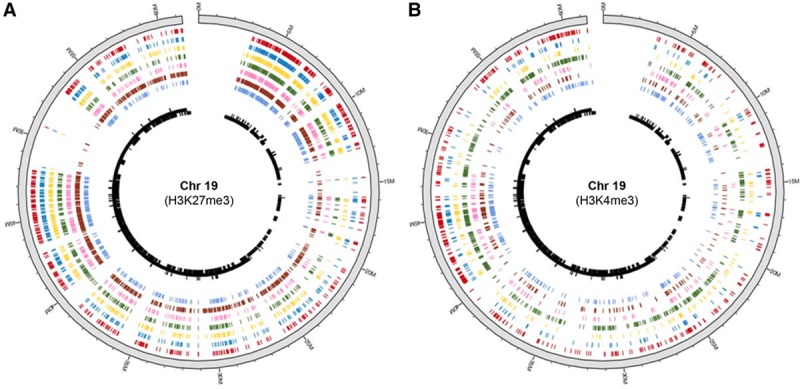
Occupancy of histone marks varies between cell types. Circos plot of mouse chr19 shows (A) repressive H3K27me3 and (B) active H3K4me3 peaks across different tissues. Color-coding of tissues (outside to inside): heart (red), cerebellum (blue), kidney (yellow), liver (green), thymus (orange), testis (dark red), and spleen (light blue). The black track represents mm10 gene density on chromosome 19. Data are from the ENCODE (Encyclopedia of DNA Elements) database.
Figure 2.
Figure 2.
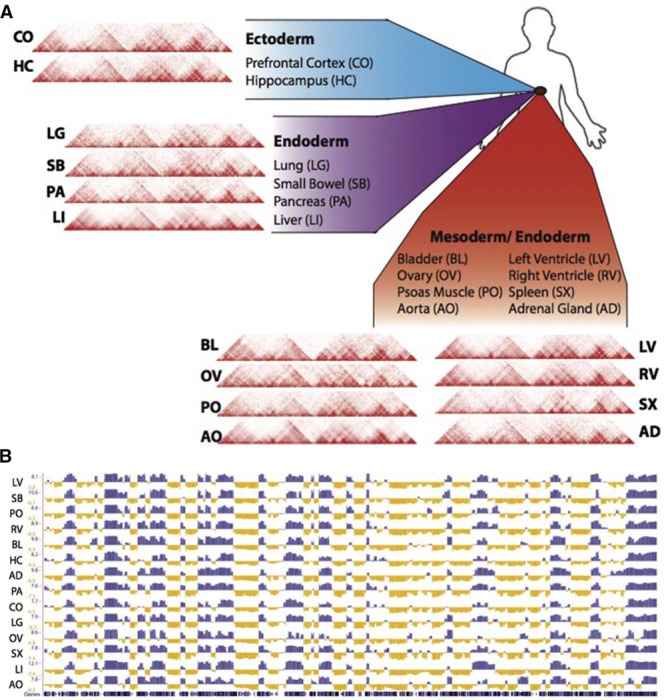
Chromatin conformation capture data reveal similarities in chromatin organization between cell types. A, Representative contact matrices from 14 human tissues (A), and their A/B compartmentalization profiles (B), demonstrate similarities at the scale of topologically associated domains (TADs) and compartmentalization. AD indicates adrenal gland; AO, aorta; BL, bladder; CO, prefrontal cortex; HC, hippocampus; LG, lung; LI, liver; LV, left ventricle; OV, ovary; PA, pancreas; PO, psoas muscle; RV, right ventricle; SB, small bowel; and SX, spleen. Black track represents mm10 gene density on chromosome 19. Data are from the ENCODE (Encyclopedia of DNA Elements) database. Adapted from Schmitt et al with permission. Copyright ©2016, the Authors.
Figure 3.
Figure 3.
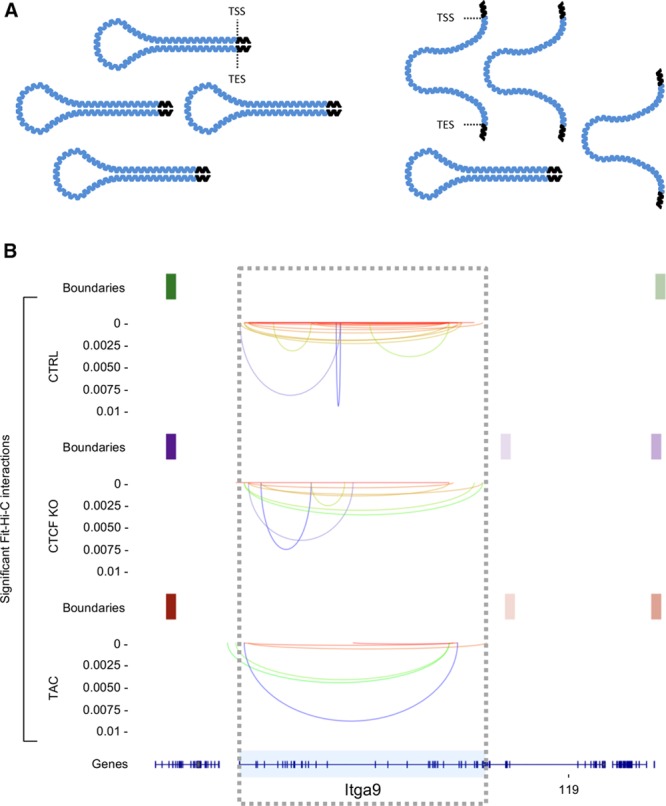
Chromatin looping. A, Schematic representation of chromatin looping, in this example between transcription start (TSS) and end (TES) sites of a gene. The model is an interpretation of chromatin capture data (which shows a decrease in interactions during cardiac pathology) and is intended to represent the frequency of a given conformation, not a population effect across cells: left, under normal conditions, loops are stably formed; right, because loops are less stable, they are less frequently captured experimentally. B, An example gene displaying this behavior. Top is control, middle is CTCF (CCCTC-binding factor) knockout, and bottom is transverse aortic constriction. Rectangles are topologically associated domain boundaries, and lines are chromatin interactions detected by Hi-C (Reprinted from Rosa-Garrido et al with permission. Copyright ©2017, the American Heart Association). Online Table II shows a list of genes that undergo the phenomenon described in the figure.
Figure 4.
Figure 4.
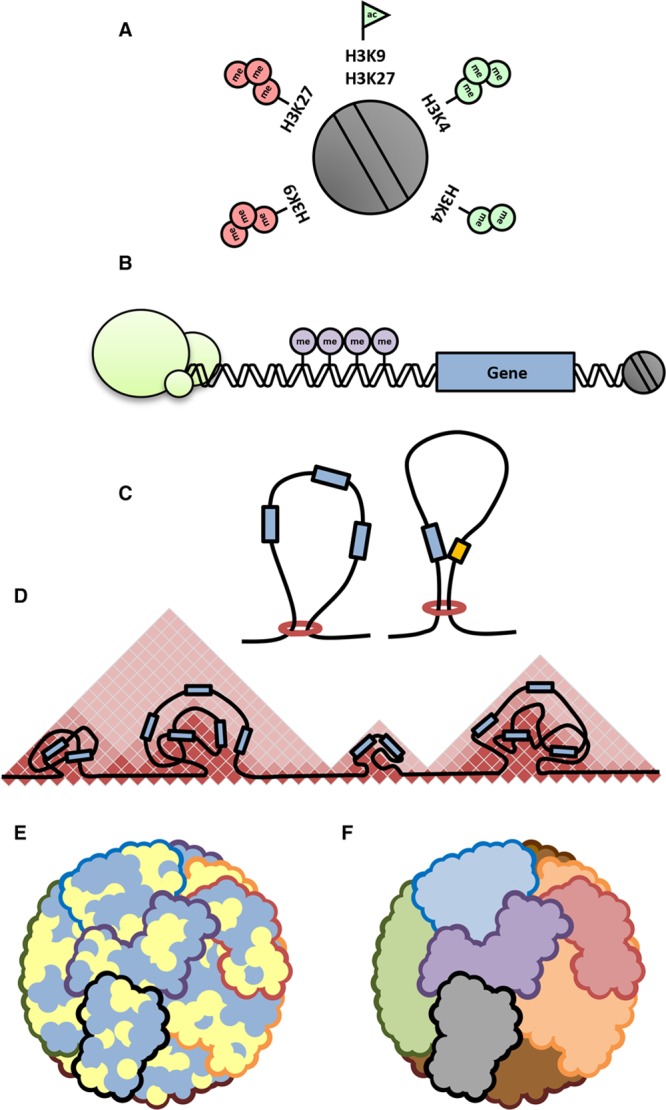
Chromatin architectural features. A, The functional unit of chromatin is the nucleosome, which can be decorated by a variety of post-translational modifications that modulate accessibility to transcription factors or chromatin modifiers. B, At the gene level, transcription factors or repressors (green circles) confer context-specific regulation of transcription with varying levels of sequence specificity. DNA methylation (purple circles) typically repress promoter activity of genes although this phenomenon is associated with expression when found within gene bodies. C, Chromatin looping enables formation of gene expression or silencing neighborhoods, as well as facilitating structural units suitable for higher order packing. D, Topologically associating domains (TADs) are regions of preferential chromatin interactions. E, Hi-C data reveal chromatin compartmentalization into active and inactive, or A and B compartments of the genome, respectively (here shown in yellow and blue; note, this is a stylistic interpretation of how A and B compartments might interact because chromatin capture studies do not reveal actual localization coordinates within the nucleus). F, Chromosome paint experiments have revealed distinct territories that contain entire chromosomes within the nucleus, allowing formation of intra- and interchromosomal interactions that may regulate transcription or other tasks of the nucleus.
Figure 5.
Figure 5.
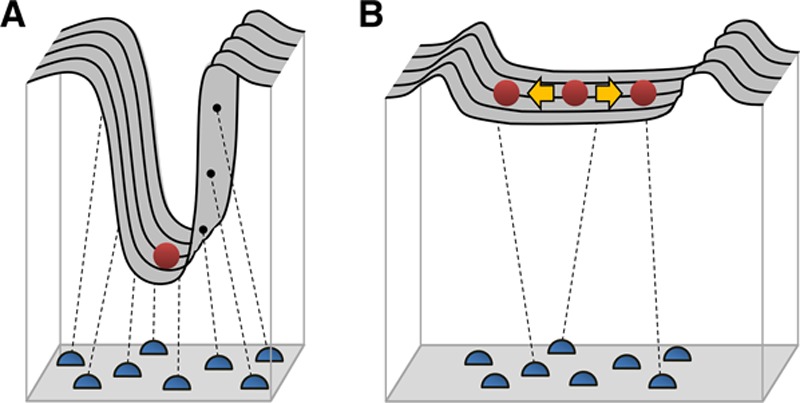
Plasticity in epigenomic landscapes may allow for transcriptome reprogramming in disease. Adapting Waddington’s concept of, to paraphrase, the chemical tendencies underpinning the epigenetic landscape (The Strategy of the Genes, New York: The Macmillan Company; 1957), the figure depicts how, when some of the chemical tendencies (A; which we now know to be the DNA, proteins, and RNA that establish the 3-dimensional structure of the epigenome, blue semicircles) are perturbed by experiment or environment (B), the red ball (which here represents a cell or cell population) can adopt different positions along the energy landscape, becoming sufficiently plastic to enable disease-associated gene expression.
Figure 6.
Figure 6.
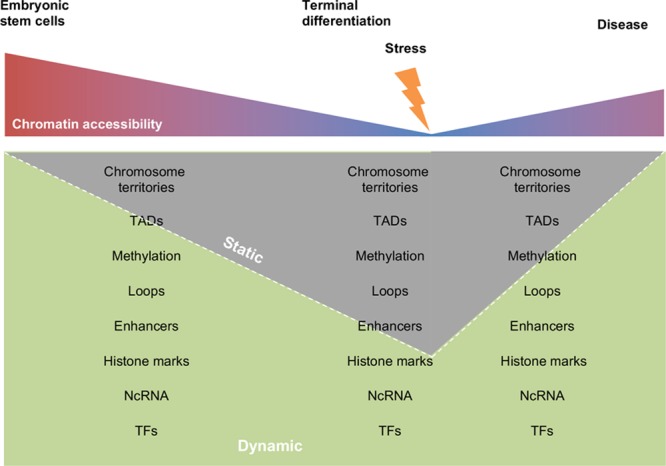
Model for epigenomic changes in development and disease. Development is accompanied by changes in chromatin structure and regulation to endow terminally differentiated cells with stable transcriptomes. Disease upsets this balance, transitioning select regions of the genome into more dynamic conformations through effects on chromatin structure, enhancer-gene looping and alterations in histone modification, DNA methylation, and other factors. This model is based on findings reviewed in the current paper and adapted from Rosa-Garrido et al with permission. Copyright ©2017, the American Heart Association.
Figure 7.
Figure 7.
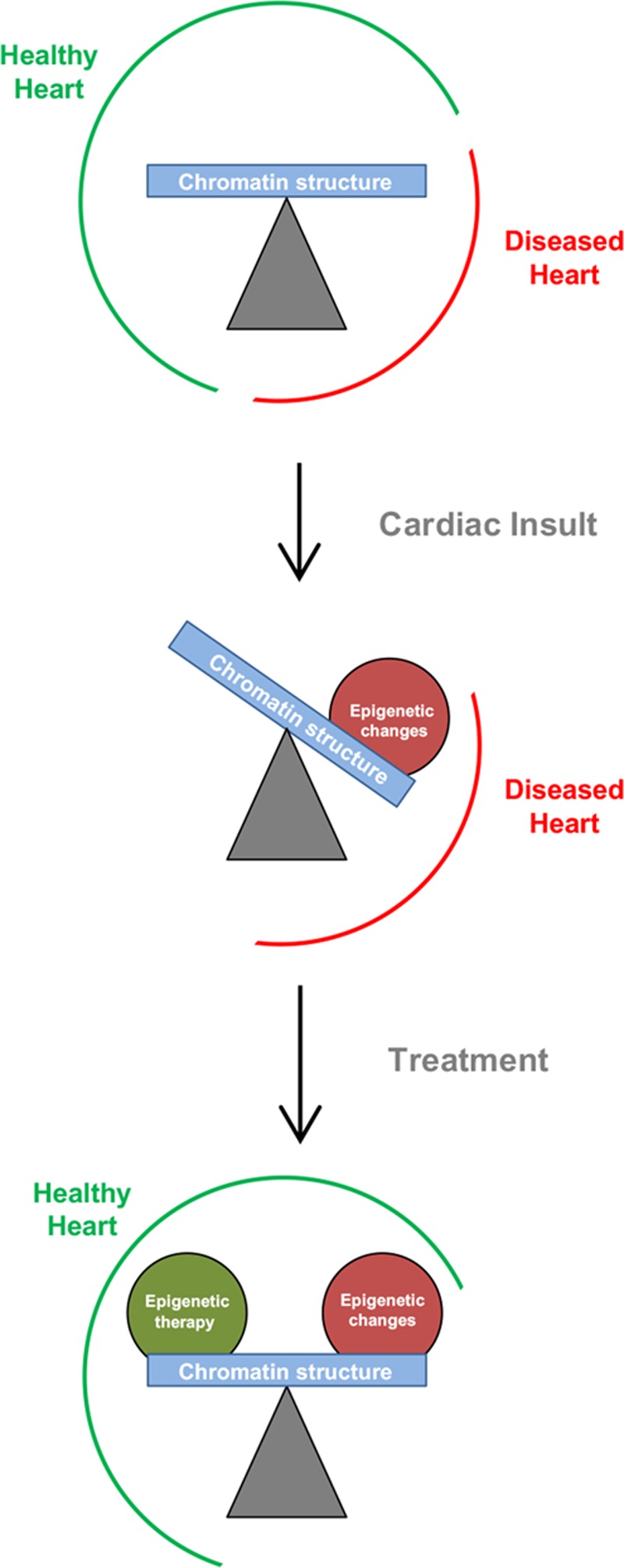
Cardiac epigenetic therapies. Changes in chromatin structure during cardiovascular pathologies alter gene expression and thereby phenotype. Epigenetic therapies (examples include histone deacetylases inhibition, BET (bromodomain and extra-terminal) inhibition, chromatin structural protein modulation, and chromatin loop or DNA methylation targeting by CRISPR/Cas9 tools) could be designed to reverse these changes by targeting intermediate chromatin features, such as accessibility and structure.

References

    1. Kornberg RD. Structure of chromatin. Annu Rev Biochem. 1977;46:931–954. doi: 10.1146/annurev.bi.46.070177.004435. - PubMed
    1. Luger K, Mäder AW, Richmond RK, Sargent DF, Richmond TJ. Crystal structure of the nucleosome core particle at 2.8 A resolution. Nature. 1997;389:251–260. doi: 10.1038/38444. - PubMed
    1. Suto RK, Clarkson MJ, Tremethick DJ, Luger K. Crystal structure of a nucleosome core particle containing the variant histone H2A.Z. Nat Struct Biol. 2000;7:1121–1124. doi: 10.1038/81971. - PubMed
    1. Sekulic N, Bassett EA, Rogers DJ, Black BE. The structure of (CENP-A-H4)(2) reveals physical features that mark centromeres. Nature. 2010;467:347–351. doi: 10.1038/nature09323. - PMC - PubMed
    1. Buschbeck M, Hake SB. Variants of core histones and their roles in cell fate decisions, development and cancer. Nat Rev Mol Cell Biol. 2017;18:299–314. doi: 10.1038/nrm.2016.166. - PubMed

Publication types

MeSH terms