Review
. 2018 Aug 21:38:401-429.
doi: 10.1146/annurev-nutr-082117-051757. Epub 2018 May 23.

Nutritional Influences on One-Carbon Metabolism: Effects on Arsenic Methylation and Toxicity

Affiliations
Review

Nutritional Influences on One-Carbon Metabolism: Effects on Arsenic Methylation and Toxicity

Anne K Bozack et al. Annu Rev Nutr. .

Abstract

Exposure to inorganic arsenic (InAs) via drinking water and/or food is a considerable worldwide problem. Methylation of InAs generates monomethyl (MMAsIII+V)- and dimethyl (DMAsIII+V)-arsenical species in a process that facilitates urinary As elimination; however, MMAs is considerably more toxic than either InAs or DMAs. Emerging evidence suggests that incomplete methylation of As to DMAs, resulting in increased MMAs, is associated with increased risk for a host of As-related health outcomes. The biochemical pathway that provides methyl groups for As methylation, one-carbon metabolism (OCM), is influenced by folate and other micronutrients, including choline and betaine. Individuals and species differ widely in their ability to methylate As. A growing body of research, including cell-culture, animal-model, and epidemiological studies, has demonstrated the role of OCM-related micronutrients in As methylation. This review examines the evidence that nutritional status and nutritional interventions can influence the metabolism and toxicity of As, with a primary focus on folate.

Keywords: arsenic; arsenic methylation; folate; nutrition; one-carbon metabolism.


Figures
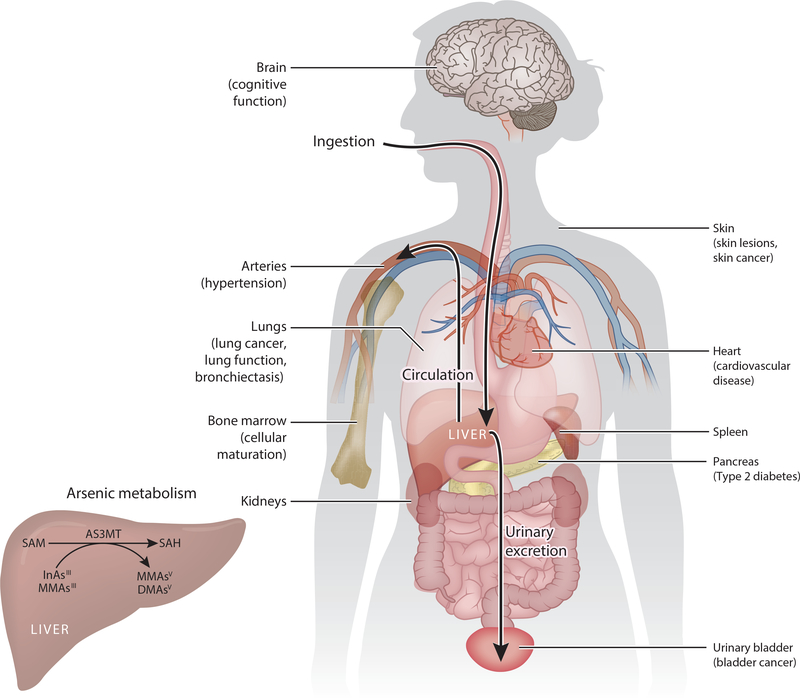
Figure 1
Figure 1
Arsenic metabolism, target tissues, and comorbidities. Chronic As exposure has been associated with increased risk of skin lesions (melanosis, leukomelanosis, and keratosis), cardiovascular disease, hypertension (91), impaired intellectual function, inflammation, diabetes, and cancers. Ingested As accumulates in multiple tissues, including the spleen, liver, lungs, kidneys, bladder, skin, and bone marrow. (Inset) AS3MT is predominantly expressed in the liver, although AS3MT mRNA has also been detected in the kidneys, adrenal gland, bladder, heart, and brain (92). Abbreviations: AS3MT, arsenic-3-methyltransferase; DMAsV, dimethylarsinic acid; InAsIII, arsenite; MMAsIII, monomethylarsonous acid; MMAsV, monomethylarsonic acid; SAH, S-adenosylhomocysteine; SAM, S-adenosylmethionine.
Figure 2
Figure 2
Arsenic metabolism. According to the Challenger pathway (24), AS3MT catalyzes the oxidative methylation of arsenite using SAM as the methyl donor, forming MMAsV and SAH. MMAsV is then reduced to MMAsIII before a subsequent oxidative methylation step, yielding DMAsV and SAH. Abbreviations: AS3MT, arsenic-3-methyltransferase; DMAsV, dimethylarsinic acid; MMAsIII, monomethylarsonous acid; MMAsV, monomethylarsonic acid; SAH, S-adenosylhomocysteine; SAM, S-adenosylmethionine.
Figure 3
Figure 3
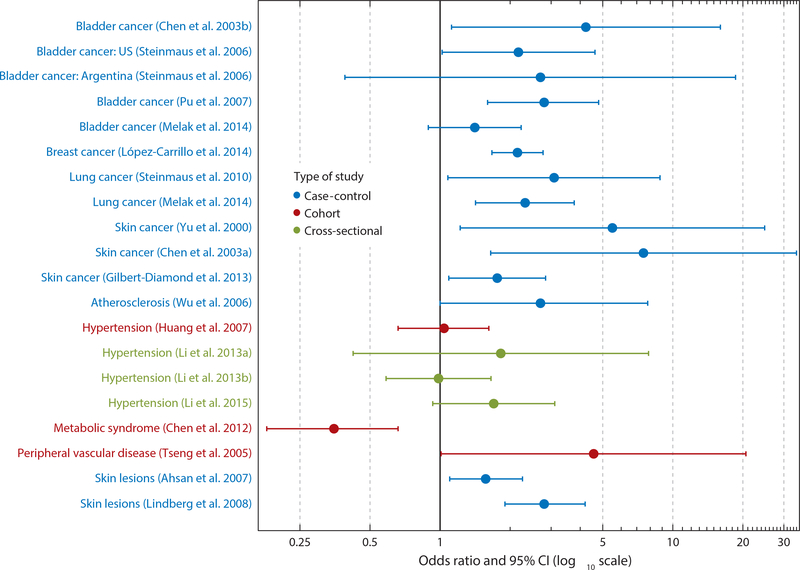
Summary plot of odds ratios and 95% CI for health outcomes reported to be associated with %MMAs in urine (, –, , , –91, 94, 97, 103, 123, 140, 144, 153, 166, 170). Abbreviations: %MMAs, percent monomethyl-arsenical species; CI, confidence interval.
Figure 4
Figure 4
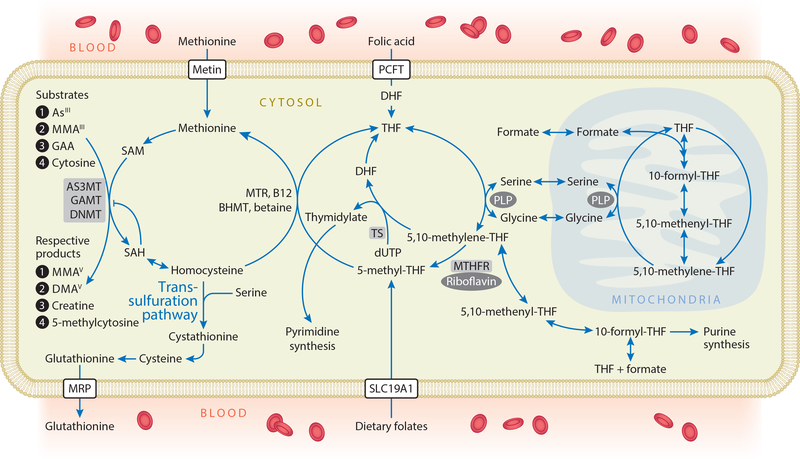
One-carbon metabolism. FA, arising from fortified foods or nutritional supplements, is reduced to DHF and THF by dihydrofolate reductase. Serine hydroxymethyl-transferase transfers one-carbon units from serine to THF, with PLP as a coenzyme, forming 5,10-methylene-THF. This is either used for the synthesis of thymidylate or reduced to 5-methyl-THF. Dietary folates can enter one-carbon metabolism as 5-methyl-THF. The methyl group of 5-methyl-THF is transferred to homocysteine in a reaction catalyzed by MTR and utilizing B12 as a cofactor, generating methionine and THF. Alternatively, in the liver, betaine can donate a methyl group for the remethylation of homocysteine in a reaction catalyzed by BHMT. Methionine adenosyltransferase enzymes activate methionine to form SAM—the methyl donor for numerous acceptors, including arsenicals, GAA (the precursor to creatine), and DNA—in reactions that involve substrate-specific methyltransferase enzymes. These methylation reactions generate the methylated products and SAH, a potent product inhibitor of most methyltransferases. SAH is hydrolyzed to generate homocysteine, which is either remethylated to regenerate methionine or directed to the transsulfuration pathway and ultimately glutathionine synthesis. Abbreviations: AS3MT, arsenic-3-methyltransferase; BHMT, betaine homocysteine methyltransferase; DHF, dihydrofolate; DMAsV, dimethylarsinic acid; DNMT, DNA methyltransferases; FA, folic acid; GAA, guanidinoacetate; GAMT, guanidinoacetate-N-methyltransferase; InAsIII, arsenite; MMAsIII, monomethylarsonous acid; MMAsV, monomethylarsonic acid; MRP, multidrug resistance proteins; MTR, methionine synthase; PCFT, proton coupled folate transporter; PLP, pyridoxal phosphate; SAH, S-adenosylhomocysteine; SAM, S-adenosylmethionine; SLC19A1, solute carrier family 19 (folate transporter), member 1, also known as RFC1; THF, tetrahydrofolate; TS, thymidylate synthetase.

References

    1. Agusa T, Iwata H, Fujihara J, Kunito T, Takeshita H, et al. 2009. Genetic polymorphisms in AS3MT and arsenic metabolism in residents of the Red River Delta, Vietnam. Toxicol. Appl. Pharmacol 236:131–41 - PubMed
    1. Ahsan H, Chen Y, Kibriya MG, Slavkovich V, Parvez F, et al. 2007. Arsenic metabolism, genetic susceptibility, and risk of premalignant skin lesions in Bangladesh. Cancer Epidemiol. Biomark. Prev 16:1270–78 - PubMed
    1. Am. Cancer Soc. 2016. Known and probable human carcinogens. Am. Cancer Soc., Atlanta, GA. https://www.cancer.org/cancer/cancer-causes/general-info/known-and-proba...
    1. Aposhian HV, Aposhian MM. 2006. Arsenic toxicology: five questions. Chem. Res. Toxicol 19:1–15 - PubMed
    1. Argos M 2015. Arsenic exposure and epigenetic alterations: recent findings based on the Illumina 450K DNA Methylation Array. Curr. Environ. Health Rep 2(2):137–44 - PMC - PubMed