


eXpression2Kinases (X2K) Web: linking expression signatures to upstream cell signaling networks
- PMID: 29800326
- PMCID: PMC6030863
- DOI: 10.1093/nar/gky458
eXpression2Kinases (X2K) Web: linking expression signatures to upstream cell signaling networks
Abstract
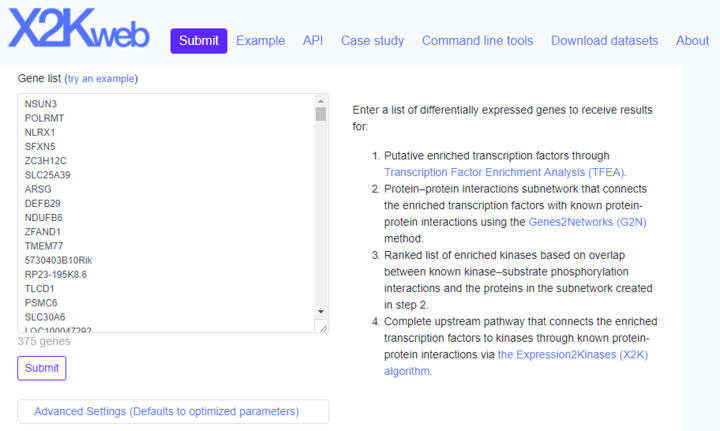
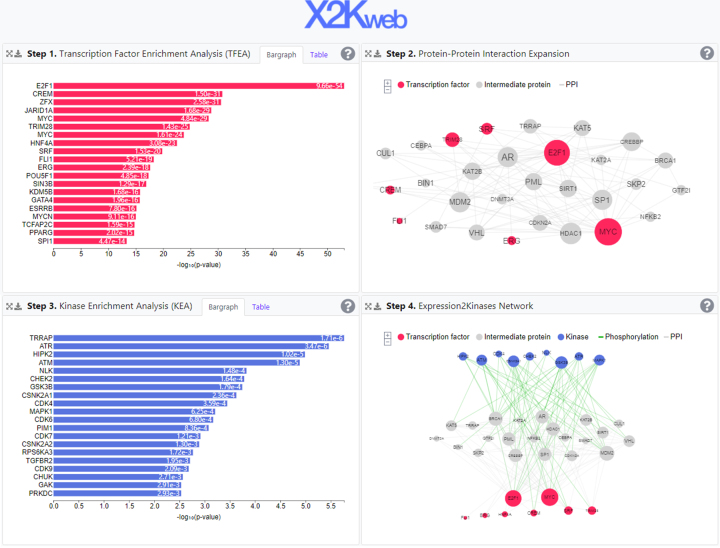
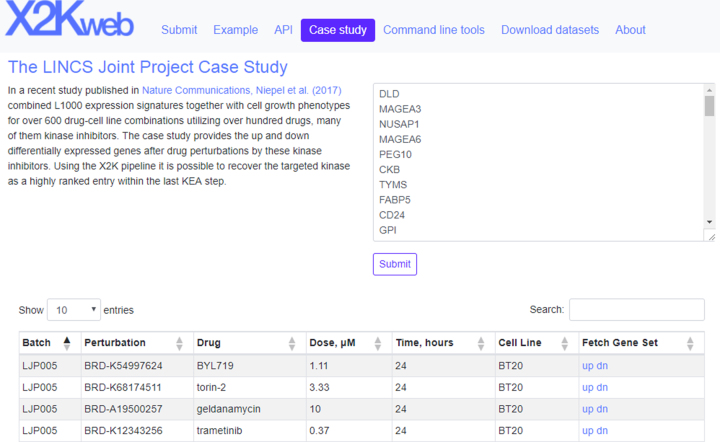
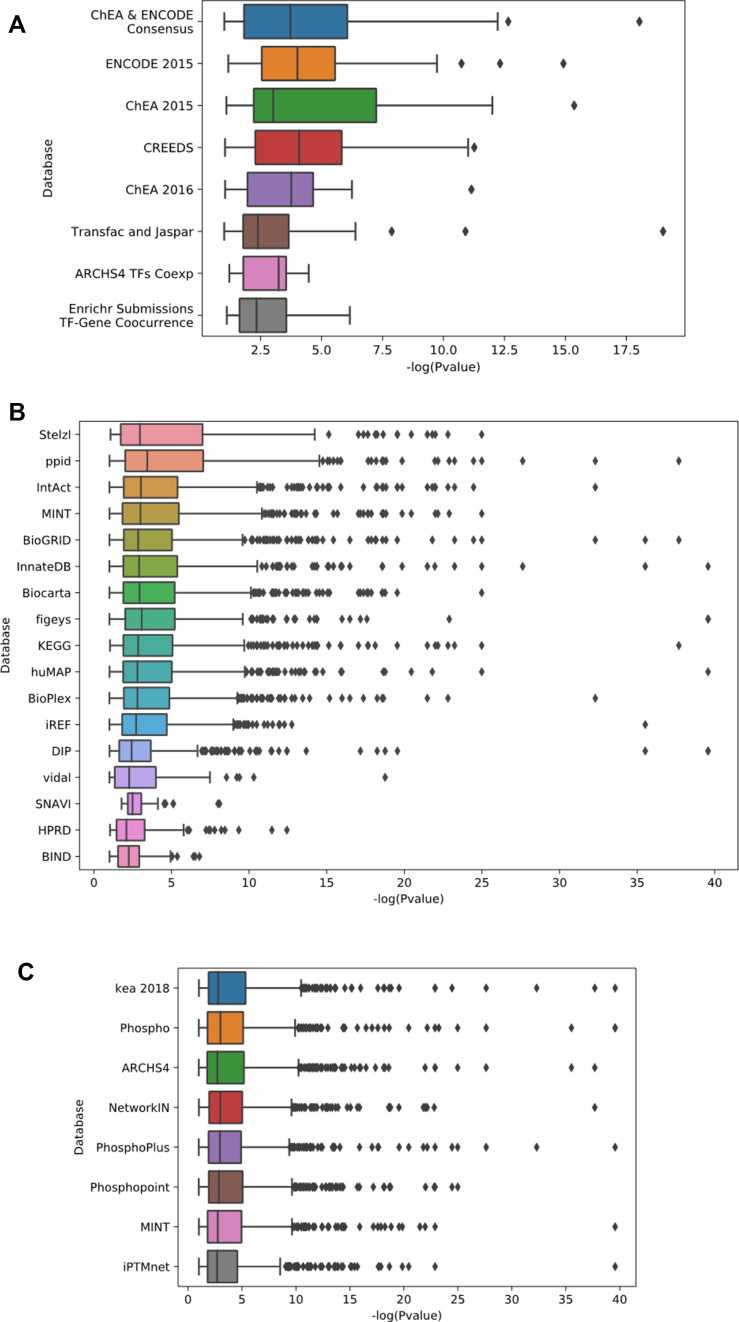
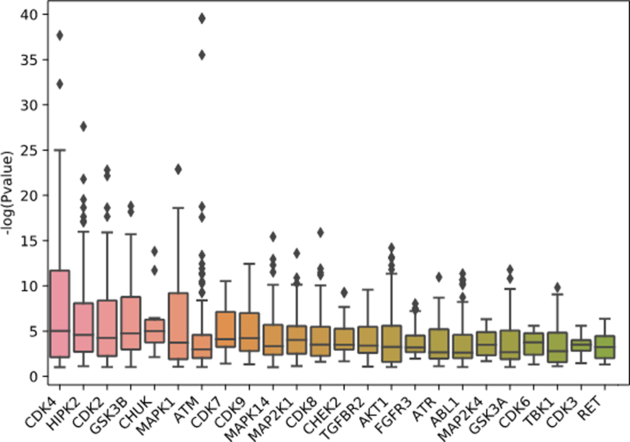
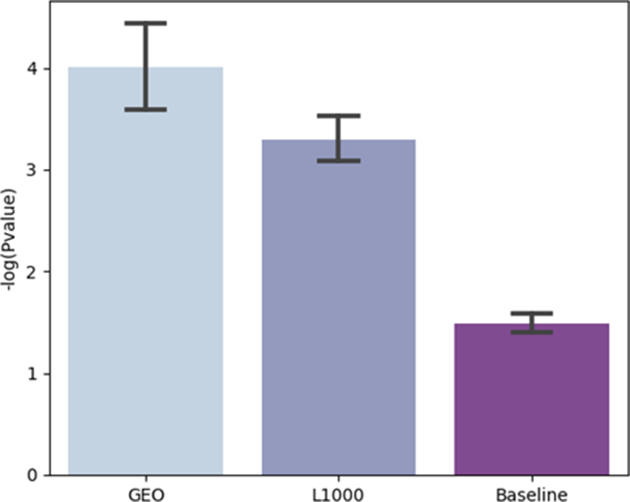
While gene expression data at the mRNA level can be globally and accurately measured, profiling the activity of cell signaling pathways is currently much more difficult. eXpression2Kinases (X2K) computationally predicts involvement of upstream cell signaling pathways, given a signature of differentially expressed genes. X2K first computes enrichment for transcription factors likely to regulate the expression of the differentially expressed genes. The next step of X2K connects these enriched transcription factors through known protein-protein interactions (PPIs) to construct a subnetwork. The final step performs kinase enrichment analysis on the members of the subnetwork. X2K Web is a new implementation of the original eXpression2Kinases algorithm with important enhancements. X2K Web includes many new transcription factor and kinase libraries, and PPI networks. For demonstration, thousands of gene expression signatures induced by kinase inhibitors, applied to six breast cancer cell lines, are provided for fetching directly into X2K Web. The results are displayed as interactive downloadable vector graphic network images and bar graphs. Benchmarking various settings via random permutations enabled the identification of an optimal set of parameters to be used as the default settings in X2K Web. X2K Web is freely available from http://X2K.cloud.
Figures
References
-
- Casado P., Rodriguez-Prados J.-C., Cosulich S.C., Guichard S., Vanhaesebroeck B., Joel S., Cutillas P.R.. Kinase-substrate enrichment analysis provides insights into the heterogeneity of signaling pathway activation in leukemia cells. Sci. Signal. 2013; 6:rs6. - PubMed
-
- Horn H., Schoof E.M., Kim J., Robin X., Miller M.L., Diella F., Palma A., Cesareni G., Jensen L.J., Linding R.. KinomeXplorer: an integrated platform for kinome biology studies. Nat. Methods. 2014; 11:603–604. - PubMed
-
- Alvarez M.J., Giorgi F., Califano A.. Using viper, a package for virtual inference of protein-activity by enriched regulon analysis. Bioconductor. 2014; 1–14.
Publication types
MeSH terms
Substances
Grants and funding
LinkOut - more resources
Full Text Sources
Other Literature Sources
Molecular Biology Databases
