


The tumor suppressor protein p53 and the ferroptosis network
- PMID: 29800655
- PMCID: PMC6251771
- DOI: 10.1016/j.freeradbiomed.2018.05.074
The tumor suppressor protein p53 and the ferroptosis network
Abstract
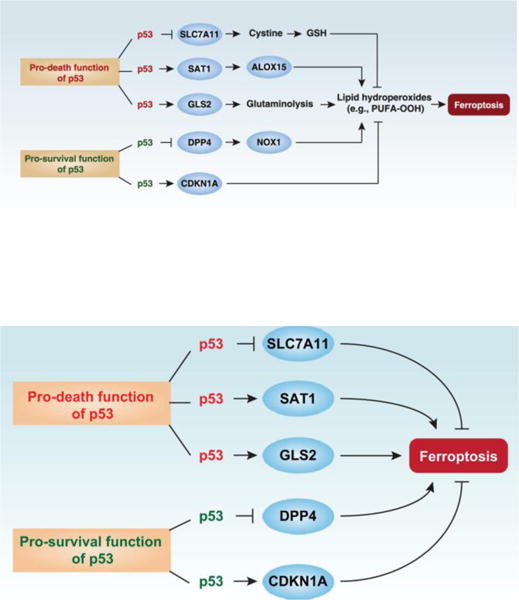
Ferroptosis is a form of lipid peroxidation-induced cell death that can be regulated in many ways, from altering the activity of antioxidant enzymes to the level of transcription factors. The p53 tumor suppressor is 'the guardian of the genome' that participates in the control of cell survival and division under various stresses. Beyond its effects on apoptosis, autophagy, and cell cycle, p53 also regulates ferroptosis either through a transcriptional or posttranslational mechanism. On one hand, p53 can enhance ferroptosis by inhibiting the expression of SLC7A11 (solute carrier family 7 member 11) or by enhancing that of SAT1 (spermidine/spermine N1-acetyltransferase 1) and GLS2 (glutaminase 2). On the other hand, p53 suppresses ferroptosis through the direct inhibition of DPP4 (dipeptidyl peptidase 4) activity or by the induction of CDKN1A/p21 (cyclin dependent kinase inhibitor 1 A) expression. Here, we review recent discoveries and emerging trends in the study of the ferroptosis network and highlight the context-dependent impact of p53 on ferroptosis and oxidative stress.
Keywords: Autophagy; Cell death; Ferroptosis; p53.
Copyright © 2018 Elsevier Inc. All rights reserved.
Figures
References
-
- Kruiswijk F, Labuschagne CF, Vousden KH. p53 in survival, death and metabolic health: a lifeguard with a licence to kill. Nat Rev Mol Cell Biol. 2015;16(7):393–405. - PubMed
-
- Chipuk JE, Kuwana T, Bouchier-Hayes L, Droin NM, Newmeyer DD, Schuler M, Green DR. Direct activation of Bax by p53 mediates mitochondrial membrane permeabilization and apoptosis. Science. 2004;303(5660):1010–4. - PubMed
-
- Chipuk JE, Bouchier-Hayes L, Kuwana T, Newmeyer DD, Green DR. PUMA couples the nuclear and cytoplasmic proapoptotic function of p53. Science. 2005;309(5741):1732–5. - PubMed
Publication types
MeSH terms
Substances
Grants and funding
LinkOut - more resources
Full Text Sources
Other Literature Sources
Medical
Research Materials
Miscellaneous
