Patterns of Tobacco Cessation Attempts and Symptoms Experienced Among Smokers With Head and Neck Squamous Cell Carcinoma
- PMID: 29800964
- PMCID: PMC6145745
- DOI: 10.1001/jamaoto.2018.0249
Patterns of Tobacco Cessation Attempts and Symptoms Experienced Among Smokers With Head and Neck Squamous Cell Carcinoma
Abstract
Importance: Among smokers with head and neck squamous cell carcinoma (HNSCC), there is ample evidence regarding the benefits of smoking cessation prior to treatment. Prior data indicates that increased attempts at cessation result in higher likelihood of cessation after diagnosis but the prediagnostic patterns of smoking cessation attempts among those smokers developing HNSCC has not been characterized. Data of this kind may direct cessation efforts toward increased efficacy.
Objective: To determine the frequency and character of tobacco cessation attempts and symptoms experienced prior to development of HNSCC, as well as to determine the correlation of these symptoms with number of cessation attempts and maximum quit days.
Design, setting, and participants: Cross-sectional study including 123 active smokers with HNSCC recruited from a tertiary medical center at an academic institution from February 2014 to May 2017.
Exposures: All included patients were active cigarette smokers prior to developing HNSCC.
Main outcomes and measures: Patients provided data indicating intensity of smoking, duration, number of cessation attempts, maximum number of days during which they successfully ceased smoking, and symptoms during cessation attempts. Principal component analysis was used to identify clustering of symptoms.
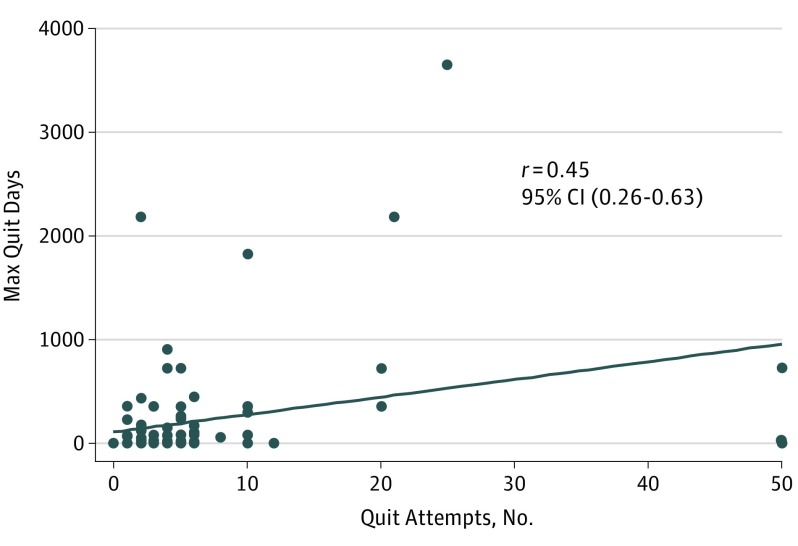
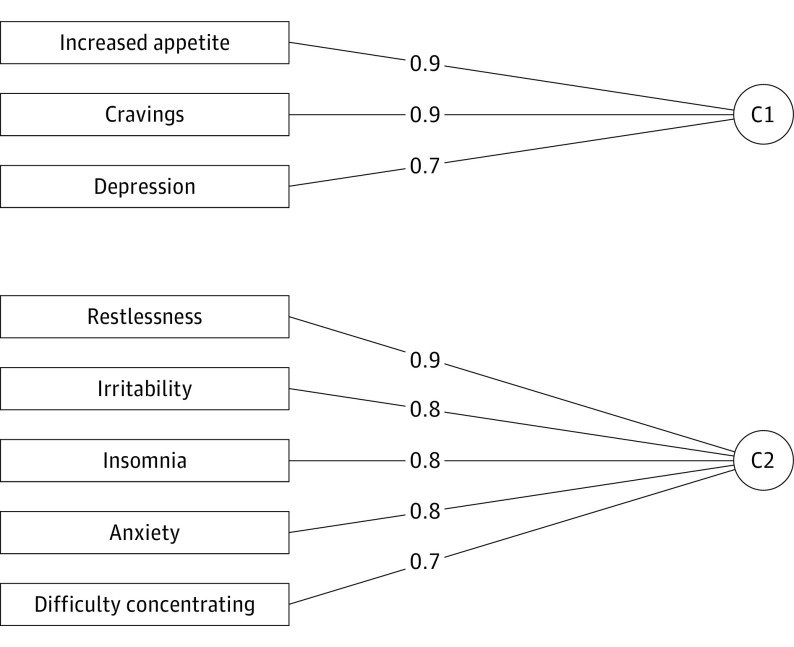
Results: In total, 123 patients were identified (97 men, 23 women, and 3 unspecified) from February 2014 to May 2017 as active smokers (mean [SD] age, 59.4 [9.0] years; median [interquartile range] age, 58.5 [54.8-66.0] years); patients had oral (n = 39 [32%]), oropharyngeal (n = 44 [36%]), laryngeal (n = 32 [26%]) or hypopharyngeal (n = 7 [6%]) tumors. Overall, 108 patients (88%) had made at least 1 prior attempt at cessation, and the mean number of lifetime cessation attempts was 6.6. Symptoms of cravings, restlessness, irritability, and anxiety were reported most frequently. Symptoms were clustered into 2 component groups: component group 1 (C1; increased appetite, cravings, depression) and component group 2 (C2; restlessness, irritability, insomnia, anxiety, and difficulty concentrating). Component group 2 correlated with quit attempts (Spearman correlation, 0.268 [95% CI, 0.07 to 0.45]), and C1 and C2 were not correlated with maximum quit days. Cessation attempts and maximum quit days positively correlated with each other.
Conclusions and relevance: Our analysis shows that symptoms during cessation attempts tend to cluster and that most patients made 1 or more cessation attempts. Many patients successfully ceased before restarting. Our data suggest that patients experiencing C2 symptoms make more quit attempts; C1 symptoms may be more difficult to overcome because they are associated with fewer quit attempts. Future work will address whether amelioration of these symptoms may help smoking cessation among smokers with HNSCC.
Conflict of interest statement
Figures
References
-
- Blanchard CM, Denniston MM, Baker F, et al. . Do adults change their lifestyle behaviors after a cancer diagnosis? Am J Health Behav. 2003;27(3):246-256. - PubMed
-
- Gritz ER, Nisenbaum R, Elashoff RE, Holmes EC. Smoking behavior following diagnosis in patients with stage I non-small cell lung cancer. Cancer Causes Control. 1991;2(2):105-112. - PubMed
-
- Duffy SA, Terrell JE, Valenstein M, Ronis DL, Copeland LA, Connors M. Effect of smoking, alcohol, and depression on the quality of life of head and neck cancer patients. Gen Hosp Psychiatry. 2002;24(3):140-147. - PubMed
Publication types
MeSH terms
Grants and funding
LinkOut - more resources
Full Text Sources
Other Literature Sources
Miscellaneous