


Isometric muscle strength in children and adolescents using Handheld dynamometry: reliability and normative data for the Brazilian population
- PMID: 29802034
- PMCID: PMC6235825
- DOI: 10.1016/j.bjpt.2018.04.006
Isometric muscle strength in children and adolescents using Handheld dynamometry: reliability and normative data for the Brazilian population
Abstract
Objective: Isometric muscle strength measured by Handheld dynamometer indicates physical ability. There is no normative data for the Brazilian population. This study aims (a) to describe the development of isometric muscle strength in healthy children and adolescents 5-15 years of age; (b) to evaluate Handheld dynamometer inter and intra-rater reliability.
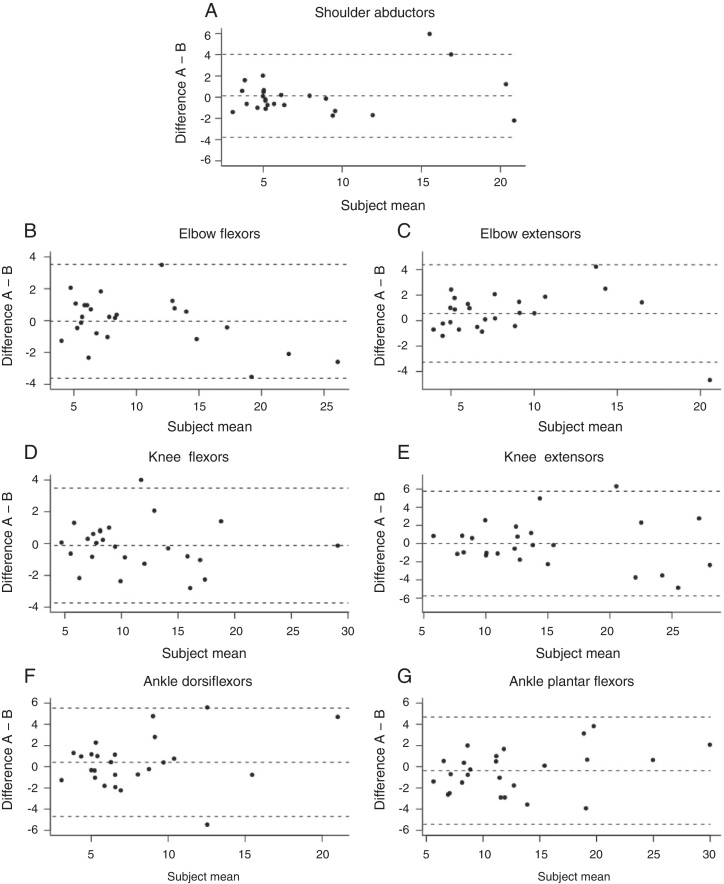
Methods: Isometric muscle strength was obtained for shoulder abduction, elbow and knee flexion and extension, dorsiflexion and plantar flexion in 55 boys and 55 girls, aged between 5 and 15 years. Inter-rater reliability was determined based on the evaluation of 2 raters, with a 20-min interval between them. Intra-rater reliability was based on 2 evaluations from the same rater, one week apart. Interclass correlation coefficient (ICC2,1; 3,1), Bland Altman plots and linear regression models with mixed effects were used to quantify inter and intra-rater reliability, agreement and associations with physical activity level and maturational factors.
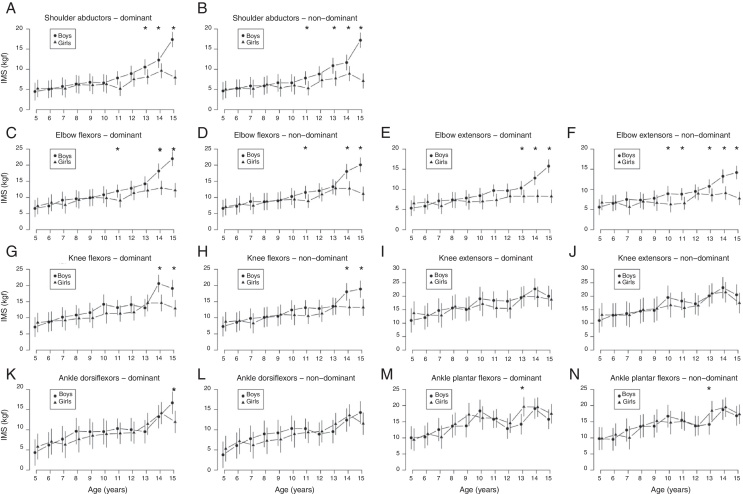
Results: A linear development of isometric muscular strength was observed for ages between 5 and 10. After age 10, boys showed a larger isometric muscular strength, when compared to girls. Both inter and intra-rater measurements of the Handheld dynamometer are reliable (ICC>0.63).
Conclusions: This study shows increase in isometric muscle strength starting at 10 years of age for boys, when compared to girls and inter and intra-rater reliability for the assessment of isometric strength, using the Handheld dynamometer for the muscle groups tested on the dominant and non-dominant side, for children between 5 and 15 years of age.
Keywords: Adolescents; Children; Handheld dynamometer; Muscle strength; Reliability.
Copyright © 2018 Associação Brasileira de Pesquisa e Pós-Graduação em Fisioterapia. Publicado por Elsevier Editora Ltda. All rights reserved.
Figures
Comment in
-
The (un)standardized use of handheld dynamometers on the evaluation of muscle force output.Braz J Phys Ther. 2020 Jan-Feb;24(1):88-89. doi: 10.1016/j.bjpt.2019.10.004. Epub 2019 Nov 13. Braz J Phys Ther. 2020. PMID: 31740163 Free PMC article. No abstract available.
References
-
- Rose K.J., Burns J., Ryan M.M., Ouvrier R.A., North K.N. Reliability of quantifying foot and ankle muscle strength in very young children. Muscle Nerve. 2008;37:626–631. - PubMed
-
- Hébert L.J., Maltais D.B., Lepage C., Saulnier J., Crête M., Perron M. Isometric muscle strength in youth assessed by hand-held dynamometry. Pediatr Phys Ther. 2011;23:289–299. - PubMed
-
- Bittencourt N.F.N., Santos T.R.T., Gonçalves G.G.P. Reference values of hip abductor torque among youth athletes: influence of age, sex and sports. Phys Ther Sport. 2016;21:1–6. - PubMed
MeSH terms
LinkOut - more resources
Full Text Sources
Other Literature Sources
Medical
