


Sex, amyloid, and APOE ε4 and risk of cognitive decline in preclinical Alzheimer's disease: Findings from three well-characterized cohorts
- PMID: 29803541
- PMCID: PMC6131023
- DOI: 10.1016/j.jalz.2018.04.010
Sex, amyloid, and APOE ε4 and risk of cognitive decline in preclinical Alzheimer's disease: Findings from three well-characterized cohorts
Abstract
Introduction: Our objective was to investigate the effect of sex on cognitive decline within the context of amyloid β (Aβ) burden and apolipoprotein E genotype.
Methods: We analyzed sex-specific effects on Aβ-positron emission tomography, apolipoprotein, and rates of change on the Preclinical Alzheimer Cognitive Composite-5 across three cohorts, such as the Alzheimer's Disease Neuroimaging Initiative, Australian Imaging, Biomarker and Lifestyle, and Harvard Aging Brain Study (n = 755; clinical dementia rating = 0; age (standard deviation) = 73.6 (6.5); female = 55%). Mixed-effects models of cognitive change by sex, Aβ-positron emission tomography, and apolipoprotein ε4 were examined with quadratic time effects over a median of 4 years of follow-up.
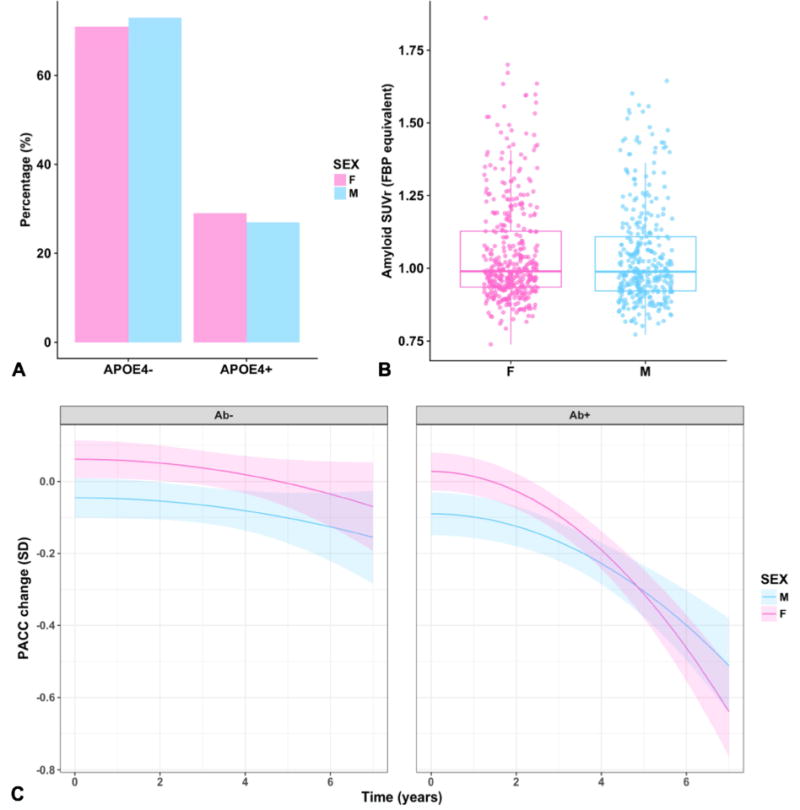
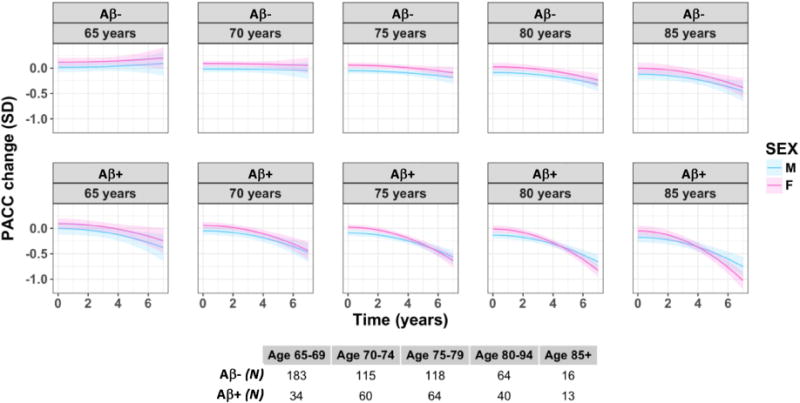
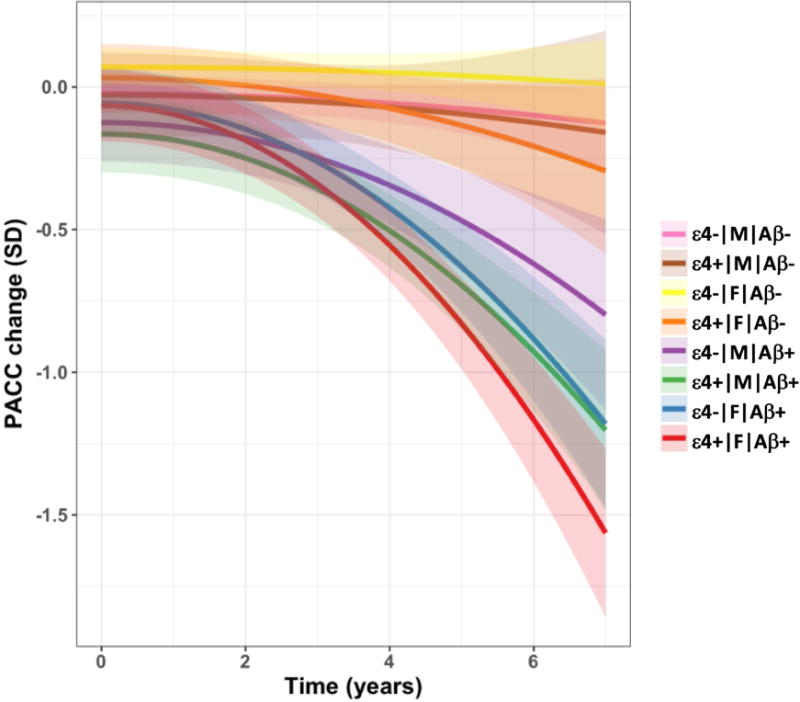
Results: Apolipoprotein ε4 prevalence and Aβ burden did not differ by sex. Sex did not directly influence cognitive decline. Females with higher Aβ exhibited faster decline than males. Post hoc contrasts suggested that females who were Aβ and apolipoprotein ε4 positive declined faster than their male counterparts.
Discussion: Although Aβ did not differ by sex, cognitive decline was greater in females with higher Aβ. Our findings suggest that sex may play a modifying role on risk of Alzheimer's disease-related cognitive decline.
Keywords: APOE; Amyloid; Cognitive decline; Gender; Preclinical Alzheimer's disease; Sex.
Copyright © 2018 the Alzheimer's Association. All rights reserved.
Figures
References
-
- Andersen K, Launer LJ, Dewey ME, Letenneur L, Ott A, Copeland JRM, et al. Gender differences in the incidence of AD and vascular dementia: The EURODEM Studies. Neurology. 1999;53:1992. - PubMed
-
- Fiest KM, Roberts JI, Maxwell CJ, Hogan DB, Smith EE, Frolkis A, et al. The Prevalence and Incidence of Dementia Due to Alzheimer’s Disease: a Systematic Review and Meta-Analysis. Canadian Journal of Neurological Sciences/Journal Canadien des Sciences Neurologiques. 2016;43:S51–S82. - PubMed
-
- Perera G, Pedersen L, Ansel D, Alexander M, Arrighi HM, Avillach P, et al. Dementia prevalence and incidence in a federation of European Electronic Health Record databases: The European Medical Informatics Framework resource. Alzheimer’s & Dementia. 2018;14:130–9. - PubMed
Publication types
MeSH terms
Substances
Grants and funding
- K24 AG035007/AG/NIA NIH HHS/United States
- R01 AG037497/AG/NIA NIH HHS/United States
- S10 RR021110/RR/NCRR NIH HHS/United States
- R01 AG027435/AG/NIA NIH HHS/United States
- R21 AG038994/AG/NIA NIH HHS/United States
- P50 AG005134/AG/NIA NIH HHS/United States
- U01 AG010483/AG/NIA NIH HHS/United States
- K23 AG049087/AG/NIA NIH HHS/United States
- R01 AG034556/AG/NIA NIH HHS/United States
- R01 EB014894/EB/NIBIB NIH HHS/United States
- S10 RR023043/RR/NCRR NIH HHS/United States
- R01 AG026484/AG/NIA NIH HHS/United States
- U01 AG032438/AG/NIA NIH HHS/United States
- P01 AG036694/AG/NIA NIH HHS/United States
- U01 AG024904/AG/NIA NIH HHS/United States
- U19 AG024904/AG/NIA NIH HHS/United States
- K23 EB019023/EB/NIBIB NIH HHS/United States
- P41 EB015896/EB/NIBIB NIH HHS/United States
- U19 AG032438/AG/NIA NIH HHS/United States
- S10 RR023401/RR/NCRR NIH HHS/United States
LinkOut - more resources
Full Text Sources
Other Literature Sources
Medical
Miscellaneous
