


Protective Effects of Donepezil Against Alcohol-Induced Toxicity in Cell Culture: Role of Caspase-3
- PMID: 29804239
- PMCID: PMC5991078
- DOI: 10.1007/s12640-018-9913-3
Protective Effects of Donepezil Against Alcohol-Induced Toxicity in Cell Culture: Role of Caspase-3
Abstract
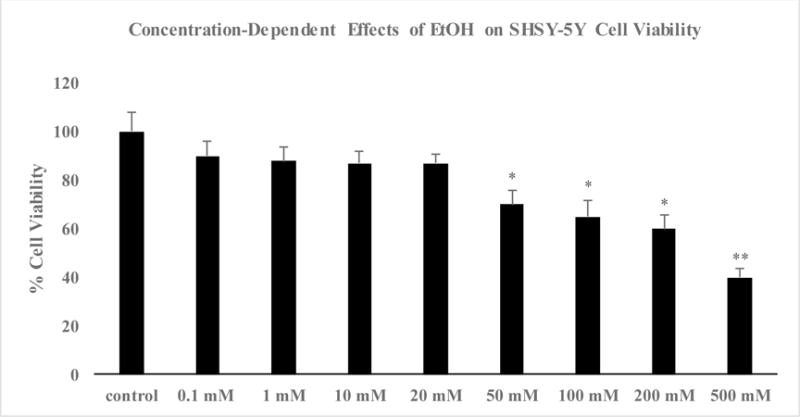
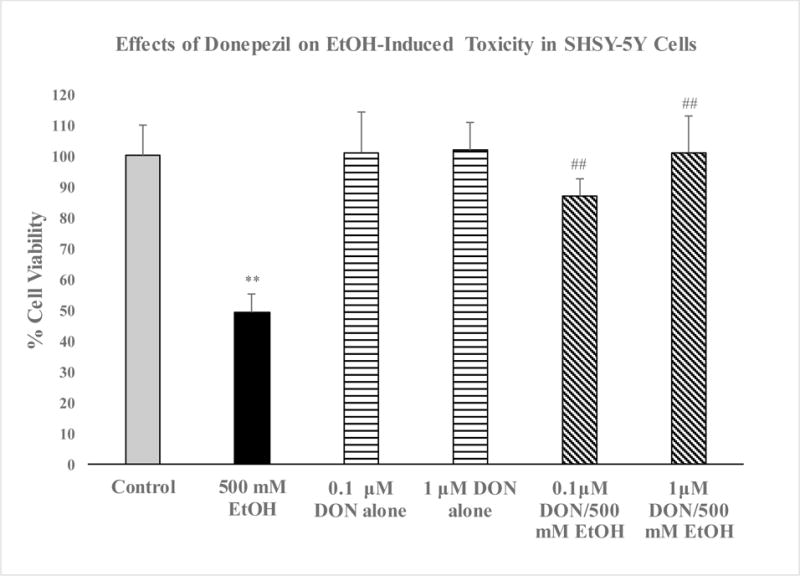
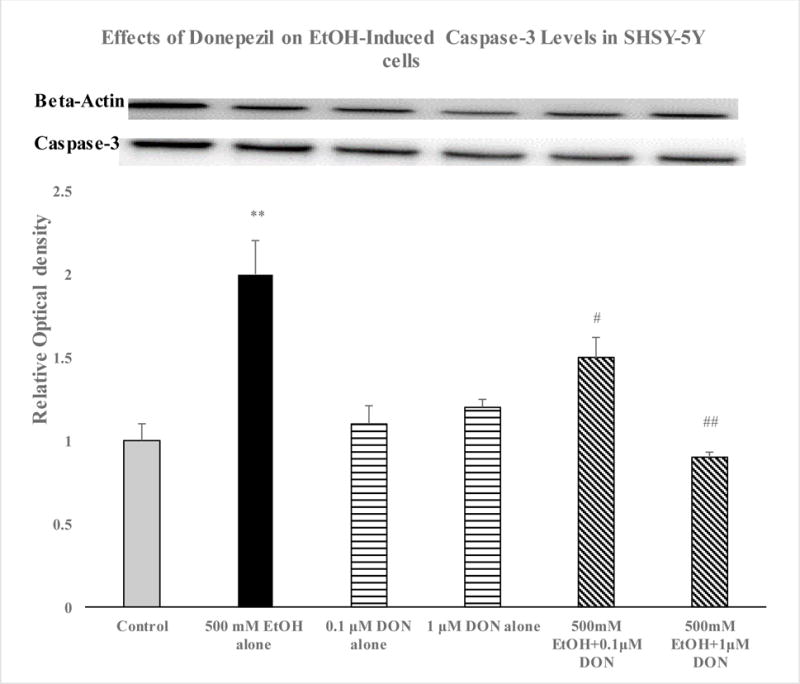
Ethanol (EtOH) is one of the most frequently abused drugs with heavy health, economic, and societal burdens. Although moderate to low EtOH may have some neuroprotective effects, heavy EtOH consumption associated with high blood alcohol level (BAL) can be quite detrimental. The brain is particularly vulnerable to the damaging effects of high BAL, leading to neuronal loss, cognitive, and behavioral deficits. Although the exact causes of these detriments are not fully elucidated, it is believed that damage to the cholinergic system is at least partially responsible for the cognitive impairment. Thus, high BAL may result in selective apoptotic damage to the cholinergic neurons. Donepezil (DON), a centrally acting, reversible and non-competitive acetylcholinesterase (AChE) inhibitor, approved for use in Alzheimer's disease (AD), may also attenuate EtOH-induced cognitive impairment. Cognitive effects of DON might be due to an anti-apoptotic activity as some AChE inhibitors have been shown to have this property. The aim of this study was to determine whether DON might protect against EtOH-induced toxicity and whether such protection might be apoptotically mediated. We exposed the human neuroblastoma-derived, SH-SY5Y cells to a relatively high concentration of EtOH (500 mM) for 24 h and evaluated the effects of two concentrations of DON (0.1 and 1.0 μM) on alcohol-induced toxicity and caspase-3, an apoptotic marker. We found a dose-dependent protection of DON against EtOH-induced toxicity as well as dose-dependent attenuation of EtOH-induced increases in caspase-3 levels. Thus, DON may inhibit apoptosis as well as alcohol-induced toxicity.
Keywords: Acetylcholinesterase inhibitor; Apoptosis; Caspase-3; Neuroprotection; Neurotoxicity; SH-SY5Y cells.
Figures
References
-
- Akaike A, Takada-Takatori Y, Kume T, Izumi Y. Mechanisms of Neuroprotective Effects of Nicotine and Acetylcholinesterase Inhibitors: Role of α4 and α7 Receptors in Neuroprotection. J Mol Neurosci. 2010;40:211. - PubMed
-
- Antonelli M, Ferrulli A, Sestito L, Vassallo GA, Tarli C, Mosoni C. Alcohol addiction - the safety of available approved treatment options. Expert Opin Drug Saf. 2018;17:169–177. - PubMed
-
- Arendt T, Allen Y, Sinden J, Schugens MM, Marchbanks RM, et al. Cholinergic-rich brain transplants reverse alcohol-induced memory deficits. Nature. 1988;332:448–450. - PubMed
-
- Brats RT. On neurodegenerative diseases, models, and treatment strategies: lessons learned and lessons forgotten a generation following the cholinergic hypothesis. Exp Neurol. 2000;163:495–529. - PubMed
-
- Brodaty H. Realistic expectations for the management of Alzheimer’s disease. Eur Neuropsychopharmacol. 1999;9(Suppl 2):S43–S52. - PubMed
MeSH terms
Substances
Grants and funding
LinkOut - more resources
Full Text Sources
Other Literature Sources
Research Materials
