


Child Pedestrian Street-Crossing Behaviors outside a Primary School: Developing Observational Methodologies and Data from a Case Study in Changsha, China
- PMID: 29805959
- PMCID: PMC5967269
- DOI: 10.1016/j.jth.2018.01.005
Child Pedestrian Street-Crossing Behaviors outside a Primary School: Developing Observational Methodologies and Data from a Case Study in Changsha, China
Abstract
Background: Child pedestrian injury is a significant global public health challenge, and prevention programming requires an understanding of the context children face when crossing the street. Methods to understand children's behavior in real-world pedestrian settings are sparse in low- and middle-income countries.
Methods: Children in grades 1-6 were videotaped crossing a three-lane street outside their school in Changsha, China. Tapes were coded to collect: (1) extent of adult supervision, (2) whom children crossed the street with, and (3) safe behaviors exhibited by children.
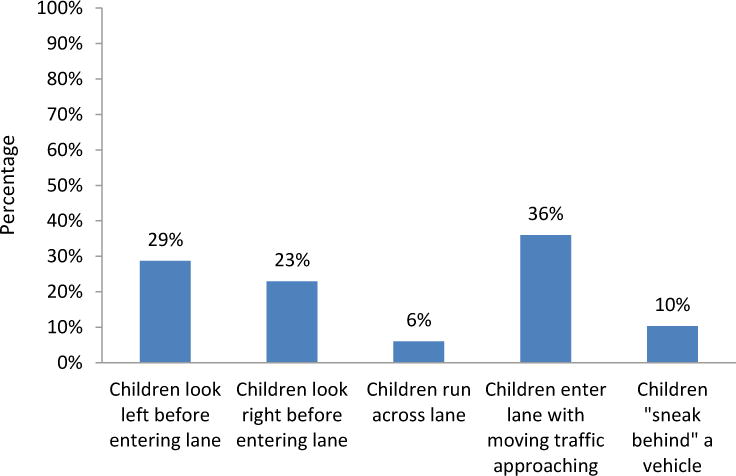
Results: Observational videotape methods yielded data that could be reliably coded to understand Chinese children's behavior crossing the street outside their primary school. In total, we observed 216 child pedestrians crossing the street, including 105 girls, 105 boys, and 6 for whom gender could not be determined. 51% of observations occurred in the morning before school and 49% in the afternoon after school. Children encountered a busy and somewhat-chaotic traffic environment. Adults were always present to help, but children appeared to heed adult advice concerning the crossing only about 70% of the time. Fewer than 1/3 of children looked at oncoming traffic before they entered a lane and over 1/3 entered a lane with moving traffic approaching.
Conclusion: Observational methods of coding videotaped behavior proved effective to understand and code children's risk and safety while crossing the street outside their primary school. At the street environment we studied, we found that children's pedestrian behavior involved significant risk.
Keywords: China; children; cognitive development; pedestrian; safety.
Figures
References
-
- Institute for Health Metrics and Evaluation. Global Burden of Disease (GBD) Visualizations. Retrieved 3/7/17 from: http://www.healthmetricsandevaluation.org/gbd/visualizations/country.
-
- Ma S, Hu GQ, Li QF, Zhou MG. Pedestrian mortality between 2006 and 2010 in China: findings from non-police reported data. Biomed Environ Sci. 2013;26:853–856. - PubMed
-
- Sun Y, Liu Y, Tao F-B. Associations between active commuting to school, body fat, and mental well-being: Population-based, cross-sectional study in China. J Adol Health. 2015;57:679–685. - PubMed
-
- Karsch HM, Hedlund JH, Tison J, Leaf WA. Review of Studies on Pedestrian and Bicyclist Safety, 1991–2007. Washington, DC: National Highway Traffic Safety Administration; Jun, 2012. (Report No. DOT HS 811 614).
-
- Hu JT. Road traffic safety law of the People’s Republic of China. Forestry Labour Safety. 2003;9:67–71. In Chinese.
Grants and funding
LinkOut - more resources
Full Text Sources
Other Literature Sources