


Artificial light at night alters behavior in laboratory and wild animals
- PMID: 29806740
- PMCID: PMC6205897
- DOI: 10.1002/jez.2173
Artificial light at night alters behavior in laboratory and wild animals
Abstract
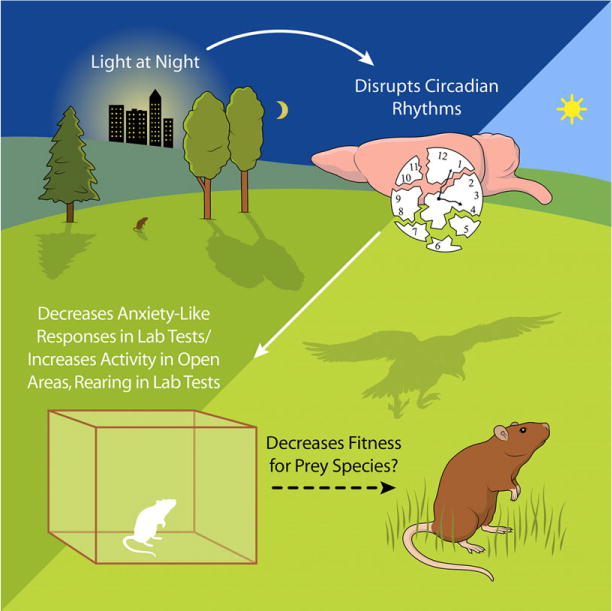
Life has evolved to internalize and depend upon the daily and seasonal light cycles to synchronize physiology and behavior with environmental conditions. The nightscape has been vastly changed in response to the use of artificial lighting. Wildlife is now often exposed to direct lighting via streetlights or indirect lighting via sky glow at night. Because many activities rely on daily and seasonal light cues, the effects of artificial light at night could be extensive, but remain largely unknown. Laboratory studies suggest exposure to light at night can alter typical timing of daily locomotor activity and shift the timing of foraging/food intake to the daytime in nocturnal rodents. Additionally, nocturnal rodents decrease anxiety-like behaviors (i.e., spend more time in the open and increase rearing up) in response to even dim light at night. These are all likely maladaptive responses in the wild. Photoperiodic animals rely on seasonal changes in day length as a cue to evoke physiological and behavioral modifications to anticipate favorable and unfavorable conditions for survival and reproduction. Light at night can mask detection of short days, inappropriately signal long days, and thus desynchronize seasonal reproductive activities. We review laboratory and the sparse field studies that address the effects of exposure to artificial light at night to propose that exposure to light at night disrupts circadian and seasonal behavior in wildlife, which potentially decreases individual fitness and modifies ecosystems.
Keywords: circadian rhythms; light at night; light cycle; photoperiodism; wildlife.
© 2018 Wiley Periodicals, Inc.
Figures
References
-
- Angers K, Haddad N, Selmaoui B, Thibault L. Effect of melatonin on total food intake and macronutrient choice in rats. Physiology & Behavior. 2003;80:9–18. - PubMed
-
- Bartness TJ, Wade GN. Photoperiodic control of seasonal body weight cycles in hamsters. Neuroscience & Biobehavioral Reviews. 1985;9:599–612. - PubMed
-
- Beauchamp G. Visual obstruction and vigilance: A natural experiment. Journal of Avian Biology. 2015;46:476–481.
-
- Beauchamp G, McNeil R. Vigilance in greater flamingos foraging at night. Ethology. 2003;109:511–520.
Publication types
MeSH terms
Grants and funding
LinkOut - more resources
Full Text Sources
Other Literature Sources
