


Cigarette use trajectories in young adults: Analyses of predictors across system levels
- PMID: 29807215
- PMCID: PMC6819815
- DOI: 10.1016/j.drugalcdep.2018.03.055
Cigarette use trajectories in young adults: Analyses of predictors across system levels
Abstract
Background: Cigarette smoking escalates most in early to middle young adulthood. However, little research has examined a range of multilevel factors in relation to smoking trajectories during this time.
Methods: We examined: 1) trajectories of cigarette smoking among 2967 US college students (aged 18-25) in a two-year, six-wave longitudinal study (using growth mixture modeling); and 2) intrapersonal- (i.e., other substance use, depressive symptoms, ADHD symptoms,); interpersonal- (i.e., adverse childhood events, social support, parental tobacco and marijuana use), and community-level (i.e., type of college, rural vs. urban setting) predictors of differing trajectories (using multinomial logistic regression).
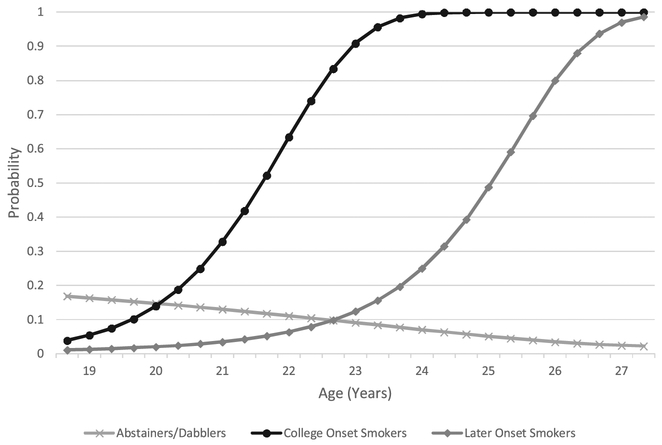
Results: We identified three trajectory classes: 1) Dabblers, who used cigarettes at one point in their life or not at all (85.6%); 2) College Onset Smokers, who began smoking regularly during the college years (6.2%); and 3) Later Onset Smokers, who began smoking during the mid- to late-20 s (8.2%). Multinomial regression (with Dabblers as the reference group) showed that predictors of being College Onset Smokers included being male (p = .031); Asian (p = .001) but not Black (p = .008; Ref: White); early onset smokers (i.e., initiation before age 15; p = .006); past 30-day users of little cigars/cigarillos (p = .024), alcohol (p < .001), and marijuana (p = .008); children of tobacco users (p = .050); and public (p = .031) or a technical college students (p < .001; Ref: private college); predictors of being Later Onset Smokers were being male (p = .019) and technical college students (p = .005).
Conclusions: Despite some young adults' smoking initiating/escalating in middle young adulthood, few risk factors were documented. This understudied period warrants greater examination to inform intervention.
Keywords: Marijuana use; Risk factors; Substance use; Tobacco use; Young adults.
Copyright © 2018 Elsevier B.V. All rights reserved.
Conflict of interest statement
Conflict of interest
The authors declare no conflicts of interest.
References
-
- American Lung Association, 2016. State of Tobacco Control, 2016. Retrieved from. www.stateoftobaccocontrol.org.
-
- Arnett J, Tanner J, 2006. Emerging Adults in America: Coming of Age in the 21st Century. Retrieved from. American Psychological Association, Washington, DC.
-
- Bachman J, O’Malley P, Schulenberg J, Johnston L, Bryant A, Merline A, 2002. The Decline of Substance Use in Young Adulthood: Changes in Social Activities, Roles, and Beliefs. Retrieved from:. Psychology Press, Mahwah, NJ.
Publication types
MeSH terms
Grants and funding
LinkOut - more resources
Full Text Sources
Other Literature Sources
Medical
Miscellaneous
