


Comment
doi: 10.1016/j.molmed.2018.05.006.
Epub 2018 May 26.
The Way of Tau: Secretion and Synaptic Dysfunction
Affiliations
- PMID: 29807705
- PMCID: PMC6771005
- DOI: 10.1016/j.molmed.2018.05.006
Item in Clipboard
Comment
The Way of Tau: Secretion and Synaptic Dysfunction
Trends Mol Med.
2018 Jul.
Abstract
Tau, a microtubule-associated protein, is linked to many neurodegenerative diseases, including Alzheimer's disease (AD). A recent study uncovered a new pathway for its secretion, leading to its transcellular uptake, while another study found that tau secreted from human induced pluripotent stem cells (iPSCs) modeling trisomy 21-related AD caused synaptic impairment in rats. These findings could inform tau-directed therapies.
Copyright © 2018 The Author(s). Published by Elsevier Ltd.. All rights reserved.
Figures
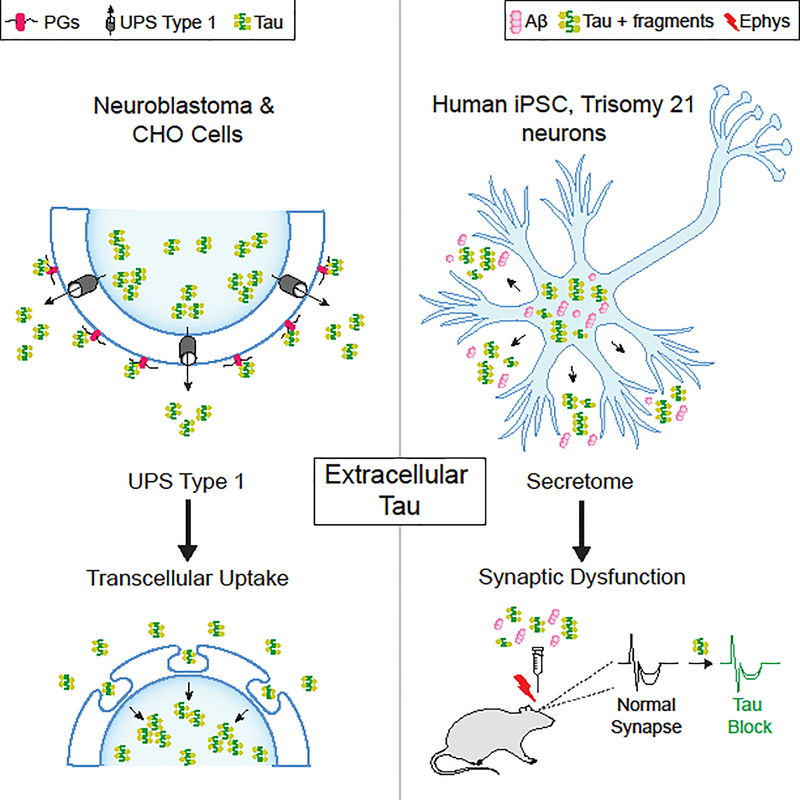
Extracellular Tau Undergoes Unconventional Secretion in Cell Lines and Induces Synaptic Deficits when Derived from Trisomy, Induced Pluripotent Stem Cell (iPSC) Neurons. (A) Work by Katsinelos et al. [5]: extracellular tau derived from its overexpression in neuroblastoma (SH-SY5Y) and Chinese hamster ovary (CHO) cell lines showed evidence of export via unconventional pathway secretion type 1 (UPS 1). The secretion of extracellular tau is facilitated by sulfated proteoglycans (PGs) at the cell surface, where tau clusters before its release into culture medium. Tau is then taken up by neighboring cells, where it appears to aggregate. Thus, the transcellular spread of tau follows UPS 1 secretion. (B) Work by Hu et al. [8]: extracellular tau and its fragments were found along with amyloid beta (Aβ) in secretomes of human-derived iPSCs differentiated into neurons with trisomy 21, modeling Alzheimer’s disease (AD). Secretomes injected into the rat brain caused synaptic dysfunction through extracellular tau. Immunodepletion of tau, but not Aβ, blocked secretome-induced synaptic deficits measured by in vivo electrophysiology. Of note, extracellular tau secreted from amyloid precursor protein gene (APP) duplication or PS1 mutation neurons did not induce acute synaptic deficits. Not shown in either panel are characteristics or mechanisms of tau not examined in the two studies, including vesicular tau secretion, mechanisms of tau uptake, aggregation and/or phosphorylation status of tau, or propagation of tau.
Comment on
-
Extracellular Forms of Aβ and Tau from iPSC Models of Alzheimer's Disease Disrupt Synaptic Plasticity.Cell Rep. 2018 May 15;23(7):1932-1938. doi: 10.1016/j.celrep.2018.04.040. Cell Rep. 2018. PMID: 29768194 Free PMC article.
-
Unconventional Secretion Mediates the Trans-cellular Spreading of Tau.Cell Rep. 2018 May 15;23(7):2039-2055. doi: 10.1016/j.celrep.2018.04.056. Cell Rep. 2018. PMID: 29768203
References
-
- Prince M et al. (2015) World Alzheimer Report 2015: The Global Economic Impact of Dementia, An Analysis of Prevalence, Incidence, Cost and Trends, Alzheimer’s Disease International
-
- Lee VM et al. (2001) Neurodegenerative tauopathies. Annu Rev Neurosci 24, 1121–1159 - PubMed
-
- Katsinelos et al. Unconventional secretion mediates the trans-cellular spreading of tau. Cell Reports (in press) - PubMed
Publication types
MeSH terms
Substances
Grants and funding
LinkOut - more resources
Full Text Sources
Other Literature Sources
Medical
